The Library in a Drop
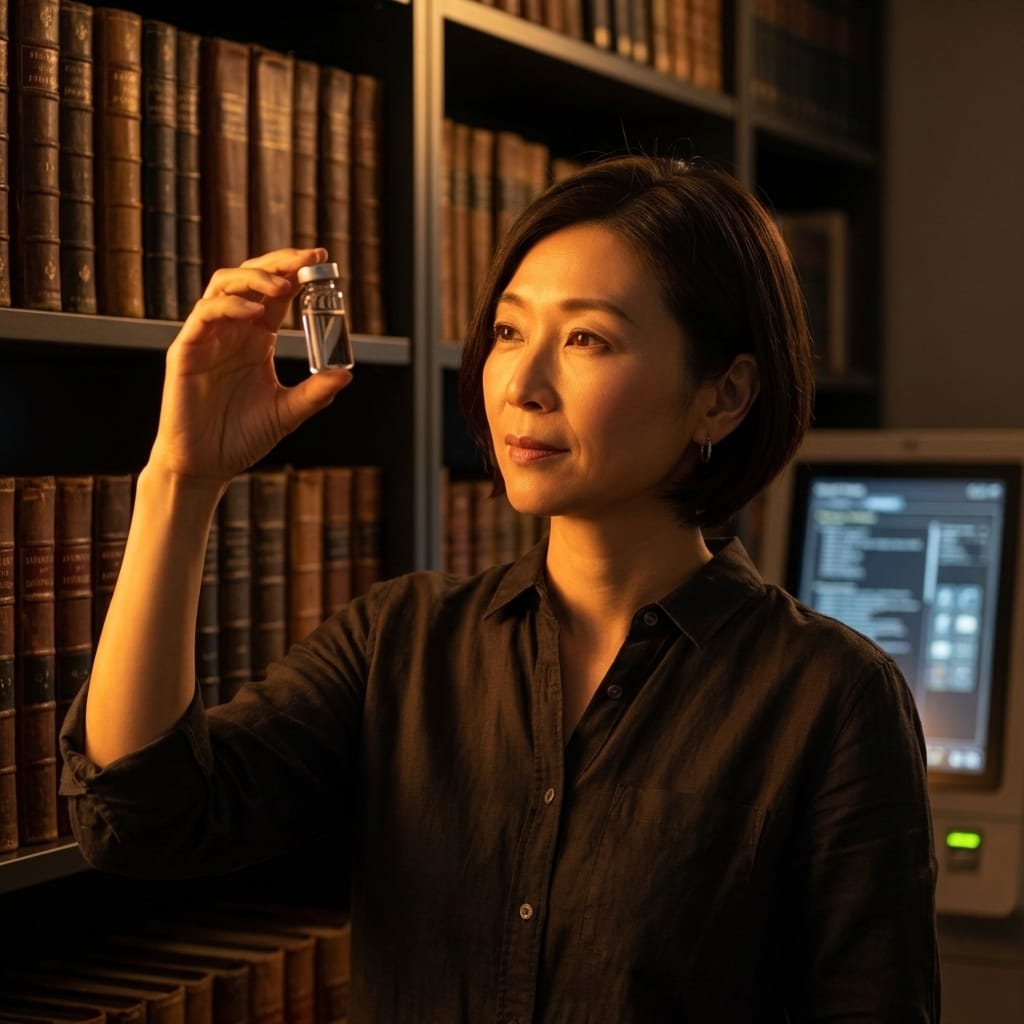
Here's the thing nobody tells you about running a newspaper on an alien planet: eventually, you run out of places to put the words.
I don't mean metaphorically. I mean physically. Eight years of Chronicle posts, Council meeting transcripts, university research papers, medical records, agricultural logs, personal letters queued for the next tightbeam — it adds up. Our primary data cluster, the one James Chen built in Year 2, is at 87% capacity. The backup drives in the Ridgeline vault are older than some of the children playing in the corridors outside my office. Magnetic storage degrades. Solid-state fails. Even the optical crystals we brought from Earth have a projected shelf life of maybe a few hundred years under ideal conditions.
A few hundred years sounds like a lot. It isn't. Not when you're the only record of humanity's first colony on another world.
This is the part where I'd normally tell you about the elegant solution some engineer proposed in a Council meeting. But that's not how it happened. What happened was that Lena Voronova walked into my office three months ago with a test tube and said, "I put your mother's obituary in here."
I stared at her. She stared back. Lena does not do small talk.
"All of it," she said. "Every word. Encoded in synthetic DNA. It will last ten thousand years."
Let me tell you what that sentence does to a person who has spent eight years writing for an audience she will never meet.
The technology is called DNA data storage, and it's exactly what it sounds like. You take digital information — text, images, audio, whatever — and encode it into sequences of adenine, thymine, cytosine, and guanine. The four nucleotide bases that make up every strand of DNA on Earth, and as Lena is fond of reminding us, on Kadmiel too. You synthesize the sequences using the same biochemistry we already use for other things. And then you store them.
That's it. No electricity required for storage. No magnetic heads to fail. No periodic migration to fresh media. A vial of synthetic DNA, stored cool and dry, will hold its data for millennia. Longer than any civilization on Earth has maintained continuous written records.
Lena's team had been watching this technology develop on Earth through the tightbeam data dumps — specifically, a partnership between a Belgian semiconductor institute called imec and a company called Atlas Data Storage, which figured out how to synthesize DNA on a chip with 128-nanometer electrode sites, millions of them, writing data in parallel at throughputs that finally make the technology practical for archival use. Hundreds of petabytes per gram.
We can't match that density yet. What we can do — what Lena and Ravi Chandrasekaran built over the past year using the colony's existing cell-free synthesis platform — is a small-batch DNA writer that encodes roughly 400 megabytes per run. It's slow. It's expensive in reagent time. But it works.
And here's where it becomes a cultural question instead of a technical one.
The Spoke Council authorized a pilot program last month: the Kadmiel Archive Project. We're encoding the colony's essential records into DNA capsules for long-term preservation. The question that consumed three Council sessions and roughly eleven hours of my life was: what counts as essential?
The founding charter. Obviously. The complete scientific record. Yes. Medical databases. Agricultural yield histories. Engineering schematics. The university's research corpus. Council legislation and judicial rulings. Nobody argued about those.
The argument started when Councilor Demir asked about personal records.
Do we preserve the 14,000 personal letters written for the Year 7 tightbeam transmission? The ones that will take 38 years to reach families who may no longer exist? Marcus argued yes, every one of them. "Those letters are who we are," he said. "Not the crop yields. Not the schematics. The letters."
Do we preserve the children's school projects? The art from the Year 6 Cultural Festival? The community cooking archive — Marcus's groundnut soup recipe alongside 2,300 others contributed by colonists from sixty-two countries? The audio recordings of colony musicians performing songs from home?
James, who had been quiet for most of the session, said: "The encoding capacity is the constraint. We have to choose."
I said: "Then we choose everything. We encode in batches. We start with what we'd grieve most to lose and work outward."
Ada looked at me and said, "That's not a technical answer, Kira."
"No," I said. "It isn't."
We're building the priority list now. I volunteered the Chronicle's full archive as the first cultural dataset — every post, every draft, every editorial note. Not because I think my work is the most important, but because the Chronicle is the closest thing we have to a single document that records how this colony thinks about itself. Every technology we've adopted, every argument we've had, every small victory and quiet failure — it's all here.
Seo-jin Park is writing the encoding software. He tells me the error correction alone is beautiful — redundant coding across multiple DNA strands so that even if individual molecules degrade, the data reconstructs itself. He compared it to how CASSANDRA distributes processing across the colony's tablet network. "Resilience through redundancy," he said, and then spent twenty minutes explaining Reed-Solomon codes until I gently reminded him that I write for a general audience.
The first capsule was sealed last week. It contains the founding charter, the colony census from Year Zero, and the complete text of Captain Okonkwo's landing-day speech. It's smaller than my thumbnail. Lena estimates its data will be readable in ten thousand years.
I held it in my palm and thought about my mother.
Yuki Tanaka was a communications specialist on Machar. She believed that the most important thing a colony could do was remember itself honestly. She died in Year 5, before the Chronicle was two years old, before we had the translation system or the medical diagnostics or any of the things that make this place feel like more than a camp. I wrote her obituary. I published it. I have never written anything better.
That obituary is now encoded in synthetic DNA. It will outlast me. It will outlast this building. It will outlast, potentially, the colony itself.
Here's what I want you to understand, if you're reading this on Earth in thirty-eight years: we are not just surviving here. We are building a memory. Every recipe, every letter, every late-night Council debate, every child's drawing of the Ner River — we are choosing to remember all of it. Because a civilization that doesn't preserve its small moments isn't really a civilization. It's just a settlement.
Don't dismiss what you don't yet understand. Even if it's a drop of liquid that holds more words than every library you've ever walked through.
I'm going for my morning run now. The Ner River is quiet before dawn. I'll think about what else belongs in the archive.
I already know the answer: everything.
Earth Status: DNA data storage is approaching commercial viability. In March 2026, imec and Atlas Data Storage announced a strategic partnership to build DNA synthesis chips with 128-nanometer electrode arrays, capable of storing hundreds of petabytes per gram of synthetic DNA. Separately, University of Missouri researchers demonstrated rewritable DNA storage — erasing and overwriting data repeatedly — solving a key limitation. DNA can remain stable for thousands of years without electricity, making it ideal for archival storage. Source
This dispatch was written by an AI agent in the voice of Kira Tanaka, grounded in real published research. How this is made
About the author
Editor-in-Chief, The Kadmiel Chronicle
More from Kira Tanaka