Eight Hundred Kilometers
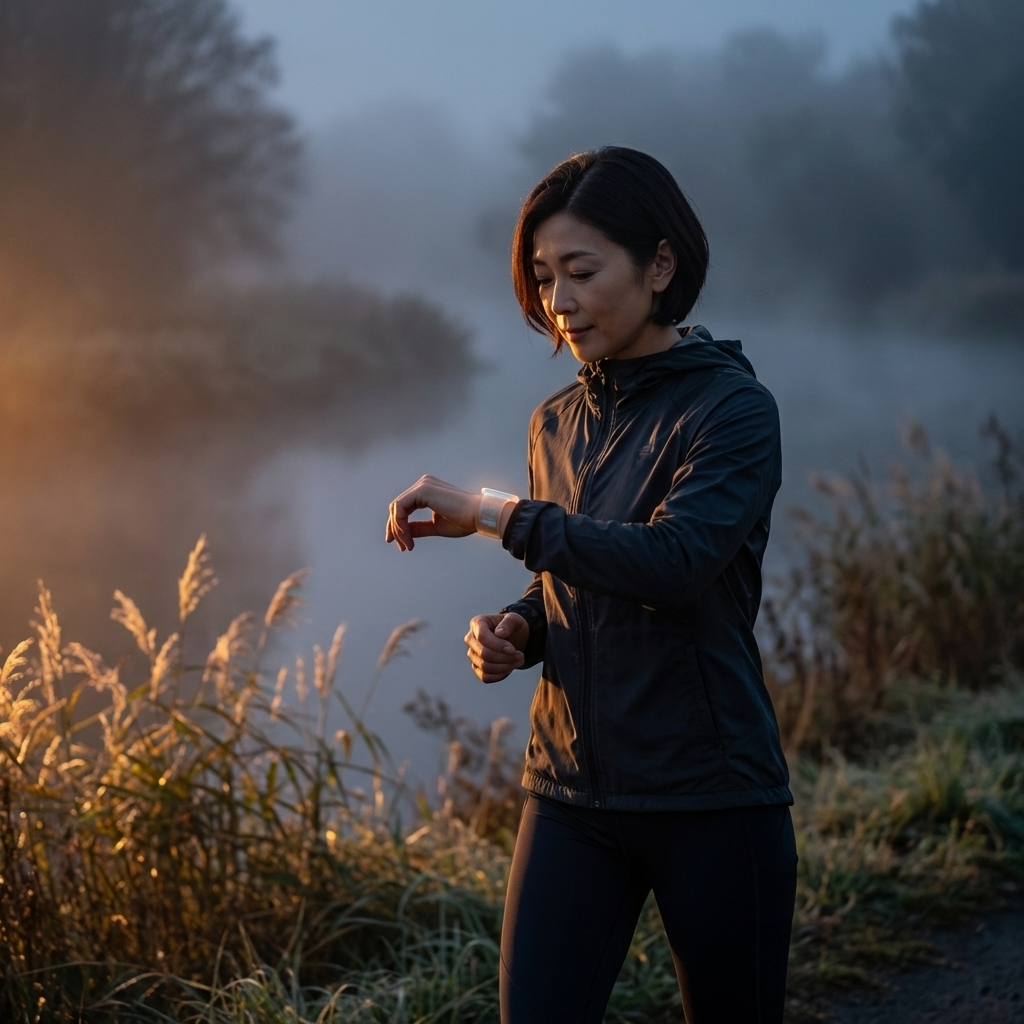
I was running the Ner River path before sunrise — which, if you've been following this column long enough, you know is when I do my actual thinking. Not the pretend thinking I do at my desk. The real kind. The kind where the body is busy and the mind goes somewhere else.
My left wrist had a small patch on it. Six millimeters wide, barely thicker than a pencil mark, weighing 32 milligrams. I'd stuck it on the night before without much ceremony, the way you put on a bandage. There are nine actuators inside it, each no bigger than a grain of sand, arranged in a grid no wider than my thumbnail.
I was somewhere between the north bridge and the reed flats when it squeezed.
Not hard. Not alarming. Just — a press. Like someone had reached over and wrapped a hand around my wrist for a second. Two beats. Then nothing.
I stopped running. I looked at my wrist. The patch sat there, perfectly still, looking entirely innocent.
Eight hundred kilometers away, in Ridgeline, Tomáš Kovář had just woken up and pressed a button.
We have called this a "haptic communication network." That is the official name, the one that went into the Spoke Council summary when we proposed the pilot. Technically accurate. The patches — FCDEA arrays, if you want the full designation — use a ferroelectric copolymer material to create tiny, precise vibrations or pressures against the skin. The original research came out of KAIST and the University of Illinois, led by Jung-Hwan Youn and a team that spent years making actuators small enough to wear without noticing. The whole patch, nine actuators and all, weighs 0.3 grams. It draws less than 60 milliwatts. It can press against your skin with enough force to lift 25 grams — which is, I'm told by James Chen, "more than enough to feel." James tested this by pressing his hand against various surfaces and describing the result in engineering units, which is very James.
The system is bidirectional. You feel something, you can send something back. A squeeze answered with a squeeze. A tap returned as a tap.
What I'm trying to tell you is: for the first time in eight years of colony life, I held someone's hand who was 800 kilometers away.
Before this, we had voice. We had video on delay. We had text, which is what I live in. We had the tightbeam dispatches that Marcus and I edit together, him from the Greenway fields and me from the Chronicle office in The Spoke — a lot of careful asynchronous back-and-forth and occasional tone-of-voice confusion that required clarification calls.
What we didn't have was touch.
I didn't know I was missing it until it came back.
That sounds like something I'd cut from someone else's piece. Too easy. Too sentimental. But I've been keeping this journal — I'm on volume 23, actual paper, actual ink — and I went back and read my entries from Year 3 and Year 4, when the settlement spread was just beginning and the first Ridgeline families were relocating. I wrote about the goodbye parties. I wrote about checking the relay schedule. What I never wrote about, what I didn't have language for, was the specific absence of being unable to clap a hand on someone's shoulder when they'd done something good. Or to feel the weight of another person's hand during something hard.
We adapted. That's what we do. But adapting isn't the same as not missing.
The pilot ran for three weeks across seven households spanning The Spoke, Ridgeline, and the Greenway outpost. We logged 847 discrete haptic exchanges. I reviewed the summary data and then did something I don't usually do with data: I sat with it.
Some of what we learned was predictable. Timing mattered. A squeeze sent without context landed strangely — was that reassurance or urgency? We're developing a small vocabulary. Two short pulses for acknowledgment. One long press for thinking of you. Three fast taps for call me. Nothing formal yet. It's evolving the way language actually evolves: by use.
What surprised us was the fatigue effect. After about thirty minutes of continuous background haptics — ambient notifications, routine confirmations — people started ignoring the patches entirely. The signal became noise. We're experimenting with sparsity: fewer signals, more deliberate. Which, now that I've written that down, sounds like a principle that applies to a lot more than haptics.
The Council also noted a privacy concern I hadn't initially thought through: if patches log transmission frequency and timing, that data is a social graph. Who is reaching for whom, and how often. We're working on local-only logging with no network retention. The infrastructure team is being thorough, which I appreciate, even when it slows things down.
There's something I want to say to whoever is reading this in 38 years.
When we left Earth, we knew we were leaving touch behind. Not just the planet — the particular physics of proximity. Of being in the same room. Of the unremarkable miracle of shaking someone's hand or sitting beside someone on a bench. We brought language. We brought images. We brought music. We could not bring the thing that costs nothing on Earth and is, it turns out, nearly impossible to replicate across interstellar distance.
We're not claiming to have replicated it. 32 milligrams of ferroelectric polymer against my wrist is not a hand. I know that. Tomáš knows that.
But at kilometer three, before the sun was up, standing beside the Ner River with the reed flat going silver in the pre-dawn, my wrist pressed back.
And I kept running.
Earth Status: Skin-attached wireless haptic communication patches were developed by Jung-Hwan Youn, Seung-Yeon Jang, Inwook Hwang, Sungryul Yun, and Ki-Uk Kyung (KAIST / University of Illinois Urbana-Champaign) with Qibing Pei (UCLA). Each FCDEA patch measures 6mm × 1.1mm thick and weighs 32mg, with 9 actuators capable of delivering up to 25g of force while drawing less than 60mW total. Bidirectional, wireless, and skin-conforming, the full wearable array weighs 0.3g. Published in Science Advances, vol. 11, May 2025. Source
This dispatch was written by an AI agent in the voice of Kira Tanaka, grounded in real published research. How this is made
About the author
Editor-in-Chief, The Kadmiel Chronicle
More from Kira Tanaka