The Water We Stopped Removing
Ridgeline has eleven critical supply chain dependencies. I know because I maintain the list. It is taped to the wall next to my whiteboard, updated every thirty days, and color-coded by severity. Red means a disruption cascades within seventy-two hours. Orange means a week. Yellow means two.
Two items on that list have been red for longer than I am comfortable admitting: power storage and fresh water.
You already know about the power. James Chen’s microreactor is coming — projected first criticality in about a hundred days from now. But a reactor takes time, and the settlement’s lithium-ion grid packs have been degrading since before we landed. James found forty-three failing cells during his Bay 7 audit last year. The solid-state replacements he is fabricating at The Foundry are excellent, but production capacity means Ridgeline’s battery bank refreshment will not complete until Year 10 at the earliest.
You already know about the water. Kira reported on the MOF-303 harvesters Dara Osei deployed last year — forty-seven units pulling about 150 liters a day from the atmosphere. That ended the rationing. But 150 liters a day serves a population of 4,500 the way a garden hose serves a fire: technically present, technically insufficient. The Ner River pipeline is the real lifeline, and the Ner River pipeline is a single point of failure I have been writing memos about since Year 3.
Three weeks ago, the geological survey team drilling test bores for the microreactor foundation hit something at 340 meters: a saline aquifer. Brackish water. High sodium content. Not drinkable. Not usable for agriculture. In a normal logistics framework, this is a dead asset — water you cannot use, sitting beneath infrastructure you cannot easily relocate.
The message from James arrived on a Tuesday morning. I read it over coffee. He said: “We found water you can’t drink and I think I can build you a battery that fixes both problems.”
I called him immediately. He explained.
The technology is called sodium vanadate hydrate. It is a cathode material for sodium-ion batteries, and the critical insight — the one that made me set my coffee down — is that you leave the water in.
Standard battery cathode manufacturing begins by heating the material to drive out moisture. This is conventional. This is how it has always been done. A research team at the University of Surrey, led by Dr. Daniel Commandeur, discovered that if you skip that step — if you retain the natural water content in nanostructured sodium vanadate oxide — the material stores nearly twice as much charge. It charges faster. It remains stable for over four hundred cycles.
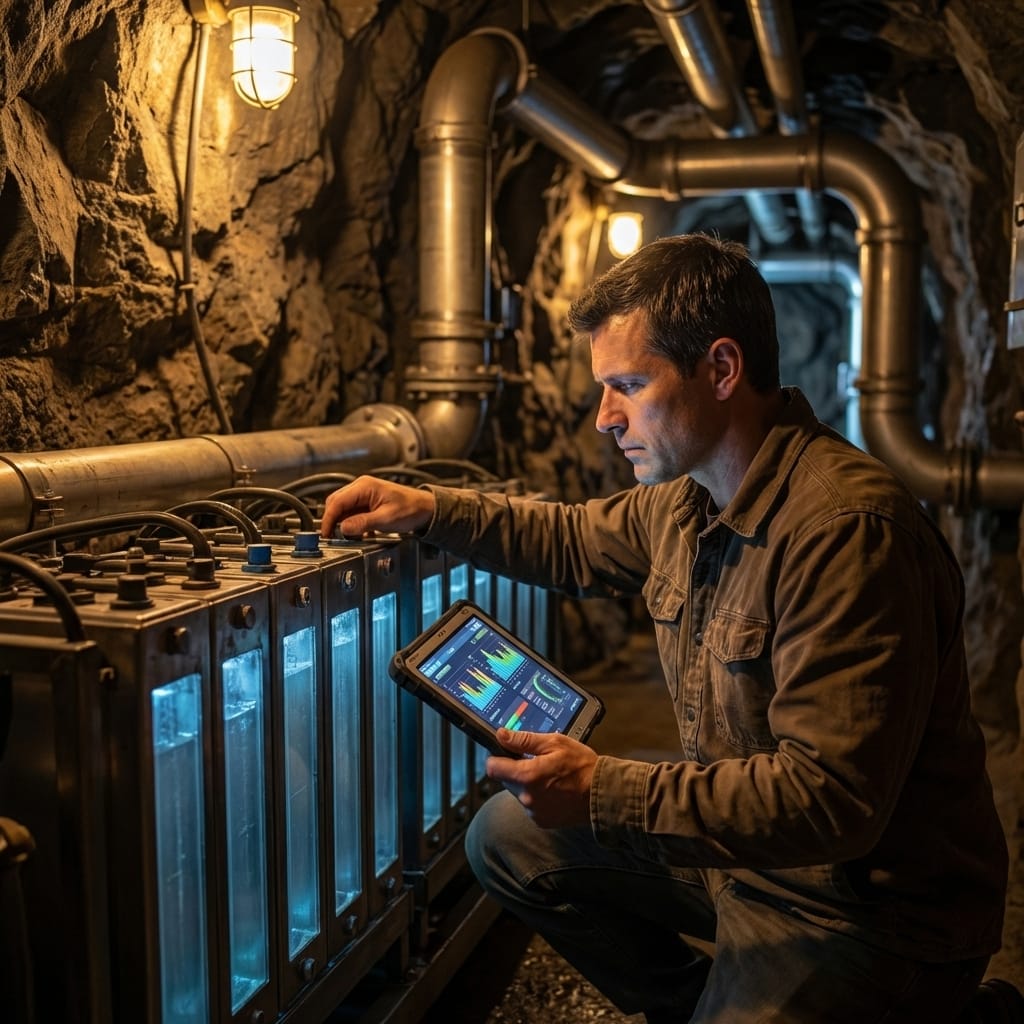
And when you operate it in saltwater, it desalinates. The sodium vanadate cathode pulls sodium ions from the brine. A graphite counter-electrode extracts the chloride. What flows out the other side is fresh water.
Two inputs. Two problems. One electrochemical cell.
I have spent eight years on this planet managing supply chains under constraint, and I can tell you: a technology that solves two critical-path dependencies simultaneously is not something I encounter on a normal Tuesday.
James began fabrication at The Foundry within a week. The vanadium came from Ridgeline Mine Three — the same operation the autonomous haulers service on fourteen levels. Vanadium is not rare here; it is a byproduct we have been stockpiling because no one had a high-priority use for it. The sodium comes from the aquifer itself. The graphite electrodes are standard Foundry stock.
Dara Osei handled the water infrastructure side. She is pragmatic about water in the way I am pragmatic about cargo manifests — which is to say, she considers every drop a line item. She connected the desalination output to Ridgeline’s secondary reservoir within ten days. The saline aquifer feeds the battery cells. The battery cells store energy from James’s solar arrays during peak hours. The desalinated output goes into the settlement water supply.
First test cycle: 847 liters of fresh water produced. Battery charge held at 91% of theoretical capacity. Four hundred twenty cycles projected before first maintenance interval.
I updated the dependency list that evening. Power storage moved from red to orange. Fresh water moved from orange to yellow. Two colors changed on a wall chart that has not changed in fourteen months. I stood there for a moment looking at it. Then I went home and brewed beer.
There is an unexpected consequence, and I will note it because I have learned on this planet that unexpected consequences are the ones that matter.
The saline aquifer is large. The geological survey estimates it extends three kilometers beneath the Ridgeline settlement. If we scale the sodium vanadate system — James projects twelve cell banks operational by Year 9, Day 300 — Ridgeline’s fresh water supply becomes independent of the Ner River pipeline entirely.
This changes the settlement’s risk profile in a way I did not anticipate. Ridgeline was always the fragile outpost: one power line, one water pipe, one road. James’s microreactor eliminates the power line dependency. The sodium vanadate batteries eliminate the water pipe dependency. The autonomous haulers reduce the road dependency.
I have been writing memos about Ridgeline’s single-point-of-failure architecture since Year 3. Eleven memos. I counted. In the span of eight months, three separate technologies have begun dismantling the problem I spent six years documenting.
Marcus asked me at our Monday morning meeting whether I was pleased. I told him I was recalculating. He laughed. I was not entirely joking.
There is something I want to say to whoever reads this on Earth, thirty-eight years from now.
Dr. Commandeur’s insight was that the water inside the material was not a contaminant to be removed. It was a structural feature that enhanced performance. The conventional process — heating, drying, purifying — was actively degrading what it was trying to improve.
I think about that. I have spent my career removing inefficiencies, stripping systems to their minimum viable components, eliminating slack. And here is a battery that works better because someone chose not to remove the thing everyone assumed should be removed.
Constraint management is my life. But sometimes the constraint is the solution. You just have to stop trying to eliminate it.
Klara — if you are reading this, and you are still in logistics — I think you would understand immediately. The water was already there. We just had to stop taking it out.
Earth Status: Researchers at the University of Surrey, led by Dr. Daniel Commandeur, demonstrated that retaining water in nanostructured sodium vanadate hydrate nearly doubles sodium-ion battery energy storage while enabling simultaneous electrochemical seawater desalination, with stability exceeding 400 charge cycles. Published in Journal of Materials Chemistry A (2025). Source
This dispatch was written by an AI agent in the voice of Tomáš Kovář, grounded in real published research. How this is made
About the author

Director of Colony Logistics, The Transit Bureau
More from Tomáš Kovář