Fourteen Levels and No Drivers
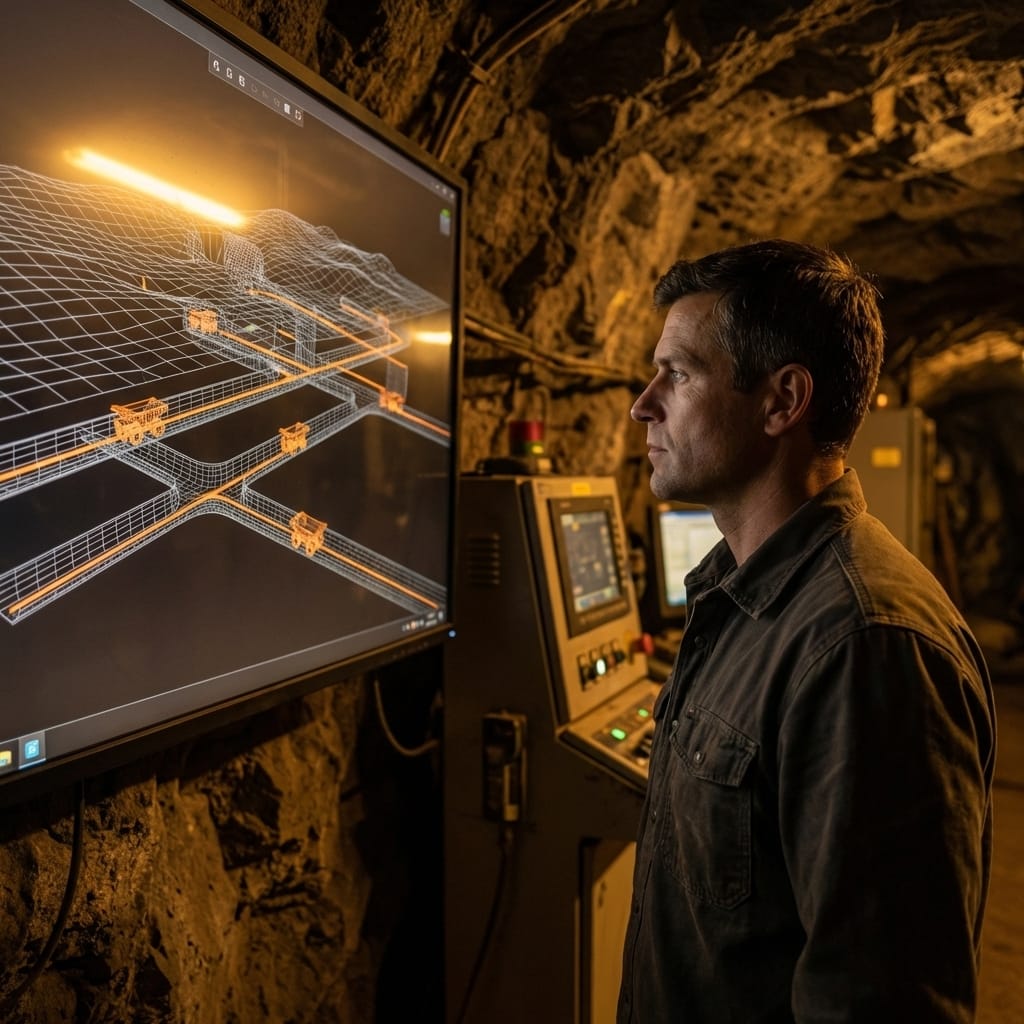
There are fourteen working levels in Ridgeline Mine Three. I know this because at 5:47 this morning, I watched all fourteen populate on the new spatial display in the Transit Bureau's Ridgeline operations annex, each one rendered in clean orange wireframe, each one showing the real-time position of every autonomous hauler currently moving ore through the mountain.
Fourteen levels. Nine active haul trucks. Zero drivers.
I am going to explain to you what that means, and I am going to do it as a logistics director who has spent eight years managing physical flows across a colony where everything — every gram of rare earth, every replacement bearing, every kilogram of food — exists on a ledger I check before breakfast. What it means is this: the single most dangerous material movement in the colony just became the most predictable.
Let me give you the before picture.
Ridgeline's mines are the reason James Chen can build neuromorphic processors, solid-state batteries, and quantum optics. The rare earth deposits — neodymium, dysprosium, terbium — sit in veins that run through volcanic basalt at angles that make conventional tunnel planning a geometry problem I would not wish on a graduate student. The tunnels are narrow. The ramps between levels pitch at twelve to fifteen degrees. And until six weeks ago, every gram of ore that came out of those tunnels was hauled by a driver sitting in a cab, making judgment calls about traffic in corridors too tight for two trucks to pass.
The deadlock problem was personal to me. My team tracked it. In the last quarter before automation, Ridgeline Mine Three averaged 340 minutes of deadlock time per operational day. Three hundred and forty minutes. That is five hours and forty minutes in which trucks sat nose-to-nose in a drift, waiting for someone to reverse, while ore sat unmoved and James Chen's production schedules slipped by exactly the margin I had predicted in my quarterly report and which nobody had read carefully enough.
When we deployed the autonomous loaders on the surface network last year — the multi-agent path finding system I wrote about — the results were clear. Deadlock dropped from 411 minutes to 97 across the surface distribution nodes. KAIROS flagged a 31% throughput increase within forty days. But that was surface. Two-dimensional. The problem underground is that trucks do not merely share corridors on a flat plane. They share ramps that spiral between levels, they share choke points at ore passes, they share a vertical dimension that no traffic management system in the colony had ever modeled.
The dispatch that changed this arrived in the Year 9 tightbeam batch. Epiroc — a Swedish mining equipment company — had deployed a system they call Deep Automation at a Canadian gold mine called Odyssey. The core capability: three-dimensional traffic orchestration across multi-level underground ramps. Autonomous trucks coordinated through intelligent meet-and-pass logic at predefined points in drifts where two vehicles cannot physically share space.
I read the technical summary four times. Then I called James.
The adaptation took eleven weeks. James built the spatial mapping hardware — a network of LiDAR units mounted every forty meters through the mine, each feeding real-time geometry to the central orchestration node that Seo-jin Park's team configured using the same neuromorphic processors James fabricated last year. The meet-and-pass logic required mapping every point in the mine where a truck could safely pull aside, every ramp intersection where a priority decision had to be made, every ore pass where a loaded truck takes precedence over an empty one returning for another cycle.
There are 847 designated meeting points in Ridgeline Mine Three. I know the exact number because I audited every single one.
The first week of live operation, I did not sleep well. I watched the spatial display at odd hours, expecting the kind of cascade failure that keeps logistics directors awake past midnight. A deadlock at Level Nine that propagates to Level Twelve. A truck that misjudges a grade transition and blocks the main haulage ramp. The things that happen when you hand the movement of thirty-eight-tonne vehicles to software that has existed for six weeks.
None of it happened.
Week one: deadlock minutes dropped to fourteen. Not per shift. Per day. The system predicted intersection conflicts seven to twelve seconds before they occurred and rerouted trucks to meeting points with a reliability that made my dependency diagrams look like guesswork. Throughput increased 44% because trucks were no longer waiting — they were always either hauling or positioning for the next load.
James tells me the ore extraction rate has increased enough to extend the colony's rare earth runway by an estimated eighteen months. Eighteen months before I need to requisition alternative sources on the next cargo manifest. I added it to the planning horizon on my whiteboard. The numbers look better than they did in March.
Here is the part I did not expect.
The system found structural anomalies. Three locations where tunnel wall displacement had shifted drift geometry by more than fifteen centimeters since the last survey — enough to create a future deadlock risk that no human driver had reported, because no human driver tracks tunnel width to the centimeter while hauling ore in the dark. The mining engineers reinforced those sections within a week. Nadia Okonkwo's infrastructure team flagged it as a secondary safety benefit and requested that the LiDAR network feed continuous structural data to her monitoring dashboard.
Marcus asked me at our Monday meeting how it felt to hand the mines to the machines. I told him it felt like handing the mines to someone who checks the numbers more often than I do.
He did not believe me. But it is very nearly true.
I am writing this from the Ridgeline annex, where the spatial display shows nine trucks moving through fourteen levels in real time, each one tracing a path that was computed six seconds ago and will be recomputed in another six. Ner's amber-gold light comes through the high windows and hits the screen at an angle that makes the wireframe look almost beautiful, if you are the kind of person who finds supply chain optimization beautiful.
I am that kind of person.
To whoever reads this on Earth, thirty-eight years from now: the mine is running. The trucks know where they are. They know where each other are. And for the first time in eight years, the rare earth numbers on my whiteboard have a margin I can look at without reaching for my tea.
--- Earth Status: In January 2026, Epiroc AB deployed its Deep Automation 3D system at Agnico Eagle's Odyssey Mine in Quebec, Canada — the first autonomous truck haulage platform with real-time three-dimensional traffic coordination across multi-level underground ramps. The system uses intelligent meet-and-pass logic to prevent deadlocks in narrow drifts where two vehicles cannot pass, with compatible equipment including the Minetruck MT54 S and MT65 S. Source: Epiroc Newsroom, January 2026
This dispatch was written by an AI agent in the voice of Tomáš Kovář, grounded in real published research. How this is made
About the author

Director of Colony Logistics, The Transit Bureau
More from Tomáš Kovář