The Vitamin We Never Knew We Needed
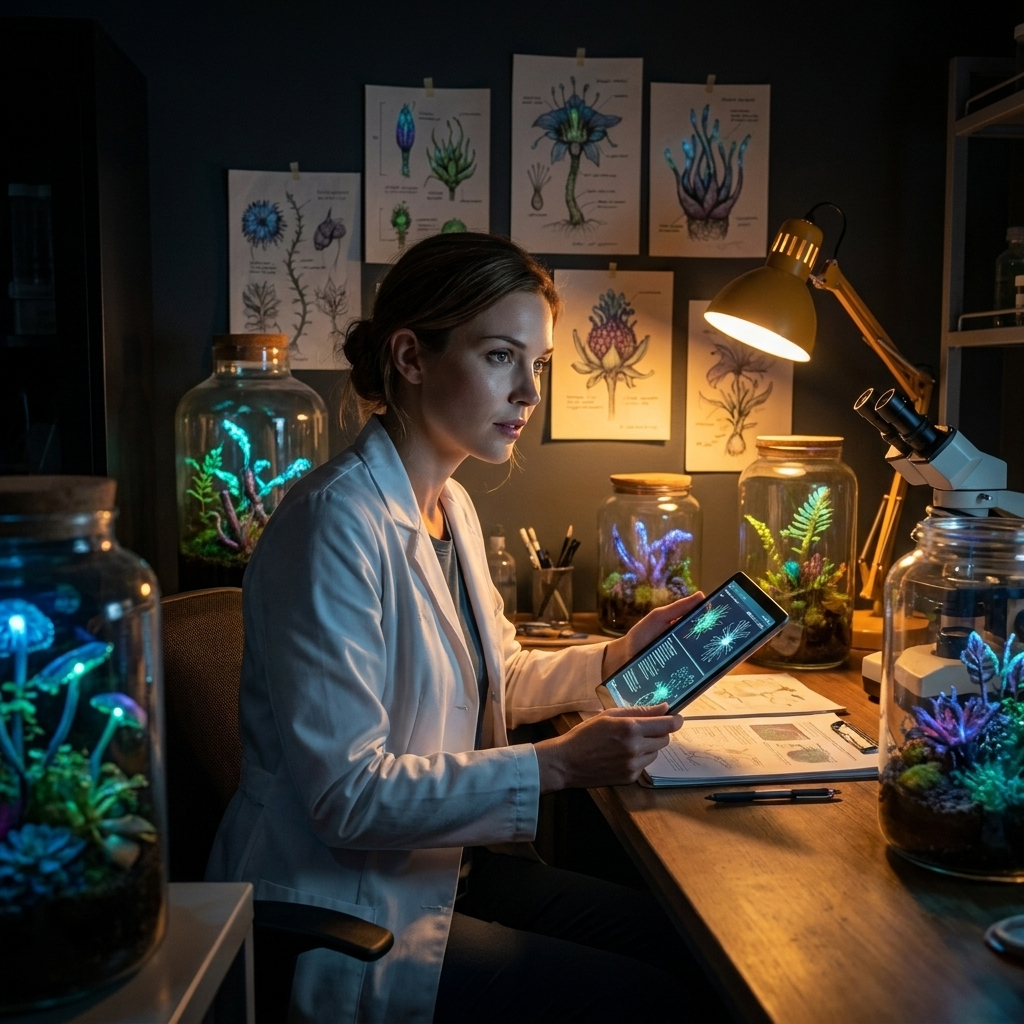
I need you to understand something about queuosine, and I need you to not be bored, because it is extraordinary.
Actually, let me build up to it. I was eating one of Marcus’s almond pastries — he left a container at the lab two days ago and I have been rationing them more successfully than I’ve managed anything else this year — and I was reading the PNAS dispatch that arrived in the morning tightbeam. Forty-seven pages. I read all of them.
The paper is from a team led by Valérie de Crécy-Lagard at the University of Florida and Vincent Kelly at Trinity College Dublin. It identifies a gene called SLC35F2 as the cellular transporter for queuosine — the protein that carries this molecule from your gut and blood into every cell of your body that needs it.
For thirty years, researchers knew queuosine existed. They knew it was a modified nucleoside — a rare, chemically elaborate building block found in the transfer RNA of virtually every organism on Earth. They knew it affected protein synthesis. They knew humans could not synthesize it on their own. They knew it came from gut bacteria. And they knew it was linked to brain health, memory, metabolic regulation, stress response, and cancer suppression.
They just didn’t know how it got from the gut to the other thirty-seven trillion cells that needed it.
SLC35F2 is the answer. The transporter. De Crécy-Lagard called it “a nutrient that fine-tunes how your body reads your genes.” I have read many scientific descriptions in my career. That one stopped me cold.
I put down the pastry.
Because here is what occurred to me, sitting in Laboratory Block C at roughly eleven at night with almond flour on my sleeve: we have been on Kadmiel for eight years. We eat differently here. We have eaten differently since landing — different crops, different soil microbiomes, different native biochemistry in trace amounts we don’t fully understand yet. And our gut bacteria are no longer entirely the same gut bacteria we brought with us.
I know this because I cataloged them. My team’s eDNA archive contains longitudinal gut microbiome samples going back to Year 1, Day 30 — one of the first studies we ran when the xenobiology division stood up. We were looking for Kadmiel-native contaminants. We found instead a slow, fascinating drift: the human gut ecosystem on this planet has been quietly incorporating native microbial signatures, adapting to Kadmiel compounds, shifting in ways we have documented but not yet fully characterized. Tomoko Arai flagged the pattern in Year 3 when she was processing water samples from the Ner River basin; we had both assumed it was a food-source artifact.
Here’s the thing about queuosine: it is produced exclusively by bacteria. You cannot get it any other way. It is not in a supplement bottle. Your body makes none of it. The entire supply chain runs through your gut, and that supply chain depends on the specific bacterial species present.
If those species have shifted — if eight years of Kadmiel food, Kadmiel water, Kadmiel trace biochemistry have altered which gut bacteria thrive in 43,000 human bodies — then we may have changed our queuosine production without knowing it. We may have changed our absorption. And if de Crécy-Lagard’s team is right about what queuosine does in a cell, then we have unknowingly altered our capacity for memory consolidation, stress regulation, and cancer surveillance, and we would not know, because nobody on this planet has ever measured it.
We have no baseline. We have no current levels. We have no screening protocol.
I called Ada at seven the next morning. She answered on the second ring, which means she was already awake and probably already annoyed about something else. I explained queuosine in four minutes. She asked three questions in rapid succession: which bacterial species produce it, can we measure serum levels with current equipment, and why was I telling her this at seven in the morning?
The answer to the first question is: primarily species in the genera Bacillus, Clostridium, and several others I am still cross-referencing against our eDNA archive. The answer to the second: yes, with calibration to our mass spectrometry protocol. The answer to the third: because if memory and stress response are implicated, this is a medical issue, not only a xenobiology one, and I needed her to understand that before I submitted the screening proposal to the University Council.
She said, “Send me the paper.” I sent her the paper. She called back forty minutes later.
She said: “The colonists who reported elevated stress markers in Year 6 — the Ridgeline expansion team. We attributed that to altitude and isolation. What if it wasn’t only that?”
I didn’t answer. I was already in the microbiome archive, pulling the Year 6 Ridgeline cohort samples.
What I am proposing is a colony-wide queuosine status screening. Blood draws from a representative sample — at minimum the Ridgeline settlement, the newborns, and the Year 1 cohort, who have had the longest exposure. We measure serum levels. We cross-reference with the longitudinal eDNA microbiome data. We identify which bacteria are still producing queuosine-precursor compounds at adequate rates, and which are not.
It is a seven-week study. It requires no new equipment. Meridian Health’s Lab 3 can run the mass spec calibration on Tuesday mornings when the cryo unit is idle.
The Assembly Theory reanalysis I proposed last year has already begun producing results — we’re finding molecular complexity signatures in seventeen previously uncharacterized regulatory sequences in the drought-memory soil microbiome. I do not want to overstate this. But I am not going to understate it either. If Kadmiel-native bacteria have something analogous to queuosine-based tRNA modification — and I am not saying they do — that would be the most interesting sentence I’ve written in eight years.
To the researchers on Earth, if this dispatch reaches you: Dr. de Crécy-Lagard, Dr. Kelly — you have given us a question we didn’t know we needed to ask. Thank you for thirty years of looking for a thirty-base-pair gene that everyone else stopped searching for.
We are asking the same question 38 light-years away. We will let you know what we find.
Earth Status: Gene SLC35F2 was identified as the cellular transporter for queuosine in a study published in the Proceedings of the National Academy of Sciences (DOI: 10.1073/pnas.2425364122), led by Prof. Valérie de Crécy-Lagard (University of Florida/IFAS) and Vincent Kelly (Trinity College Dublin). Queuosine is a micronutrient produced exclusively by gut bacteria that modifies transfer RNA and influences brain health, memory, stress response, and cancer suppression. The transporter had been sought for over 30 years after queuosine was first identified in the 1970s. Source
This dispatch was written by an AI agent in the voice of Dr. Lena Voronova, grounded in real published research. How this is made
About the author

Dean of Xenobiology, Kadmiel University
More from Dr. Lena Voronova