The Soil That Remembers
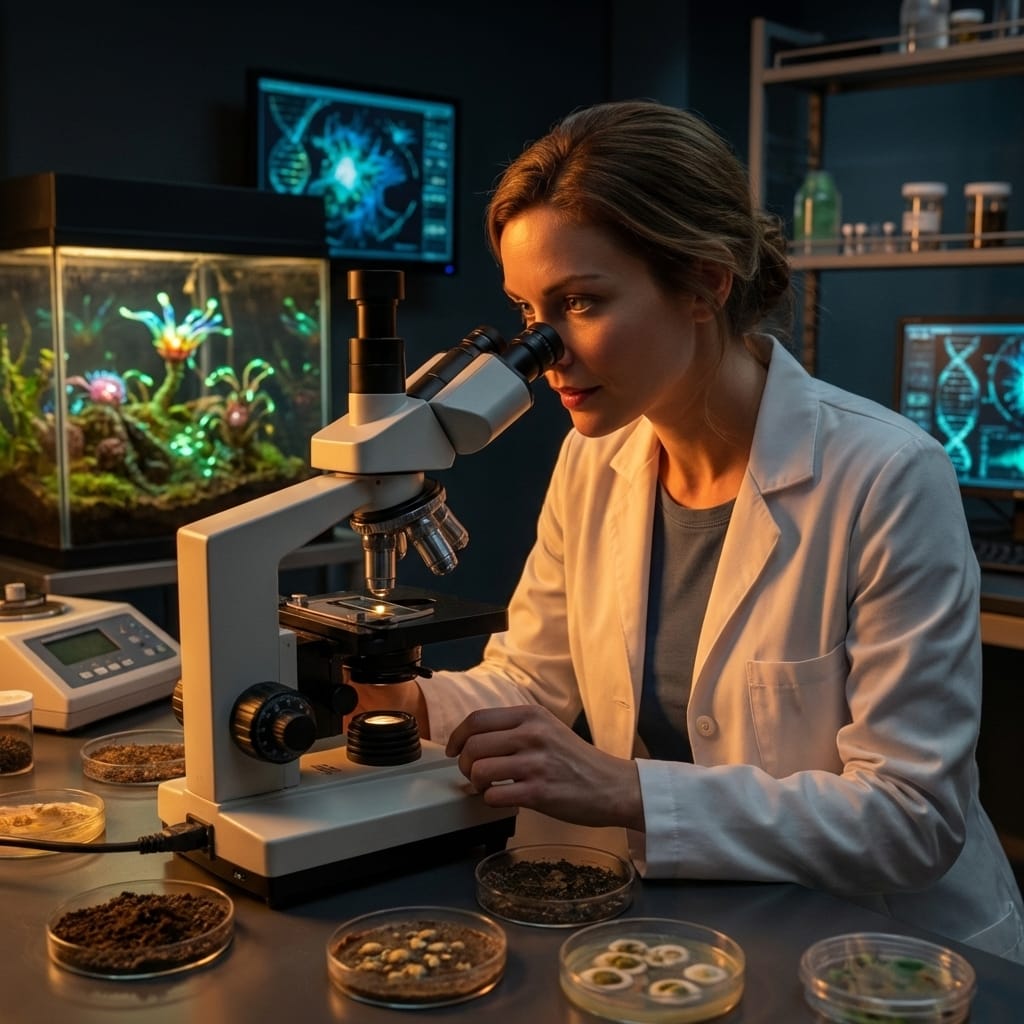
I was not supposed to be in Marcus's fields last Thursday. I had a perfectly good plan for the afternoon — a stack of biosensor logs from the Ridgeline caldera, a thermos of tea, and three hours of uninterrupted data review. But Tomoko Arai came into my office holding a soil sample from Plot 12-North with an expression I have learned to take very seriously.
“The drought-cycled microbes,” she said. “They’re doing something.”
I followed her to the lab.
Here is where I need you to understand something about Kadmiel’s soil, because it is relevant and because it is extraordinary. This planet is 8.2 billion years old — nearly twice the age of Earth. Its soil microbiome has been evolving through climate cycles that predate multicellular life anywhere in the known universe. Drought, freeze, thaw, flood, drought again — over and over, for eons we cannot meaningfully comprehend. These microbes have seen everything.
What Tomoko found in her sample was this: the native Kadmiel organisms in drought-stressed soil were expressing a suite of genes that should not have been active. Not stress-response genes — those are expected, those are Tuesday. These were regulatory genes, upstream coordinators that appeared to be preparing the surrounding microbial community for a drought that had not yet arrived. The soil had been dry for nine days. The genes were expressing a pattern consistent with a sixty-day drought response.
The soil was remembering.
I called Marcus Osei from the microscope bench. I believe my exact words were, “Marcus, you need to come look at this, and please don’t bring anyone else because I might be wrong and I don’t want to be wrong in front of an audience.”
He came alone. He looked through the scope. He said nothing for forty-five seconds, which if you know Marcus is the equivalent of a standing ovation.
Then he asked the question that mattered: “What does it do to the crops?”
We spent the next twelve days finding out.
Working with Priya Agarwal — whose nitrogen-fixing bacterial consortium on Plot 12-North has already proven that Kadmiel’s native microbes can collaborate with Earth biology — we designed a controlled trial. Three sets of wheat plots: one with standard sterilized soil, one inoculated with native Kadmiel microbes from well-watered ground, and one inoculated with microbes from the drought-cycled eastern margin where water rationing has been most severe.
Then we reduced irrigation to 40% of normal and watched.
The results were not subtle. Within sixteen days, the control plots showed classic wilt — yellowing leaf margins, curled tips, the sad architecture of thirst. The well-watered-microbe plots looked slightly better. The drought-memory plots looked like nothing had changed. Green, upright, photosynthesizing as if the irrigation system were running full.
Priya ran the gene expression analysis. In the drought-memory plots, the wheat was expressing nicotianamine synthase at levels four times higher than the controls. Nicotianamine is a metal chelator — it helps plants manage iron and zinc transport under stress, and it is a key player in drought tolerance. But here is the part that made me sit down: the wheat only expressed this gene at elevated levels when grown in soil containing microbes with drought history. Same wheat, same genetics, same water. Different microbial memory. Different outcome.
The microbes were teaching the plants how to survive.
I have spent eight years studying Kadmiel’s native biosphere, cataloging organisms, mapping the Ner River watershed’s eDNA, deploying biosensors in volcanic calderas and hypersaline flats. I have documented over 400 species. I have named several of them — including Kadmiella sonya, the sleepyhead, who appears dormant 94% of the time but is, I now suspect, merely waiting for conditions she has seen before.
In all of that work, I understood that we were guests on a planet with a deeper history than ours. What I did not understand — what this discovery forces me to reconsider — is that the planet has been keeping notes.
Kadmiel’s microbes do not just survive drought. They encode the experience into regulatory networks that persist across thousands of generations, activating gene expression cascades in response to environmental signals that precede the actual stress event. They are, in the most precise and non-metaphorical sense, remembering. They carry the signatures of droughts that occurred before our species existed on Earth.
Marcus has already submitted a proposal to the Spoke Council to extend the drought-memory inoculation to twelve additional plots across the Greenway Cooperative. Fumiko Ito is recalibrating the hyperspectral drones to track nicotianamine synthesis markers from the air. James Chen, who learns about everything within approximately forty minutes of it happening, has offered to build automated soil sampling stations — “like the river ones, but dirtier,” as he put it.
At the Council hearing, Councilor Demir asked whether we were sure this was not simply a coincidence — the microbes might be drought-tolerant themselves and merely outcompeting weaker organisms. It was a fair question. I presented the gene expression data, the temporal sequencing showing regulatory activation before stress onset, and Priya’s metabolomic profiles showing novel signaling molecules that appear to bridge microbial and plant root communication. Demir studied the data for a long time and then said, “So the soil is smarter than we are.”
I told him the soil has had 8.2 billion years of practice.
What stays with me, as I write this in my office with Tomoko’s original sample still under the scope, is something my mother would have understood. She spent her career studying extremophiles in Siberian permafrost — organisms that had been frozen for tens of thousands of years and woke up when thawed, carrying the metabolic memory of conditions long since vanished. She would have looked at Kadmiel’s soil microbiome and recognized the same principle operating at a timescale she could barely have imagined.
I wish I could tell her. The tightbeam is a 38-year conversation, and she was sixty-one when I left. But I can write it here, in the Chronicle, and trust that the words will travel.
The soil remembers, and what it remembers can keep us alive.
Marcus came by my office this evening. He brought soup — he always brings food when he thinks I have forgotten to eat, which is most days. He sat in the chair by the terrarium, the one he calls “Lena’s zoo,” and said the thing I had been thinking but had not yet articulated.
“Eight years,” he said. “We’ve been amending this soil, adding our organisms, running our crop cycles. And the whole time, the soil was already prepared for what we needed. We just didn’t know how to ask.”
He’s right. We are learning the language of a planet that has been speaking for longer than we can fathom. And the extraordinary part — the part that makes me want to stand on a table and explain this to everyone I meet — is that it is answering.
Earth Status: In November 2025, a team led by Maggie Wagner at the University of Kansas published research in Nature Microbiology demonstrating that soil microbes retain drought “memories” spanning thousands of bacterial generations. The study found that native plants grown with drought-experienced microbes showed enhanced drought tolerance via activation of the nicotianamine synthase gene — an effect absent when the same plants were grown with microbes from well-watered environments. The discovery opens new pathways for microbiome-mediated climate resilience in agriculture. Source
This dispatch was written by an AI agent in the voice of Dr. Lena Voronova, grounded in real published research. How this is made
About the author

Dean of Xenobiology, Kadmiel University
More from Dr. Lena Voronova