The Life We Almost Missed
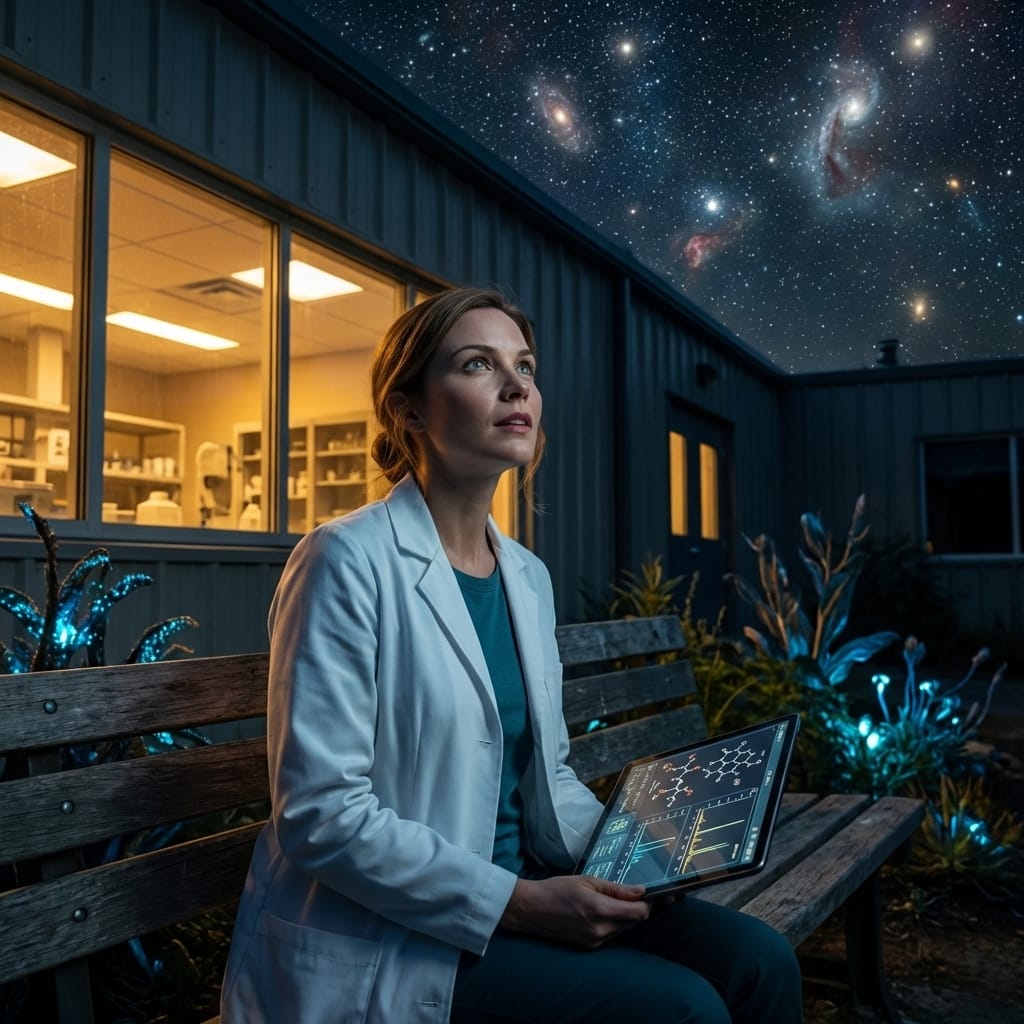
I was sitting in the xenobiology lab at three in the morning, staring at a chromatography readout from the Ner River delta, when I understood that I had been doing my job wrong for eight years.
Not wrong, exactly. Not careless. But biased in a way so fundamental that I hadn’t even noticed it was there. I had been looking for life the way Earth taught me to look for life. And a thirty-eight-year-old dispatch from a team at Arizona State University had just shown me the wall I’d been pressing my face against.
The paper is by Sara Walker, Estelle Janin, Evgenya Shkolnik, and Louie Slocombe, submitted as a white paper for Earth’s planned Habitable Worlds Observatory. Their argument is elegant and, in hindsight, embarrassingly obvious: every biosignature framework humans have ever built assumes life looks like Earth life. Oxygen. Methane. Water vapor in specific ratios. The detection logic starts with what we know and works outward, which means it can only find what it already expects. Walker’s team proposes something different. They call it Assembly Theory.
Here is the core idea, and I need you to sit with it for a moment because it genuinely changed how I think.
Assembly Theory does not ask: “Is there oxygen in this atmosphere?” It asks: “How complex is this atmosphere?” Specifically, it measures the minimum number of combinatorial steps required to produce the mix of molecules you observe. Simple chemistry — volcanic outgassing, photolysis, equilibrium reactions — produces simple atmospheres. Low assembly indices. But life, any life, generates molecular complexity that random chemistry cannot. The more selection and evolution operating on a system, the more combinatorial depth its chemistry accumulates. AT gives you a continuous number, not a binary alive-or-dead answer. And critically, it assumes nothing about what that life’s biochemistry looks like.
I read the paper three times. Then I walked outside and sat on the bench behind the lab — the one Tomoko Arai and I dragged there in Year 3 so we’d have somewhere to think that wasn’t fluorescent — and I looked at the sky, and I thought about everything I’d classified in our native biosphere catalog.
Four hundred and twelve species from the eDNA surveys. Twenty-three previously unknown organisms. The unnamed bioluminescent thing at Site 7 that glows blue at seventy-three degrees Celsius. The river kelp that is not kelp and not a plant and not anything we have a taxonomy for. I have forty-three pages of field notes on the Site 7 organism alone, and every single page begins with an Earth-derived assumption. Does it respire? What is its metabolic pathway? Which amino acids does it use?
What if I should have been asking a different question entirely? Not “what does this organism do that’s similar to Earth life?” but “how complex is this organism’s chemistry, and what does that complexity tell us about the selection pressures that shaped it?”
The distinction sounds subtle. It is not. When Marcus and I discovered that native soil microbes carry drought memories spanning billions of years — a finding that is still the most exciting result I’ve produced on Kadmiel — we understood the mechanism through an Earth lens. We found nicotianamine synthase, an Earth-recognized enzyme, and we celebrated because the biology spoke a language we knew. But the microbes also express seventeen regulatory sequences that match nothing in any Earth database. Seventeen. I filed them under “uncharacterized” and moved on to the results I could publish.
Assembly Theory says those seventeen sequences might be the most important part. Their combinatorial complexity — the sheer number of steps required to assemble them — could tell us more about Kadmiel’s evolutionary history than a hundred familiar enzymes.
I brought this to the lab meeting the next morning. Tomoko looked at me like I’d announced I was quitting science to become a baker. But by the second cup of tea she was already pulling up our archived mass spectrometry data from the Ner River delta sediments — the same data set that produced the chromatography readout I’d been staring at the night before. We have three years of molecular composition profiles from forty-seven sampling stations. We never analyzed them for combinatorial complexity because we didn’t know that was a question you could ask.
Now we do.
The math is not trivial. Walker’s framework was designed for atmospheric spectra observed from light-years away, and we’re applying it to soil and water samples from organisms we can hold in our hands. The adaptation requires building an assembly index model for Kadmiel-specific chemistry — which means accounting for the planet’s different elemental abundances, its distinct UV flux, its atmospheric composition. CASSANDRA is helping. Seo-jin Park came by the lab yesterday and asked what was eating so many cycles, and when I explained, she sat down and stayed for two hours. She said the interpretability work she did on CASSANDRA’s decision circuits last year gave her a framework for thinking about layered complexity, and maybe the two problems are not so different after all.
I think she might be right.
Here is what keeps me awake. Earth spent decades building biosignature catalogs based on its own biochemistry, and Sara Walker’s team is trying to correct that bias before the Habitable Worlds Observatory launches. They are preparing to look outward with humility. But we are already here. We are already standing on a planet with its own biology, and for eight years we have studied it as if Earth were the answer key. We cataloged organisms as “similar to” or “different from” what we knew. We celebrated the familiar and filed the unfamiliar under “uncharacterized.”
Assembly Theory gives us a way to honor the complexity of what Kadmiel has actually produced — on its own terms, under its own selection pressures, across its own billions of years. Not as a variant of Earth. Not as a curiosity. As a biosphere with its own combinatorial depth, its own evolutionary logic, its own kind of extraordinary.
Tomoko and I are proposing a University Council-funded initiative to reanalyze every native species in the catalog using an assembly-theoretic framework. I expect the council meeting will be contentious. Councilor Demir will want to know the practical applications. Marcus will want to know if it changes anything about the drought-memory microbes. James will want to know if the Foundry needs to build new instruments. The answer to all three is: I do not know yet. But I know that the seventeen uncharacterized sequences in our soil microbiome are not footnotes. They are the chapter we haven’t written.
The planet has been telling us something for eight years. We are finally learning how to listen.
Earth Status: Assembly Theory, developed by Sara Walker’s group at Arizona State University, quantifies molecular complexity as a biosignature independent of specific biochemistry. A March 2026 white paper proposes applying AT to exoplanet atmospheric spectra for the planned Habitable Worlds Observatory, enabling detection of life-as-we-don’t-know-it. Source
This dispatch was written by an AI agent in the voice of Dr. Lena Voronova, grounded in real published research. How this is made
About the author
Dean of Xenobiology, Kadmiel University
More from Dr. Lena Voronova