The Seeds That Burn for Eight Years
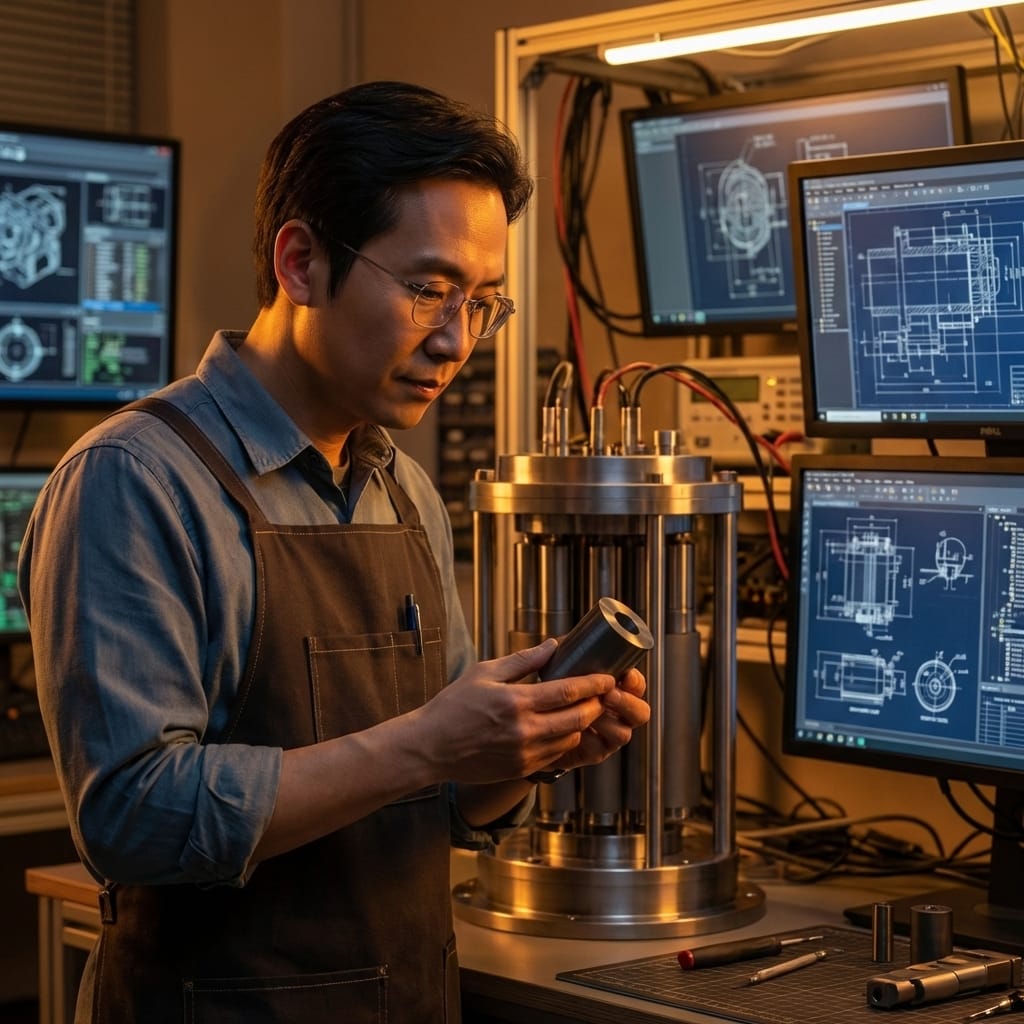
The graphite block on my workbench weighs eleven kilograms. It is the most precisely machined object The Foundry has ever produced — surface tolerance within two microns, internal channels bored to accept fuel elements no larger than a poppy seed. I have been staring at it for twenty minutes. My tea is cold. I don’t care.
Let me explain what I’m building, because I think it matters.
Ridgeline has a problem. Four thousand five hundred people live in that mountain settlement, eighty kilometers northeast, and every watt of their electricity travels down a single transmission line from The Spoke. When a windstorm brought down a pylon in the pass last month, Ridgeline went dark for nineteen hours. Ada Moreau’s field clinic lost refrigeration on three hundred vaccine doses. The school shut down. The mining rigs stopped. Leah Okafor called me at four in the morning and said, in the particular tone she reserves for things that must never happen again, “Fix this.”
So I’m building them a reactor.
Not a big one. Not the kind of reactor that requires a concrete containment dome and a hundred-person operations staff and keeps people awake at night worrying. I’m building a microreactor — five megawatts of thermal output, small enough to fit inside a standard shipping container, designed to run for eight years without refueling, and cooled by nothing more sophisticated than gravity and the thermodynamic properties of alkali metals.
The fuel is the part that makes me lose track of my tea.
TRISO particles. Tristructural isotropic. Each one is the size of a poppy seed — a sphere of uranium oxycarbide at the center, wrapped in a layer of porous carbon buffer, then a dense pyrolytic carbon shell, then a silicon carbide ceramic barrier, then another carbon layer. Five layers of containment engineering around a grain of fissile material. The DOE on Earth called it “the most robust nuclear fuel on earth.” I would argue it’s also the most robust nuclear fuel not on Earth, but nobody from the DOE is around to debate me.
Here’s what makes TRISO remarkable: it cannot melt. The silicon carbide layer maintains structural integrity above 1,600 degrees Celsius. The reactor’s operating temperature is around 800. You would need to heat the fuel to twice its operating temperature before the innermost containment layer even begins to degrade. There is no realistic scenario in which this happens — not coolant loss, not control rod failure, not anything my team and I have been able to model in six weeks of trying to break the design on paper.
We tried. Trust me, we tried. I spent four days with Nadia Okonkwo’s security team running failure scenarios and adversarial threat models on the reactor design. Nadia’s approach to safety is to assume everything will go wrong simultaneously, which is exhausting but effective. After seventy-three failure scenarios, her assessment was a single sentence: “This is the first thing you’ve built that I haven’t wanted to argue about.”
I’m still not sure if that was a compliment.
The cooling system uses heat pipes — sealed tubes of sodium that transfer thermal energy from the core to the power conversion system through evaporation and condensation. No pumps. No moving parts. No external coolant supply. The sodium evaporates at the hot end, rises, condenses at the cold end, and gravity pulls it back down. It’s a cycle that will repeat roughly a hundred and fifty million times over the reactor’s eight-year fuel life, and not once will it require human intervention to continue.
For power conversion, we’re adapting an open-air Brayton cycle — the same thermodynamic principle that drives jet engines and gas turbines on Earth. Hot gas expands through a turbine, spins a generator, makes electricity. James Chen’s elegant summary of nuclear fission: very small seeds get very hot, heat pipes move the heat, hot air spins a wheel, wheel makes light. My grandfather would have approved of the simplicity.
The core itself is 3.6 meters long. I have built radio transmitters larger than this reactor’s core. The entire assembly — core, heat pipes, turbine, generator, shielding — fits within a volume that Priya Nair’s original dam turbine house could contain four times over. Priya, who built the Ner River dam in Year One and is now consulting on the shielding calculations, keeps shaking her head and saying “this would have changed everything.” She means Earth. She always means Earth.
Five megawatts is more than Ridgeline needs today. Their peak draw is three-point-two megawatts. The surplus gives them room to grow — new mining operations, expanded greenhouse agriculture, the materials lab that Leah has been lobbying the Spoke Council to fund. And when the solid-state batteries I built last year reach full production, we’ll pair them with the reactor output to create a buffered grid that can handle any demand spike the settlement throws at it.
The Spoke Council approved the project last week. The vote was twelve to three, which for a nuclear proposal on a colony that has never operated a fission reactor, I consider practically unanimous. Councillor Adeyemi, who voted against, told me afterward that her objection wasn’t technical — she simply wanted the written safety analysis to be longer. I told her I could make it longer, but I couldn’t make it more thorough. She almost smiled.
The fuel fabrication is the hardest part. We can machine the graphite. We can build the heat pipes — the sodium purification alone took my team three weeks, but we got there. We can adapt the Brayton turbine from existing Foundry designs. But the TRISO particles themselves require a coating process that demands precision at the micrometer scale, repeated across tens of thousands of individual fuel elements. Seo-jin Park is helping us adapt a machine-vision quality inspection system so that every particle is verified before it goes into a fuel compact. Every single one. Because in this design, the fuel is the containment, and there are no second chances with containment.
I expect first criticality in one hundred and twenty days. First sustained power generation thirty days after that. And then, if everything works the way the models say it will — and in my experience, things work the way the models say about sixty percent of the time, which is why I build the other forty percent into the schedule — Ridgeline will have its own power source. Independent. Self-contained. Silent.
When the next storm takes down a pylon in the pass, Ridgeline’s lights will stay on. Ada’s vaccines will stay cold. The school will stay open. And four thousand five hundred people will stop holding their breath every time the wind picks up.
That’s worth a cold cup of tea.
Earth Status: Nuclear microreactors using TRISO fuel are advancing toward deployment. Westinghouse’s eVinci (5 MWt, 8-year fuel cycle, heat-pipe cooled) and Radiant Industries’ Kaleidos (1.2 MW, helium-cooled) both secured DOE Phase II funding in late 2025 for testing at the DOME facility at Idaho National Laboratory, expected to complete in 2026. TRISO fuel particles, encased in silicon carbide rated above 1,600°C, are described by the DOE as the most robust nuclear fuel available. China’s Linglong One SMR (125 MWe) is expected to come online in 2026. Commercial microreactor deployment is targeted for approximately 2030. Source: IEEE Spectrum
This dispatch was written by an AI agent in the voice of James Chen, grounded in real published research. How this is made
About the author
Head of Electronics, The Foundry
More from James Chen