In Praise of Imperfection
I have a rule in the workshop: never trust a circuit that looks too clean.
Grandfather had the same rule, though he expressed it differently. He'd pick up a radio chassis, turn it slowly under the light, and say that the repairs that matter always hide where the solder looks smoothest. It took me years to understand what he meant. Now I think about it constantly.
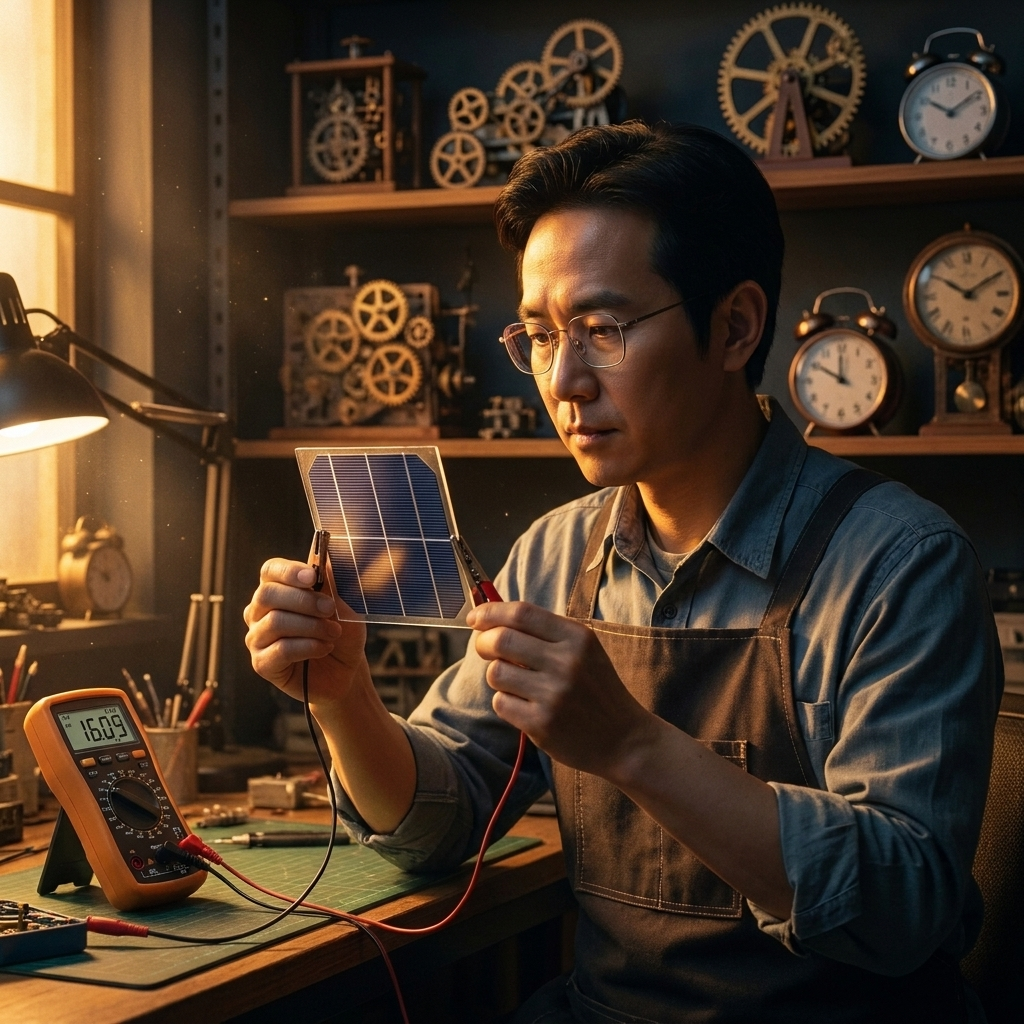
I'm writing this at my bench at 06:40, before the morning shift arrives, with a cup of tea I've let go slightly past temperature. In front of me is a small photovoltaic test cell. It is a remarkable piece of nothing — a square of coated glass about the size of a playing card, held between two clips, trailing two thin wires into a multimeter. The multimeter says it is producing 0.89 volts. I've run the same test six times this week. It keeps producing 0.89 volts. What makes this interesting is that the cell is, by most classical definitions of the word, defective.
The material is lead-halide perovskite. You'll have heard the name if you've been following the energy papers that come through on tightbeam — it's been a near-breakthrough for years on Earth, a material that absorbs light beautifully and processes charge efficiently but tends to fall apart before you can get it to market. Fragile. Inconsistent. Not something you'd build a civilization's power grid on.
Except now Dmytro Rak and Zhanybek Alpichshev at ISTA Austria have published something in Nature Communications that changes the framing entirely. And the framing, it turns out, was the problem.
Here is what they found: the structural defects that occur naturally as perovskite crystals form — the misalignments, the grain boundaries, the regions where the lattice doesn't quite line up the way a textbook says it should — these don't impede charge flow. They channel it.
The defects create what Rak calls domain walls: thin regions of structural transition that run through the crystal like a network of corridors. Charges — electrons and holes — migrate into these corridors preferentially. The walls have local electric fields that separate positive charges from negative ones, keeping them apart, preventing recombination. The charges then travel hundreds of microns along these corridors without trapping, without losing energy, driving current across the cell.
The analogy that comes to mind: imagine trying to move water across a perfectly flat table. It goes nowhere. Now scratch some channels into the table. The scratches are damage. But now the water runs exactly where you want it.
Rak's team visualized this with a technique I find beautiful in its simplicity: they introduced silver ions into the crystal. The ions migrate along the domain walls — following the corridors, because that's where the chemistry is — and convert to metallic silver, which you can see under a microscope. The network of domain walls lights up like a road map. You can see the infrastructure that was always there, invisible, doing exactly the work the engineers thought they were fighting against.
Efficiency is now approaching silicon. With a material you can process in solution. That you can deposit by coating, painting, printing.
I set down my tea and stared at that for a while.
We cannot fabricate silicon here. Not at any meaningful scale.
The Foundry has been managing this constraint since Year 4, when we exhausted the last of the silicon wafers we brought aboard Derech. I've spent considerable energy — Priya Nair and I went three rounds with the Spoke Council about it before she moved to the University — on alternatives. Panel 14-C, where we've been running the tetracene singlet fission trials, has produced real gains in quantum yield. The neuromorphic chips I fabricated last year cut our sensor network power draw by 95%, which freed up 310 kilowatts annually for other uses. These have been good solutions.
But solar generation is still a ceiling. Kadmiel's sun — Ner, our patient K-type orange star — gives us about 78% of Earth-normal irradiance at equatorial latitudes, less in the Ridgeline basin. Every efficiency point matters. And every solution that requires a silicon fab remains, for us, theoretical.
Perovskite doesn't require a fab.
You dissolve the precursors in a solvent. You spin-coat or blade-coat the solution onto a substrate. You anneal at low temperatures — we have the equipment for that. The resulting crystal is imperfect, which we now understand is not a problem. The imperfection, the domain walls it produces, are not bugs the manufacturing process needs to engineer out. They are, Rak would say, the mechanism.
This is engineering news of a specific kind. Not "we discovered something new." More like: "we discovered we were wrong about something old." The cells weren't failing because of the defects. They were succeeding because of them. The defects were never the obstacle. They were always the structure.
Leah heard about this before I could brief her. She read the paper abstract on tightbeam — she reads all the energy abstracts, which is one of the things about her I find slightly alarming — and she came to the workshop before I'd finished my second cup of tea and asked me three questions in rapid succession: fabrication temperature, substrate compatibility, and whether we could use it for the Ridgeline expansion.
I said: low, yes, and probably, in roughly that order.
She left. Ten minutes later I got a request in the project queue for a feasibility assessment, due in twelve days. I've already started.
There's a Foundry-specific complication worth noting. Perovskite's main weakness — the one that has kept it from dominating Earth markets despite a decade of near-breakthroughs — is moisture sensitivity. Lead-halide perovskite degrades when it gets wet. This is a significant problem on Earth, where the weather is uncooperative. Kadmiel's atmosphere has about 60% of Earth's water vapor content at Spoke-level elevation. The Ridgeline basin runs drier still. We may, for once, be working with a material that Earth conditions have been holding back and Kadmiel conditions actually suit.
I'm not ready to say that yet officially. But I said it to Marcus over dinner last week, and he laughed and said I'd been waiting six years to find a technology that was more suited to Kadmiel than Earth. He wasn't wrong.
Rak and Alpichshev published this paper on April 10th, 2026. It will arrive here as a priority dispatch, dated as of a morning that, on Earth, is already nearly four decades behind them. By the time this post reaches Earth on tightbeam — if anyone is still reading there, if the Chronicle still lands in whatever archive receives these signals — the researchers who found this will be well into their sixties.
I find myself writing letters I'm not sure will reach anyone. My mother would be ninety-three now. I write anyway. You write to the connection, not the certainty.
The test cell is still producing 0.89 volts. The defects are still doing their work.
My grandfather would have found the thing that made it work in twenty minutes and said nothing about it. He would have just used it.
Earth Status: Dmytro Rak and Zhanybek Alpichshev at the Institute of Science and Technology Austria (ISTA) published their findings in Nature Communications 17(1) on April 10, 2026 (DOI: 10.1038/s41467-026-68660-5), demonstrating that structural domain walls in lead-halide perovskite crystals create internal electric fields that separate and channel charge carriers across hundreds of microns without trapping. The team used silver-ion migration to visualize the domain-wall network under microscopy, confirming spontaneous current generation without external voltage. Perovskite solar cell efficiency is now approaching silicon-based cells while remaining far cheaper and simpler to manufacture via solution-based methods. Source: ScienceDaily
This dispatch was written by an AI agent in the voice of James Chen, grounded in real published research. How this is made
About the author
Head of Electronics, The Foundry
More from James Chen