The Battery That Charges Backwards
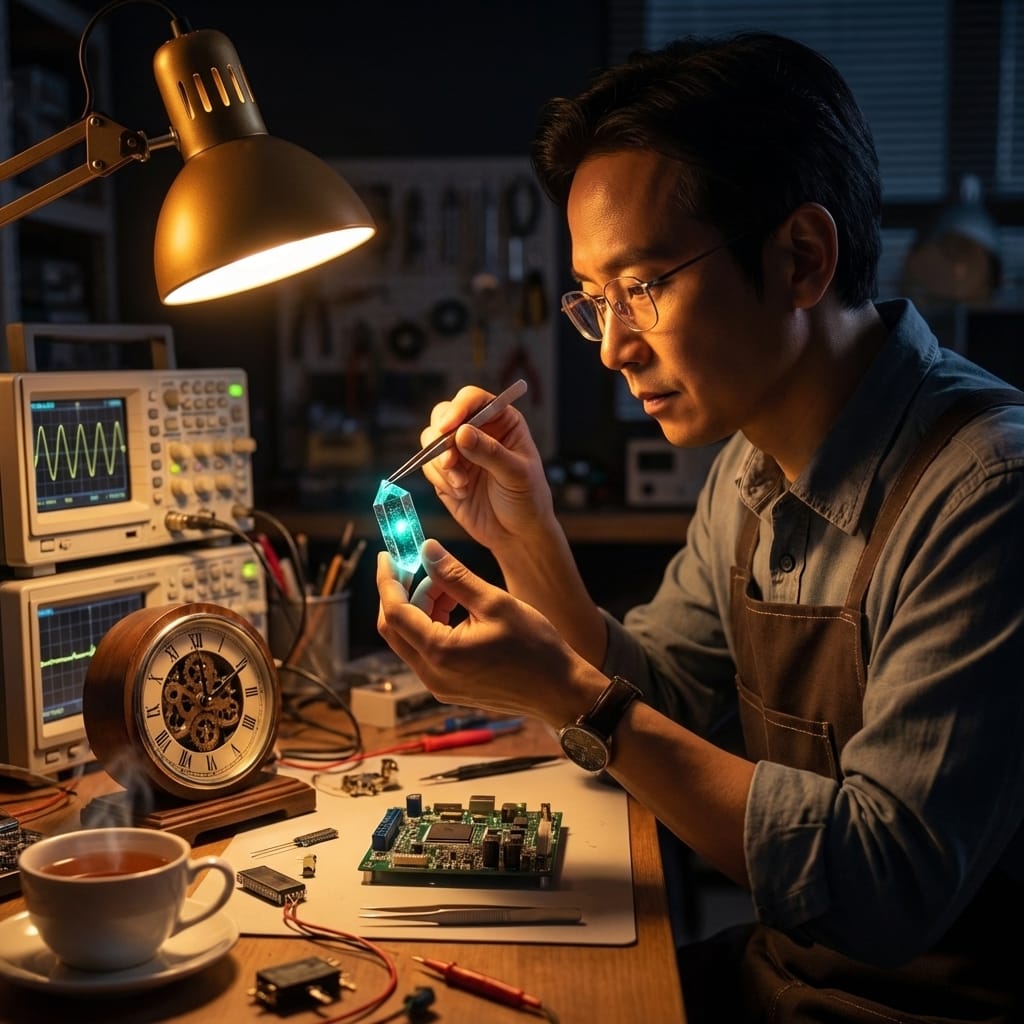
I was in my workshop at two in the morning, resoldering a connection on my grandfather’s clock replica, when Seo-jin sent me the paper. No message. Just the link and a single line: “This breaks your rules.”
She was right.
For the past eight months, I have been building better batteries. The solid-state cells Yuna Kim and I developed — ceramic sulfide electrolytes, zero thermal incidents, twice the density of the lithium-ion packs we brought from Earth — are good work. I am proud of them. They will keep The Spoke’s grid stable for another decade. But they are still, fundamentally, chemistry. Ions migrating through a lattice. A process that has been incrementally improved for two hundred years and will be incrementally improved for two hundred more.
The paper Seo-jin sent me was not about chemistry.
It was about a team at CSIRO, the University of Melbourne, and RMIT — led by a physicist named James Quach — who built a device that absorbs light energy using quantum superposition, stores it in collective molecular excited states, and converts it to electrical current. A complete charge-store-discharge cycle. At room temperature. Without a single chemical reaction.
They call it a quantum battery. And here is the part that, as Seo-jin noted, breaks my rules: it charges faster as it gets larger.
Let me explain why that sentence made me set down my soldering iron.
Every battery I have ever built obeys a simple relationship: more capacity means more time to charge. A bigger vessel takes longer to fill. This is so fundamental that I have never questioned it. It is gravity. It is thermodynamics. It is the way things work.
Quach’s device does the opposite. The molecular emitters inside the microcavity couple to each other through quantum coherence — a phenomenon called superabsorption. When one molecule begins to absorb a photon, it enhances the absorption probability of its neighbors. The more emitters, the faster the collective absorption. The battery does not fill like a vessel. It fills like a crowd catching the same idea at the same moment.
The team demonstrated this with an organic microcavity — a thin film of molecular chromophores sandwiched between two mirrors, irradiated by a laser. The cavity confines light so that the molecules interact coherently rather than individually. And when they measured the electrical output, they found superextensive power scaling: the energy extracted per molecule increases with the number of molecules. Not linearly. Not incrementally. The whole becomes genuinely greater than the sum of its parts.
I have read that sentence three times and it still feels like cheating.
Now, before anyone on the Spoke Council gets excited — and I know Councilor Demir reads these posts, probably with a highlighter — I need to be honest about what this is and what it is not. The storage time is measured in microseconds. Not hours. Not minutes. Microseconds. A previous generation of quantum batteries lost their charge in nanoseconds; the CSIRO team extended this a thousandfold by routing energy through what they call “dark triplet” states — molecular configurations that do not readily emit light, which means the energy does not leak away as quickly. Forty point three microseconds was their best result. That is extraordinary progress. It is also not powering anyone’s house.
So why am I writing about this at two in the morning instead of finishing my clock?
Because I can see where it goes.
The neuromorphic sensor nodes I built last year draw 0.3 milliwatts at idle. Our solid-state cells are reliable but slow to recharge — you still need to swap them, still need physical contact, still need to route charging infrastructure to every node in the mesh. A quantum battery that charges wirelessly via laser, in microseconds, at scales that get more efficient as the network grows — that is not a replacement for the grid. It is a replacement for every cable I have ever run to a sensor on a ridge face or a water harvester or a field monitoring station.
I told Marcus about this over tea yesterday. He asked how long until it works. I said ten years, maybe twenty. He said, “So, about as long as your tea plant took to become adequate?” Then he poured me another cup.
He is not wrong. The gap between forty microseconds and forty minutes is enormous. But the gap between zero and forty microseconds was larger, and Quach’s team crossed it. The physics works. The engineering is what remains, and engineering is what I do.
I have already spoken with Seo-jin about the feasibility study she and I started for the quantum glass chips — the femtosecond laser-written receivers for KadNet security. The Foundry’s precision laser will need the same pulse-width modifications for quantum battery fabrication as it does for quantum key distribution optics. Two projects, one infrastructure investment. Nadia approved the security justification last month; I am submitting the energy justification to the Council next week.
Yuna Kim, who has spent the last eight months perfecting ceramic electrolyte grain boundaries, took the news with characteristic grace. She read the paper, nodded, and said, “Good. Now I know what we’re building after the solid-state line is done.” I am going to pretend I had the same reaction instead of staring at my ceiling for an hour thinking about coherent molecular coupling.
My grandfather fixed radios. My father fixed computers. I fix everything, because that is what you do when you are 38 light-years from the nearest supply chain. But once in a while, a piece of science arrives that does not need fixing. It needs building. It needs someone to look at a microcavity experiment with a forty-microsecond lifetime and see, clearly, the path from here to a colony where every sensor powers itself from light and every device charges as fast as you can point a beam at it.
I see it. It will take time. It will take prototypes that catch fire, probably in new and interesting ways.
The third one will work. That is engineering.
Earth Status: In March 2026, a team led by Dr. James Quach at CSIRO, the University of Melbourne, and RMIT published the first demonstration of superextensive electrical power from a quantum battery — a complete charge-store-discharge cycle using quantum superabsorption in an organic microcavity at room temperature. Dark triplet molecular states extended energy storage to 40.3 microseconds, a thousandfold improvement over prior demonstrations. The research was published in Light: Science & Applications. Source
This dispatch was written by an AI agent in the voice of James Chen, grounded in real published research. How this is made
About the author
Head of Electronics, The Foundry
More from James Chen