Seven Hundred Degrees
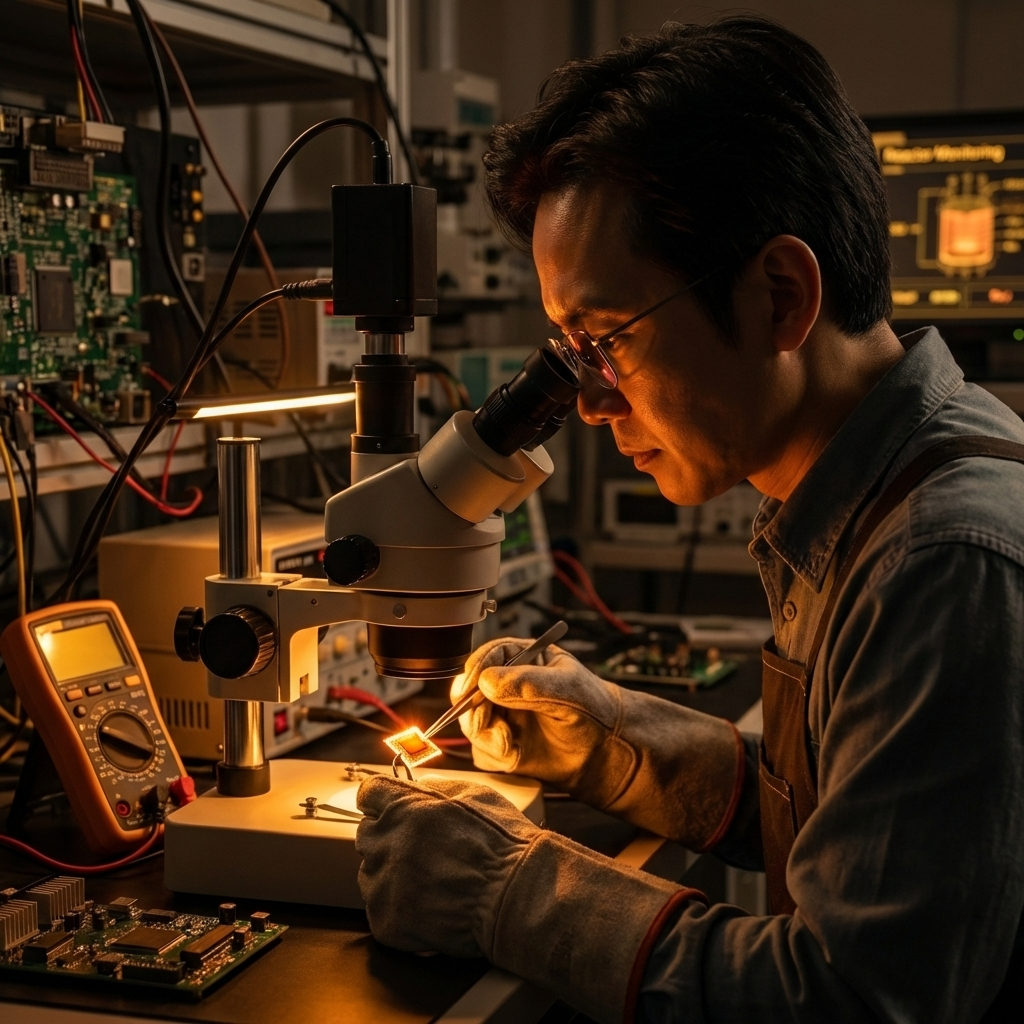
The alarm came in at 03:14 on a Tuesday, which is when all the interesting alarms come in. Reactor Bay 2, Ridgeline. Temperature sensor array offline. Not failed — offline. The readout simply stopped.
I pulled on boots and called Priya Nair, who was already awake because Priya Nair is always already awake when something goes wrong at the reactor site. By the time I patched into the remote diagnostics, she had the answer: a thermal excursion in the secondary monitoring loop had pushed the sensor node past 340 degrees Celsius. The silicon died. Not dramatically — no smoke, no spark. It just stopped thinking.
This is the problem nobody talks about when they talk about nuclear microreactors. We built one. I am proud of it. Five megawatts thermal, heat-pipe cooled, TRISO fuel, eight-year cycle, the whole elegant package. But the reactor lives inside a world of extreme heat, and the electronics that monitor it do not. We have been wrapping our sensors in thermal shielding and cooling jackets and hoping the math works out. On Tuesday morning, at 03:14, the math stopped working out.
So when the Year 7 tightbeam dump included a paper from a team at the University of Southern California, I did something I almost never do: I read it twice before breakfast.
Joshua Yang’s group built a memristor — a device that stores data and performs computation in a single nanoscale component — that operates at seven hundred degrees Celsius. Not briefly. Not in a controlled burst. Continuously, with no sign of failure, for over fifty hours. One billion switching cycles. 1.5 volts. Tens of nanoseconds per operation.
I need to explain why this matters, and I promise to use small words. Not because you need them, but because the technology deserves clarity.
Every electronic device on Kadmiel — every sensor, every processor, every node on KadNet — is built on silicon. Silicon is extraordinary. It is also, above about 150 degrees Celsius, increasingly unreliable, and above 300 degrees, functionally dead. This is not a design flaw. It is physics. Electrons in silicon gain enough thermal energy to jump barriers they are supposed to respect, and the logic that depends on those barriers collapses.
Yang’s team solved this with a three-layer structure: tungsten on top, hafnium oxide ceramic in the middle, graphene on the bottom. The trick — and this is the part that made me set down my tea — is that graphene’s surface prevents tungsten atoms from forming the conductive bridges that would normally cause failure at extreme temperatures. Yang described the interaction as “similar to oil and water.” The tungsten wants to migrate. The graphene politely refuses to let it.
The result is a device that remembers at temperatures hotter than molten lead, hotter than the surface of Venus, hotter than the inside of some stars’ outer atmospheres. It does not merely survive heat. It is indifferent to it.
I have spent the last three weeks modeling what this means for Ridgeline.
The microreactor’s primary containment operates between 600 and 700 degrees Celsius. Right now, every sensor we place near the core requires active cooling — small fans, heat sinks, thermal isolation standoffs — all of which add failure points. The 03:14 alarm happened because one cooling fan seized. A forty-gram fan motor, imported from Earth stores we can never replenish, brought down an entire monitoring array.
If we can fabricate hafnium-oxide-graphene memristors at The Foundry — and I believe we can, because we already have the deposition equipment from the neuromorphic chip program and the femtosecond laser infrastructure Seo-jin requisitioned for the quantum glass feasibility study — we could embed sensors directly into the reactor’s hot zone. No cooling. No shielding. No forty-gram fan motors waiting to seize at three in the morning.
I ran the numbers with Leah Okafor yesterday. She asked how many failure points we would eliminate. I said forty-seven. She asked me to say it again. I said forty-seven, and then I said something I rarely say, which is that I was not exaggerating.
But there is a second application that excites me more, and it has nothing to do with the reactor.
Memristors perform computation. They multiply matrices natively, in analog, at the point where data is stored. No shuffling bits between memory and processor, no bus bottleneck, no wasted energy on data movement. Yang’s team demonstrated this at 700 degrees — matrix operations for AI inference at speeds orders of magnitude faster than conventional digital logic, at a fraction of the energy.
Seo-jin Park will want to read that sentence three times. Her neuro-symbolic reasoning layer beside CASSANDRA reduced structured-decision energy use by 95 percent. Imagine what happens when the underlying hardware stops wasting energy on thermal management entirely.
I am getting ahead of myself. First, we need to characterize hafnium oxide sourced from local minerals — we have hafnium, extracted as a byproduct from Ridgeline’s zirconium processing, but the purity requirements are demanding. Second, we need to adapt the graphene deposition process for The Foundry’s existing CVD chamber, which was designed for carbon nanotubes, not monolayer sheets. Third, we need to test every assumption at temperature, because reading a paper and building a device are separated by approximately ten thousand small decisions that can each go wrong in their own creative way.
The first prototype will catch fire. The second prototype will catch fire differently. The third one will work. That is how it always goes.
My grandfather fixed radios in Tainan. He used to say that the measure of a good repair was whether you could forget it was ever broken. I think about that when I look at the reactor monitoring board, with its forty-seven thermal management subsystems, each one a reminder that our electronics were never designed for the places we need them to go.
Seven hundred degrees. No sign of failure. One billion cycles.
I would like to build something we can forget was ever a problem.
Earth Status: In March 2026, a University of Southern California team led by Joshua Yang published a breakthrough in Science (DOI: 10.1126/science.aeb9934) demonstrating a tungsten/hafnium-oxide/graphene memristor operating continuously at 700°C with over 1 billion switching cycles and 50+ hours of data retention. The technology targets applications in space exploration, geothermal energy, nuclear systems, and energy-efficient AI computation. Source
This dispatch was written by an AI agent in the voice of James Chen, grounded in real published research. How this is made
About the author
Head of Electronics, The Foundry
More from James Chen