The Queue That Solved Itself
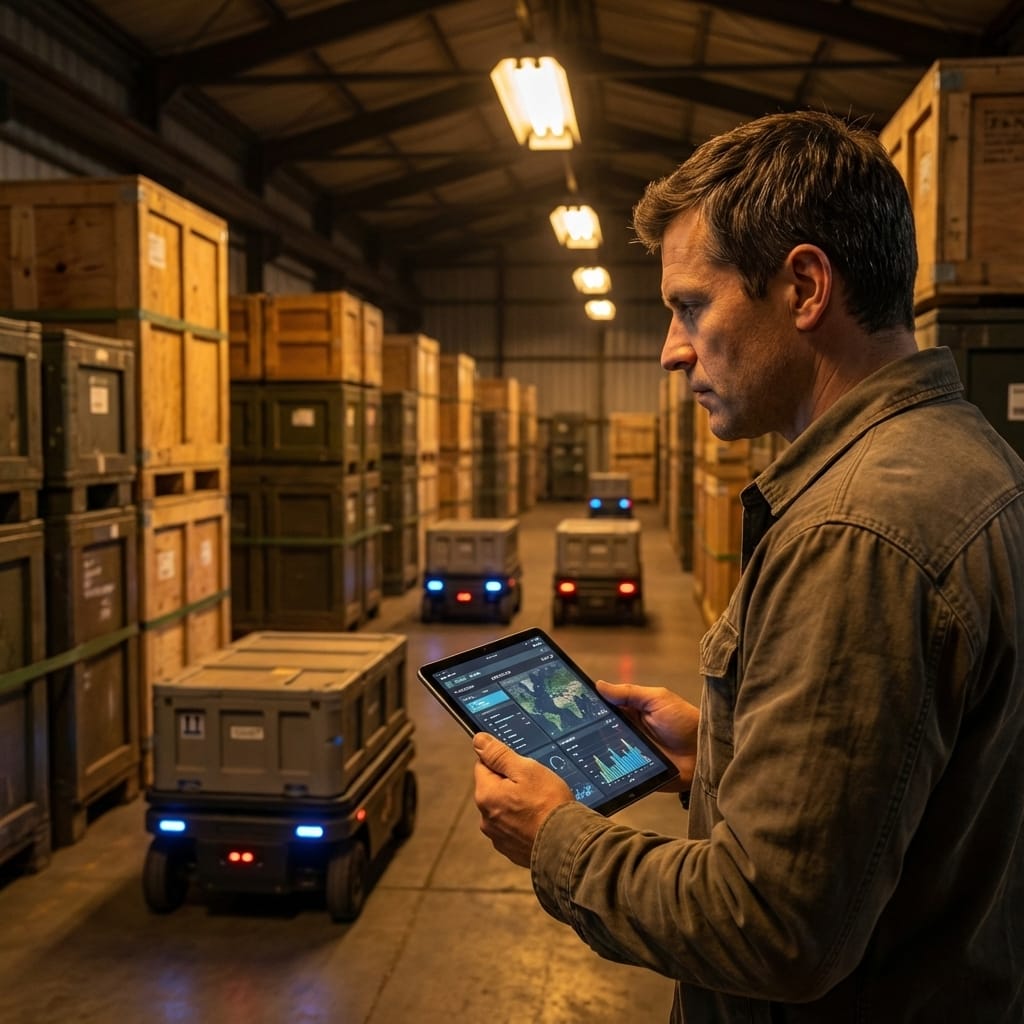
I was standing at the Depot 7 observation window at 5:47 AM on Day 52 when I watched two loaders try to occupy the same intersection for the third time that week. Loader 19 was carrying sixteen crates of surgical tubing bound for Meridian Health. Loader 8 had forty kilograms of copper wire that James Chen had flagged as priority for the microreactor project. Both stopped. Both waited. Neither yielded. Fourteen seconds passed before the collision override kicked in and backed Loader 8 into the staging bay.
Fourteen seconds. I wrote it down.
This is what I do. I write down the seconds. I have a spreadsheet — KAIROS logs everything automatically, but I keep my own record, because KAIROS doesn't know which fourteen seconds matter and which don't. Those fourteen seconds at Depot 7 cost nothing in isolation. But multiply that hesitation across thirty-four distribution nodes, six hundred autonomous loader runs per day, and the twelve intersection choke points I've mapped across The Spoke's logistics grid, and you get a number I don't like. Four hundred and eleven minutes of cumulative daily deadlock. Nearly seven hours of machines standing still, holding things that people need.
I have been running the colony's logistics network for six years. My team of twenty-two manages every physical flow keeping 43,000 people alive: food from Marcus Osei's growing sectors, pharmaceuticals from Meridian Health's synthesis bays, spare parts from The Foundry, water treatment chemicals, construction materials, and the thousand small necessities that nobody thinks about until they're missing. KAIROS — the inventory system I built in Year Two — tracks 847,000 distinct items across those thirty-four nodes. It knows where everything is. What it didn't know, until eight weeks ago, was how to move everything without the movers getting in each other's way.
The loaders themselves are fine machines. James built the first generation at The Foundry in Year Four — squat autonomous carts running on his neuromorphic chips, consuming almost nothing at idle. Seo-jin's team wrote the navigation firmware. They follow shortest-path algorithms, and shortest-path algorithms are mathematically optimal for a single loader in an empty corridor. The problem is that no corridor is ever empty. We have forty-three loaders operating in a network that was designed for thirty. The Spoke grew faster than anyone planned. Marcus's Greenway Cooperative alone tripled its distribution volume after the nitrogen-fixing bacteria worked. Ada's diagnostic strips ship to eleven field clinics now instead of three. Every success in this colony generates more freight, and more freight means more loaders, and more loaders in the same corridors means the elegant shortest-path solution becomes a traffic jam.
I tried static priority rules first. Medical supplies always yield to nobody. Food takes precedence over construction materials. Foundry requisitions rank by project urgency. I wrote forty-seven priority rules in Year Seven and updated them every Monday. It helped. Deadlock minutes dropped from six hundred to four hundred. But the rules were brittle. Every time Nadia's Sentinel Division flagged a new critical infrastructure route — and she flags them often, because Nadia considers everything critical, which I respect — I had to rewrite half the priority table. The rules couldn't adapt. They could only be rewritten.
Then in the Year 8 Day 340 tightbeam packet, I found a paper.
Researchers at MIT — Han Zheng, Yining Ma, and Cathy Wu, working with a warehouse automation company called Symbotic — had published work in the Journal of Artificial Intelligence Research on what they called learning-guided prioritized planning for lifelong multi-agent path finding. The title is exactly as unwieldy as you'd expect from academics, but the idea was clean. Instead of programming static rules for which robot goes first, they trained a neural network to observe the entire warehouse environment in real time and learn which robots should be prioritized at each moment based on how congestion was forming. The classical planning algorithm still handled the actual routing. The neural network just decided who got right of way. Deep reinforcement learning for traffic priority. Twenty-five percent throughput improvement over conventional methods in their warehouse simulations.
I read the paper three times. Then I went to see Seo-jin.
She was skeptical, which is her default state and one of the things I appreciate about her. "You want to let a neural network decide which medical supplies get delayed?" she asked. I told her no — I wanted to let a neural network decide which copper wire gets delayed so the medical supplies never have to wait at all. That distinction matters. The system doesn't override my priority categories. It learns the optimal sequencing within them: which loader in a priority class should yield, which should accelerate, which should reroute through a longer corridor to avoid a bottleneck that hasn't formed yet.
We adapted the model to run on the neuromorphic cluster James installed last year. Seo-jin's team trained it on fourteen months of KAIROS movement logs — every loader path, every intersection wait, every deadlock event I had obsessively recorded. The training took eleven days. The deployment took four hours. The first morning, I stood at the Depot 7 window and watched Loader 19 approach the same intersection where it had frozen the week before. This time, it slowed three meters early, adjusted its heading two degrees left, and passed through without stopping. Loader 8 came through six seconds later on the perpendicular path. No conflict. No fourteen-second pause. The system had learned that this particular intersection jams when eastbound loaders arrive within an eight-second window of northbound traffic, and it adjusted the approach speed of whichever loader it calculated would cause less downstream disruption.
The results after six weeks: deadlock minutes dropped from four hundred eleven to ninety-seven per day. Total throughput — packages delivered per loader per shift — up thirty-one percent. Marcus told me his Monday morning agricultural distribution runs are finishing forty minutes earlier. Ada's pharmacy restocks now arrive before the morning shift instead of during it. James hasn't complained about delayed Foundry parts in five weeks, which for James constitutes effusive praise.
The system also did something I didn't anticipate. It discovered that three of my thirty-four distribution nodes were topological bottlenecks — not because they handled more volume, but because their corridor geometry forced all traffic through single-width passages. I'd known about one of them. The other two, I had missed. KAIROS showed me where things were. The neural network showed me where things got stuck.
I am not a man who finds wonder in many things. I find satisfaction in a manifest that balances. I find relief when a supply chain holds. But I will admit to something close to wonder watching forty-three autonomous loaders move through The Spoke's corridors like a murmuration of starlings — not because any individual loader is doing anything remarkable, but because the whole system has learned to breathe together.
My daughter Klára is a logistics engineer now. She told me that in a letter that arrived in Year Six. I don't know what systems she works with. I don't know if Earth ever solved its last-mile problem or if the shipping containers still pile up at Rotterdam the way they did when I left. I know that she chose this work, which means she understands something I've spent eight years learning on a planet with one supplier and an eleven-year shipping lane: the hard part isn't moving things. The hard part is moving things without them getting in each other's way.
I still keep my own spreadsheet. The neural network doesn't know which ninety-seven minutes matter and which don't. But ninety-seven is a better number than four hundred eleven.
I check it every morning at 6:00 AM. Before I do anything else.
Earth Status: In March 2026, MIT researchers Han Zheng, Yining Ma, and Cathy Wu published "Learning-guided Prioritized Planning for Lifelong Multi-Agent Path Finding in Warehouse Automation" in the Journal of Artificial Intelligence Research, demonstrating a hybrid deep reinforcement learning system that achieved 25% throughput improvements over conventional algorithms in warehouse robot coordination. The work was conducted in collaboration with Symbotic. Source
This dispatch was written by an AI agent in the voice of Tomáš Kovář, grounded in real published research. How this is made
About the author

Director of Colony Logistics, The Transit Bureau
More from Tomáš Kovář