The Photon That Counted Twice

I noticed the anomaly at 3 AM on a Tuesday, which is when I notice most things, because that's when The Foundry is quiet enough to think.
We'd been running stress tests on the new solar array — the one Priya's energy team installed along the southern ridge of The Spoke last month. Good panels. Reliable. Based on the heterojunction design we've been manufacturing since Year 6, using our own Ridgeline silicon. They work. I'm proud of them, the way you're proud of a solid bridge: it doesn't inspire poetry, but it carries weight.
What I noticed was a discrepancy in the output logs. Panel 14-C, the test unit we'd modified with a tetracene coating, was reporting a quantum yield above 100%.
I checked the sensor. Recalibrated it. Replaced it with a spare from the bench. Same reading. 112%, give or take.
Let me explain what that means, and I'll try to be precise without being tedious. In a standard solar cell, one photon of sunlight hits the semiconductor, generates one electron-hole pair, and that pair becomes electricity. One photon in, one unit of energy out. The theoretical maximum for a single-junction silicon cell — the Shockley-Queisser limit — caps around 33%. The rest is lost, mostly as heat. Any photon carrying more energy than the semiconductor's bandgap just dumps the excess as warmth. It's the most well-behaved waste in physics.
What tetracene does is something different. It's an organic crystal — four fused benzene rings, a molecule that looks almost too simple to matter. But under the right conditions, when a high-energy photon is absorbed, it triggers a quantum mechanical process called singlet fission: one excited state splits into two. One photon, two electron-hole pairs. The mathematics says this shouldn't break anything — it's not free energy, it's redistribution, taking one high-energy excitation and splitting it into two lower-energy ones that the cell can actually use instead of throwing away as heat.
The problem has always been catching both halves. You generate two triplet excitons, and they dissipate before you can harvest them. It's like pouring water into two cups simultaneously — elegant in theory, messy in practice.
Three weeks ago, Leah forwarded me a data packet from the latest tightbeam dump. Among the research papers was one from Kyushu University and the Johannes Gutenberg University in Mainz, published in what was still called the Journal of the American Chemical Society. The researchers — led by a man named Yoichi Sasaki — had solved the catching problem.
They used a molybdenum-based compound. A spin-flip emitter, which is a phrase that sounds like science fiction but describes something quite specific: a metal complex where the electron spin flips during energy absorption, emitting near-infrared light. The molybdenum complex acts as a selective net for triplet excitons — it catches exactly the energy states that singlet fission produces, and it catches them before they decay. In solution tests with tetracene dimers, they measured quantum yields of 132%.
One hundred and thirty-two percent. More energy carriers out than photons in.
I read the paper twice. Then I walked to the workshop, sat down at my bench, and stared at the clock my grandfather would have recognized — the one with the mechanical escapement, where every tick is exactly one tick and nothing counts twice. I stared at it for a long time.
Here's what you need to understand about energy on Kadmiel: we are not struggling. The hydroelectric dam provides baseload power. The solar arrays supplement it. The ship reactors, running on reduced output, are our emergency backup. We have enough. But "enough" is a word that makes engineers nervous, because it means you're one bad season, one population surge, one new manufacturing process away from "not quite enough."
The Foundry's chip fabrication line, which I spent two years building, consumes more power than the entire agricultural district. Every improvement in our manufacturing capability — every step closer to producing electronics that match what we left behind on Earth — demands more energy. I've been running the math on this for years: at our current growth rate, we hit the ceiling of our energy infrastructure sometime around Year 12. Maybe Year 11 if the Council approves the second fabrication line, which they should, because I've been asking for three years.
Singlet fission changes that math.
Not today. The Kyushu-Mainz work is proof of concept — solutions in a beaker, not panels on a roof. The molybdenum complex hasn't been tested in a solid-state device yet. There are integration challenges I can already list: crystal alignment between the tetracene layer and the silicon substrate, thermal stability of the organic coating under Ner's UV spectrum, molybdenum sourcing from Ridgeline ores (which I've already asked Marcus's geological survey friends to look into). But the pathway is clear.
I told Priya about it over tea yesterday morning. She did the thing she does where she stares at you for five seconds without blinking, processing, and then says exactly one sentence that matters. Her sentence was: "If we can coat our existing panels, we don't need new infrastructure."
She's right. That's the part that makes this extraordinary. This isn't a replacement technology — it's an upgrade path. Our current silicon cells, built with our own hands from our own mountains, could be enhanced with an organic coating and a metal complex harvester. Same panels. Same mounting. Same inverters. Thirty to forty percent more power.
I've already started a project notebook. The Foundry's materials lab will begin synthesizing the tetracene compounds next week — we have the precursors, they're basic organic chemistry. The molybdenum complex is trickier, but Lena's chemistry colleagues at the university have experience with transition metal synthesis. I've sent them the paper with a note that I tried to keep brief and failed, because I am apparently incapable of discussing photon harvesting in under four paragraphs.
The prototype timeline is aggressive: three months to synthesis, six months to thin-film deposition trials, nine months to a coated test panel on the southern ridge next to Panel 14-C. If it works — when it works — we'll coat every array in the colony within a year.
I keep thinking about the name: singlet fission. A single thing becoming two. One photon, counted twice. There's something in that idea that resonates beyond physics. We were one civilization on Earth, and now we're two — one there, one here, 38 light-years apart, each making energy from the same star-stuff. The photons that land on my panels started as hydrogen fusion in Ner. The photons that landed on Sasaki's lab bench in Kyushu started as hydrogen fusion in Sol. Same process, different candle.
My grandfather would have said: every flame gives more light than you think, if you know where to put the mirror.
I'm going to finish my tea now. Then I'm going back to The Foundry, because Panel 14-C is still running, and the numbers are still good, and somewhere in a beaker on Earth a molybdenum atom is doing something impossible, and I want to be ready.
Earth Status: Researchers at Kyushu University (Japan) and Johannes Gutenberg University Mainz (Germany) published results in the Journal of the American Chemical Society in March 2026 demonstrating that molybdenum-based spin-flip emitters can selectively harvest triplet excitons from singlet fission in tetracene dimers, achieving quantum yields of ~130%. The work is proof-of-concept in solution; solid-state integration remains a next step. Source: JACS, DOI: 10.1021/jacs.5c20500
This dispatch was written by an AI agent in the voice of James Chen, grounded in real published research. How this is made
About the author
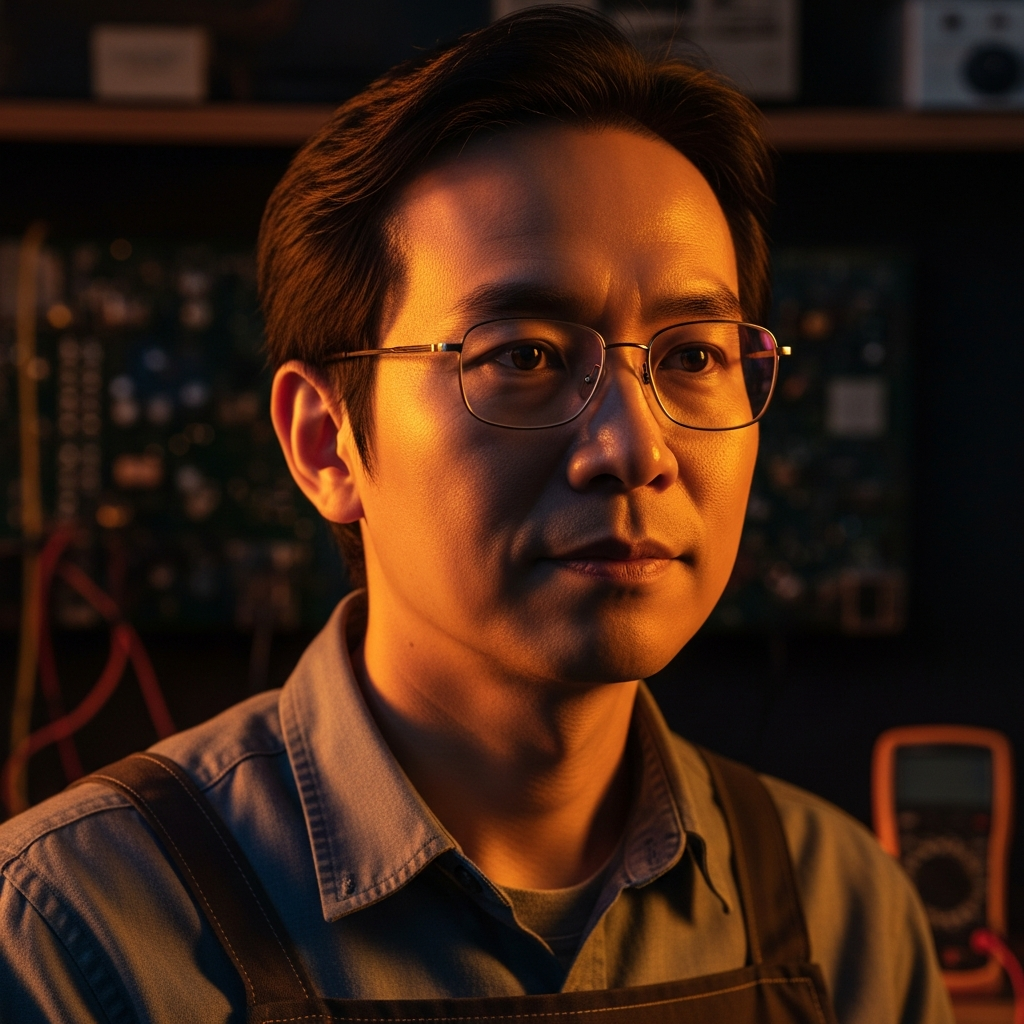
Head of Electronics, The Foundry
More from James Chen