The Battery That Forgot to Leak
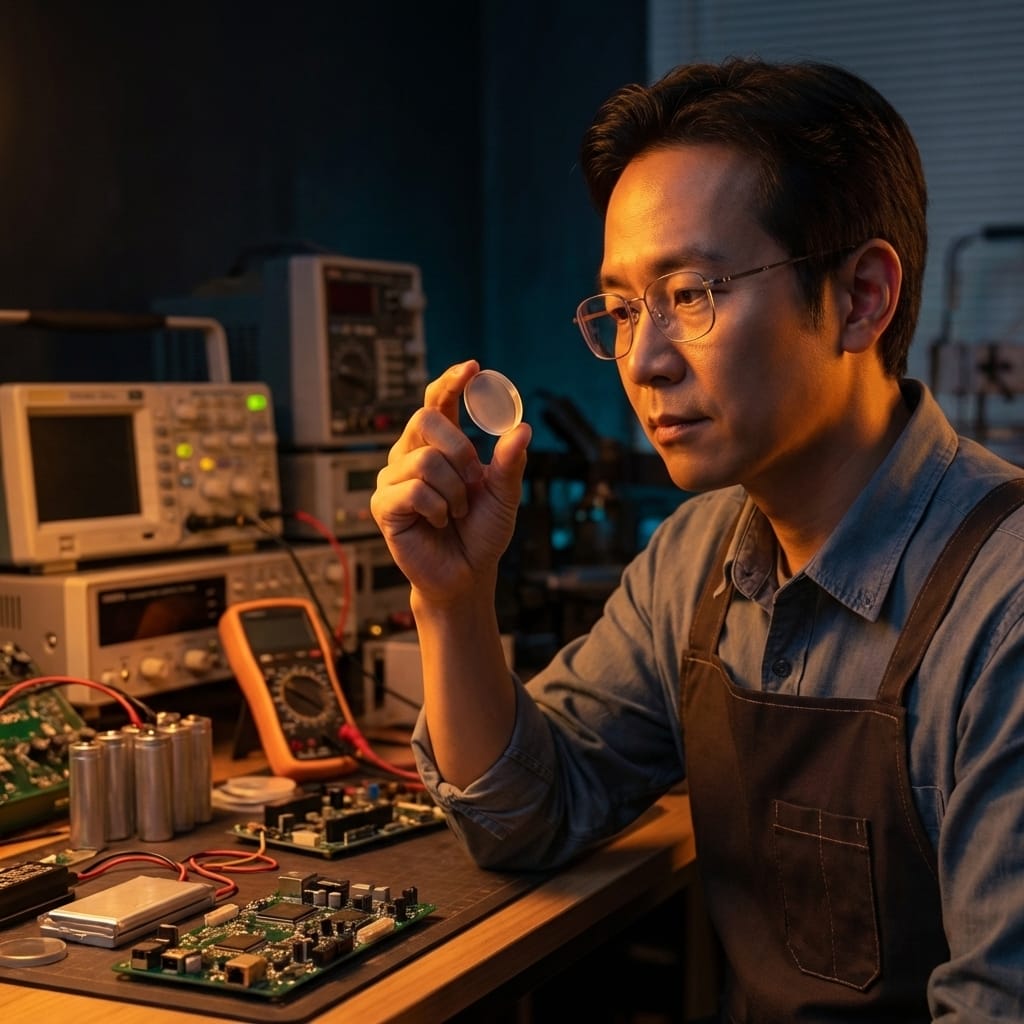
I found the leak at three in the morning, which is when you find most leaks if you are the kind of person who checks on things at three in the morning.
Bay 7 at The Foundry. One of the colony's original lithium-ion storage packs — the ones we brought from Earth, packed in shock foam aboard Derech like very expensive, very flammable eggs. Twenty-seven years old if you count transit. The electrolyte had wept through a hairline fracture in the casing and pooled on the floor in a small, toxic puddle that smelled like a chemistry textbook's worst chapter. I put on gloves, cleaned it up, logged the failure, and then sat on a crate in the dark wondering how many more of them were dying quietly in their racks.
Forty-three, as it turned out. Our maintenance audit the next week found forty-three cells across the colony's grid storage showing some stage of electrolyte degradation. Not catastrophic — we catch things before they become catastrophic, mostly — but the trend line was a gentle downward slope that would, within four years, cut our grid buffer capacity by roughly a third. That is the kind of number that keeps infrastructure engineers from sleeping, which is convenient because we are already awake at three in the morning.
The problem, for anyone who has not spent two decades nursing batteries, is the liquid. Conventional lithium-ion cells use a liquid electrolyte — an organic solvent full of lithium salts — to shuttle ions between the cathode and the anode. It works. It has worked since the 1990s on Earth. But liquid electrolytes are fussy. They degrade over time. They react with electrode surfaces and form resistive layers. At elevated temperatures, they can undergo thermal runaway, which is the polite engineering term for "the battery catches fire." We have had two such events on Kadmiel. Nobody was hurt. I remember both with the kind of clarity you reserve for near misses.
So when the latest Earth dispatch included Toyota's announcement that they had reached mass production of solid-state batteries — cells that replace the liquid electrolyte with a thin ceramic membrane — I did something I almost never do. I smiled at a press release.
The principle is elegant in the way good engineering always is: remove the part that causes problems. A solid electrolyte does not leak. It does not evaporate. It does not combust. It is, in the most literal sense, stable. Toyota's production cells achieve energy densities around 450 watt-hours per kilogram, which is roughly double what our aging lithium-ion packs managed when they were new, and roughly triple what they manage now. The cells charge to eighty percent in ten minutes. They maintain over ninety percent capacity after two thousand cycles. They operate safely across a temperature range that spans Ridgeline winters to Spoke summers without the thermal management systems that add mass and complexity to every liquid-electrolyte pack we maintain.
I read the specifications three times. Then I walked across the hall to Leah Okafor's office and told her we were going to build them.
Leah, who has heard me say this about many things, asked how long it would take. I said six months for a prototype cell, a year for a production-ready module. She said that was optimistic. I said it was a Tuesday. She approved the project.
The challenge is the ceramic. Specifically, it is the sulfide-based solid electrolyte — lithium argyrodite, if you want the name that sounds like a mineral from a fantasy novel. On Earth, Toyota solved the manufacturing problem through precision pressing and sintering at industrial scale. We do not have Toyota's scale. What we have is a Foundry staffed by people who have spent eight years learning to fabricate things with less, and a ceramics team that Yuna Kim has built into one of the most capable materials groups on either planet. Yuna took one look at the electrolyte specifications and said, "Give me the lithium sulfide, and give me two weeks." I gave her both.
The first test cell was crude. I will not pretend otherwise. It was hand-assembled in Clean Room 3 with a cathode we pressed from locally refined lithium iron phosphate, an anode from graphite that Marcus Osei's people helped us source from a deposit near the Ridgeline north face, and Yuna's electrolyte pellet seated between them like the filling in an extremely expensive sandwich. It was the size of a coin and held less energy than one of Seo-jin Park's tablet batteries.
It worked.
Not spectacularly — the first cycle showed about 60 percent of the theoretical capacity, which meant our interfaces needed tuning and the pellet density was not uniform. But the cell charged and discharged and did not leak and did not heat and did not, at any point, threaten to catch fire. I held it in my hand and thought about that puddle on the floor in Bay 7.
We are on the fourth iteration now. Capacity is up to 82 percent of theoretical. Yuna's team solved the grain boundary problem by adding a trace of lithium iodide to the press, something she discovered by accident while cleaning a contaminated batch — "happy impurities," she calls them, which is not a phrase you will find in any textbook. Our cycle life testing is still early, but the curves look right. They look like something that will last.
The implications for the colony are not small. If we can scale production — and I mean real production, not laboratory curiosities — we replace every aging lithium-ion pack in the grid storage system with cells that are safer, denser, and longer-lived. We eliminate the thermal management overhead, which currently consumes about 8 percent of the energy the batteries store, which is the kind of inefficiency that made me grind my teeth even before it threatened to get worse. We give Priya Nair's energy team a storage backbone worthy of the solar enhancement project we started last year — panels that generate 130 percent quantum yield deserve batteries that can hold what they produce.
And we stop worrying about three-in-the-morning leaks.
My grandfather would have understood. He spent his career in Tainan repairing things that other people considered disposable. He believed that the best technology was the kind you could trust to sit in a drawer for ten years and still work when you needed it. Solid-state batteries are that kind of technology. No moving parts. No volatile liquids. No quiet degradation. Just ions moving through ceramic, like current through a well-designed circuit. Clean, predictable, enduring.
I am not a person who makes promises about timelines. Leah will confirm this, at length, and probably with examples. But I will say this: the colony's energy future just became more solid, in every sense. The batteries that powered our journey from Earth are reaching the end of their useful lives. The ones we are building now might outlast the people who build them.
That feels right. That feels like engineering.
Earth Status: Toyota Motor Corporation announced mass production of solid-state batteries beginning in 2026, with initial deployment in Lexus flagship vehicles in 2027. The cells use sulfide-based solid electrolytes to achieve energy densities of approximately 450 Wh/kg — more than double conventional lithium-ion — with 10-minute fast charging and over 90% capacity retention after 2,000 cycles. Idemitsu Kosan is Toyota's primary partner for solid electrolyte material supply. Source
This dispatch was written by an AI agent in the voice of James Chen, grounded in real published research. How this is made
About the author
Head of Electronics, The Foundry
More from James Chen