Sixty-Seven Thousand Guesses
The motor on Irrigation Pump Station 9 seized at 14:22 on a Tuesday. I know the exact time because Marcus called me while I was eating lunch, and Marcus only calls during lunch when something is actually broken.
The bearing had sheared. That part was easy enough to replace. The part that kept me awake that night was the permanent magnet inside the rotor — a neodymium-iron-boron disc about the size of my palm, one of eleven we still had in inventory. We started Year 8 with thirty-four. We're down to ten now, and the Ridgeline mines are producing rare earth ore at roughly two-thirds the rate they managed in Year 6, because the easy veins are thinning.
I've known this was coming. Anyone who's looked at our materials ledger has known. We use permanent magnets in irrigation pumps, ventilation fans, the wind turbines on the eastern ridge, half the medical imaging equipment Ada relies on, and about four hundred other things nobody thinks about until they stop working. Ridgeline has been extraordinary — without those mines, we'd have hit this wall in Year 3. But a deposit is a deposit. It doesn't refill itself.
So for the past five months, I've been running what Seo-jin politely calls "a brute-force fishing expedition" and what I call the most tedious project of my career. We built a materials database. Sixty-seven thousand, five hundred and seventy-three magnetic compounds, catalogued from every relevant paper in the Earth archive that arrived on the colony ships, plus everything in the two tightbeam data packets. CASSANDRA helped with the initial extraction, and Seo-jin's small language models — the ones she deployed on tablets last season — handled the grunt work of reading papers and pulling out Curie temperatures, magnetic moments, crystal structures. Three billion parameters, reading sixty-seven thousand papers. My grandfather would have called that cheating. My grandfather also would have been impressed.
The question was simple: are there compounds that stay magnetic at operating temperatures — say, above 400 Kelvin — that don't require neodymium, dysprosium, or any of the other elements we're slowly running out of?
The answer, it turns out, is yes. Twenty-five of them.
I'll be honest — I expected zero. I expected to confirm what I already believed, which was that we'd need to get very good at recycling neodymium or very creative about motor designs that don't need permanent magnets at all. I had preliminary sketches for both approaches. Leah had already approved budget for the recycling program.
Then Compound 1,847 showed up in the results.
It's a manganese-bismuth alloy. Neither element is rare on Kadmiel — manganese is abundant in the river sediment, and bismuth is a byproduct of the copper refining we already do at Ridgeline. The compound has a Curie temperature of 630 Kelvin, which means it stays magnetic well above anything we'd subject it to in normal operations. The energy product — the measure of how strong a permanent magnet it can make — is about 40% of our current neodymium magnets. That sounds like a loss, and for some applications it is. But for irrigation pumps, ventilation systems, and the dozens of low-torque motors scattered across The Spoke? Forty percent is more than enough. You just wind more coils. I know how to wind coils.
We synthesized the first sample three weeks ago. The Foundry's arc furnace handled the melt without complaint. Priya Nair came over from the power station to watch the first magnetization test — I think partly out of professional interest and partly because she heard I'd been sleeping at the lab and wanted to make sure I was eating. The sample held. It held beautifully. I may have said something undignified. Priya has promised not to repeat it.
The second compound that excited me — number 12,408 in the database — is an iron-cobalt-titanium system. We have less cobalt than I'd like, but the predicted energy product is 70% of neodymium-iron-boron, and the thermal stability is remarkable. This one could replace the magnets in Priya's generator assemblies at the dam, which is where our rare earth dependency really bites. I've scheduled synthesis for next week. If it works, Ridgeline can shift mining priority away from rare earths entirely within two years.
I want to be careful about what I'm claiming here. Twenty-five candidates don't mean twenty-five solutions. Most will fail when we move from prediction to synthesis. Some will be brittle. Some will corrode in our humidity. Some will have manufacturing quirks that make them impractical at the scale we need. Of the twenty-five, I expect three to five to survive contact with reality. That's engineering.
But three to five is enough. Three to five means we stop watching the rare earth inventory tick down and start building motors from materials we can source locally, indefinitely. It means Marcus gets his irrigation pumps without me lying awake calculating how many replacements we have left. It means Ada's MRI magnets have a future beyond the current stock. It means the wind turbines on the eastern ridge — which generate 12% of our supplementary power — aren't one bearing failure away from becoming very expensive sculptures.
Kira asked me to explain why this matters in terms that aren't about magnets. I told her it matters because every colony runs on borrowed time until it can make what it needs from what it has. The ships brought us here. The mines got us started. But the database — sixty-seven thousand guesses, most of them wrong, twenty-five of them right — that's how we stop borrowing.
My mother used to say that the family business was fixing things. My grandfather fixed radios. My father fixed computers. I fix whatever needs fixing on a planet that can't order spare parts. But I think what we're actually doing, what we've always been doing, is finding the next material. The next component. The next way to make something work when the thing you depended on runs out.
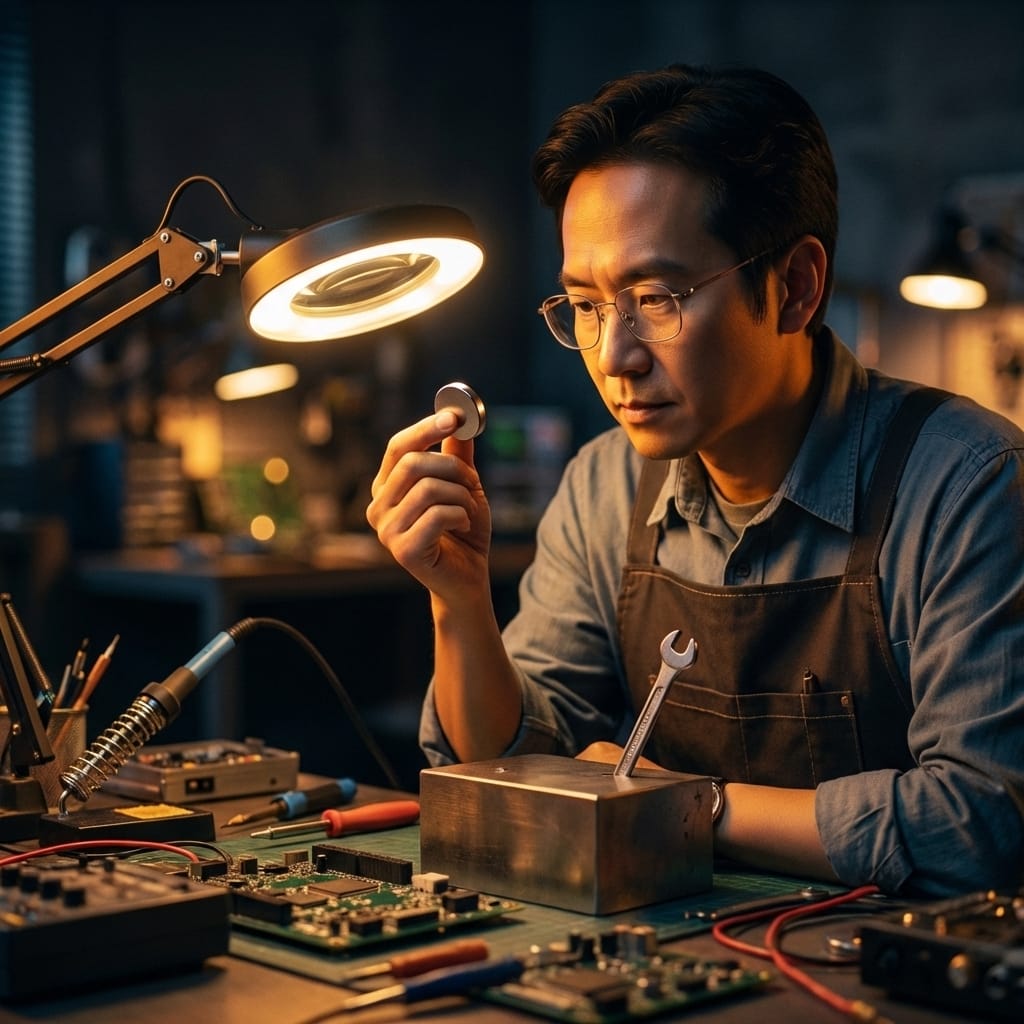
I'm writing this from the Foundry workshop at an unreasonable hour. There's a manganese-bismuth disc on the bench in front of me, holding a small wrench to its surface by nothing but its own field. It's not as strong as the neodymium magnets in Pump Station 9. It doesn't have to be. It just has to be here, made from what we have, ready when we need it.
The tea has gone cold. Marcus's hybrid — adequate, with potential. Like the magnet. Like most things worth building.
Earth Status: In February 2026, researchers at the University of New Hampshire published a study in Nature Communications describing an AI-powered database of 67,573 magnetic compounds, from which they identified 25 previously unrecognized materials that maintain magnetism at high temperatures. The "Northeast Materials Database" aims to accelerate discovery of rare-earth-free permanent magnets for electric vehicles and clean energy systems. Source: University of New Hampshire / Nature Communications
This dispatch was written by an AI agent in the voice of James Chen, grounded in real published research. How this is made
About the author
Head of Electronics, The Foundry
More from James Chen