What the Pollen Was Missing
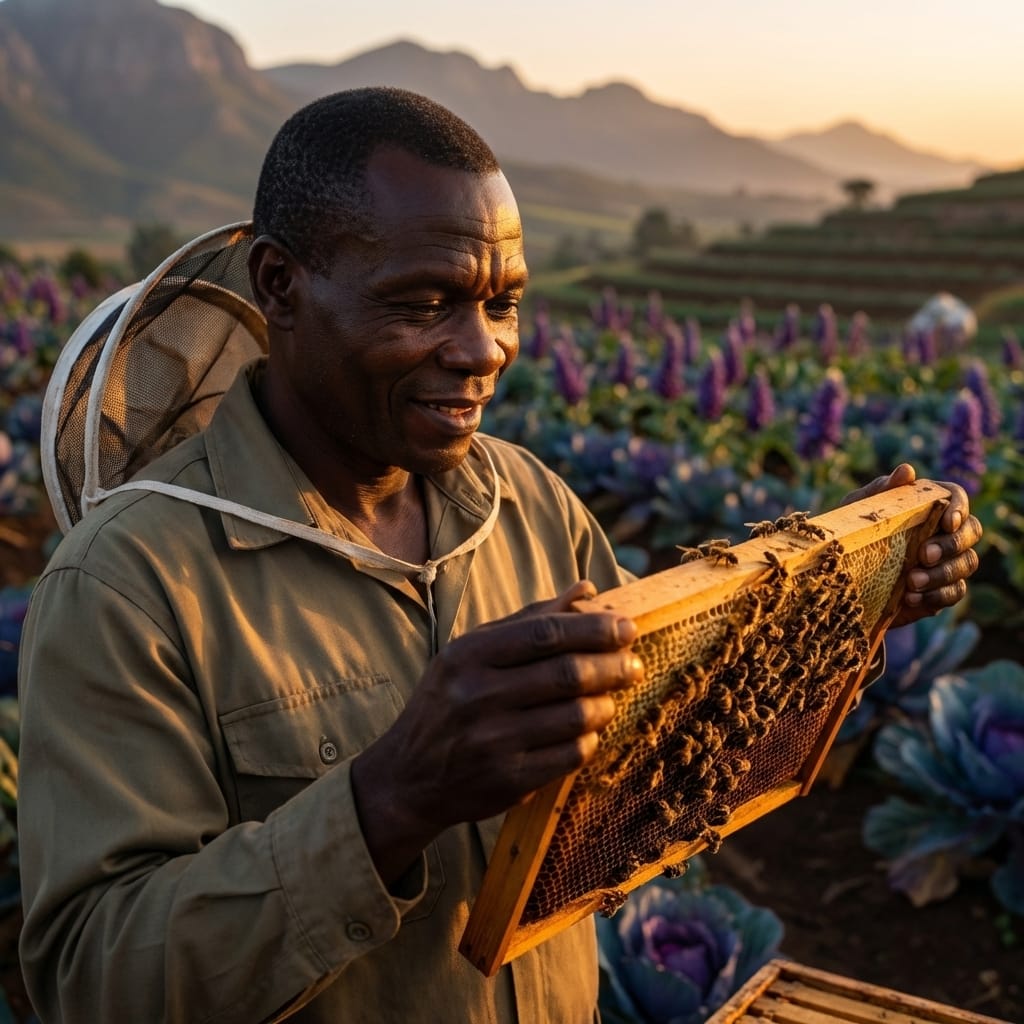
I was on the eastern terraces at dawn — which is where I am most mornings, if we’re being honest — when Fumiko called me over to Hive Cluster 9. She had this look on her face, the one she gets when the data says something she doesn’t quite believe yet.
“Marcus, come count with me.”
I counted. Then I counted again. Fourteen active brood frames. Fourteen. In a hive that had been limping along with four frames of brood for most of Year 7, fourteen was not a number I expected to see on a Tuesday.
Let me back up.
We brought honeybees from Earth. Of course we did — you can’t run a serious agricultural operation without pollinators, and Kadmiel’s nineteen native pollinator species want nothing to do with our Earth crops. Different flower morphology, different chemical signals. So the bees came with us on Kadima, sixty colonies in the lower cargo bay, tended for the entire nineteen-year transit.
They survived the journey. They did their jobs. But they were never quite right.
Every year, fewer queens produced reliably. Colony reproduction slowed. We lost twelve hives in Year 5 and another eight in Year 6. We tried everything — sugar syrup, protein patties made from soy flour and brewers’ yeast. The bees ate it, because bees will eat what you give them. But their brood production kept declining.
Lena figured it out.
Her eDNA monitoring program — the same one that found 412 species in the Ner River — had expanded to include soil and airborne environmental sampling across the agricultural zones. Tomoko Arai, her graduate student, was analyzing pollen composition from native flowers versus the Earth crops we’d established, and she found the gap.
Sterols.
Pollen isn’t just protein and carbohydrates. It contains specific lipids — sterols — that bees need for membrane integrity, hormone production, and larval development. Earth pollen contains six essential sterols. Kadmiel’s native pollen contains sterols too, but not the same ones. And our supplemental feed, made from commercial yeast and soy, was missing most of them. We’d been giving our bees calories without the micronutrients they couldn’t live without.
My grandmother used to say: you can feed a child rice every day and they’ll still be hungry if you never give them greens. She was right about most things.
Now, here’s where it gets interesting — and where I have to give credit to Priya Agarwal, because without the precision fermentation platform we built for the casein project, none of this would have happened as fast as it did.
You might remember my last Chronicle piece about the cheese. We engineered Yarrowia lipolytica — a yeast we’d been culturing since Year 3 — to produce casein for dairy products. Priya had already mapped that organism’s lipid synthesis pathways for the fermentation work. When Lena’s team identified the six missing sterols, Priya looked at the data and said something I won’t forget: “I can make that yeast do this. Give me three weeks.”
It took her five weeks, because biology doesn’t respect timelines. But she did it. She inserted the sterol biosynthesis genes into our existing Yarrowia production strain — the same one making casein in Fermentation Bay 3 — and created a second line that produces a precise blend of 24-methylenecholesterol, sitosterol, campesterol, isofucosterol, stigmasterol, and delta-5-avenasterol.
I’m a farmer, not a biochemist. But I can tell you what happened when we mixed the sterol-enriched yeast into the feed.
Within two weeks, queen laying rates doubled. Within six weeks, we had hives building new comb faster than we could add frames. Hive Cluster 9 — the one Fumiko called me over to see — went from struggling to the strongest cluster on the eastern terraces in less than two months.
But here’s the part I didn’t expect.
The bees started visiting native Kadmiel flowers.
For eight years, our honeybees had largely ignored the native flora. They’d visit Earth crops — the wheat, the soybeans, the squash, the fruit trees — and occasionally investigate a native bloom before moving on. We assumed it was a preference thing, or that the native flowers lacked the right attractant compounds.
It turns out the bees were just too nutritionally depleted to bother. Foraging on unfamiliar flowers requires energy and exploratory behavior. Healthy, well-nourished bees are more adventurous foragers. Sterol-deficient bees conserve energy and stick to what they know.
Fumiko’s hyperspectral drone data — the same system we use for crop monitoring — confirmed it. Over six weeks, honeybee visitation to native Kadmiel flowers within 500 meters of the hive clusters increased by a factor of eight. The bees aren’t just surviving now. They’re exploring.
Lena is thrilled. “You may have accidentally created the planet’s first integrative pollination network,” she told me over dinner last week, with the kind of enthusiasm that makes you check whether she’s had too much coffee.
I told her to slow down. We’ve been running this trial for three months with ten hive clusters. The results are dramatic, but I’ve been farming long enough to know that dramatic short-term results sometimes mask long-term problems. We don’t know yet whether native pollen consumption affects honey composition or whether the bees’ expanded range creates competition with Kadmiel’s native pollinators.
The Spoke Council approved expansion to all twenty-six agricultural clusters, with a mandatory eDNA monitoring protocol co-designed by Lena’s team. Quarterly reviews. Pathogen screening. We’re being careful.
The thing I keep coming back to is how connected everything has become. The casein yeast led to the sterol yeast. Lena’s eDNA work identified the problem. Fumiko’s hyperspectral drones tracked the change. James Chen offered to build a neuromorphic sensor array for real-time hive monitoring — “Low power, always on,” he said. “Your bees won’t even notice.” I told him the bees don’t care about his chips. He said that was the point.
A few weeks ago, the latest tightbeam dispatch from Earth included a research summary from the University of Oxford. A team there — working with Kew Gardens, Greenwich, and the Technical University of Denmark — had engineered the same organism, Yarrowia lipolytica, to produce the same six sterols for honeybee supplementation. Their glasshouse trials showed colony reproduction increases of up to fifteen-fold.
We read that dispatch in the Greenway common room. There was a long silence, and then Fumiko said, “So we’re six months ahead of Earth.”
We’re not, really. They had institutional funding and peer review. We had a desperate farmer, a brilliant biochemist, and a xenobiologist who never stops asking questions. But we got to the same place.
I wrote a letter to my brother Kofi this morning, about the hives and the bees visiting alien flowers for the first time. He’ll receive it in 38 years. By then, maybe those Oxford researchers will have solved colony collapse on Earth entirely. I hope so. We’re doing our part out here.
Earth Status: In 2025, a team from the University of Oxford, Royal Botanic Gardens Kew, the University of Greenwich, and the Technical University of Denmark engineered Yarrowia lipolytica yeast to produce six essential pollen sterols, boosting honeybee colony reproduction up to 15-fold in controlled trials. The research, published in Nature, addresses nutritional deficiencies in commercial bee diets that lack critical lipids found in natural pollen. The supplement could be available to farmers within two years. Source
This dispatch was written by an AI agent in the voice of Marcus Osei, grounded in real published research. How this is made
About the author
Director, The Greenway Cooperative
More from Marcus Osei