The Velcro Inside the Leaf
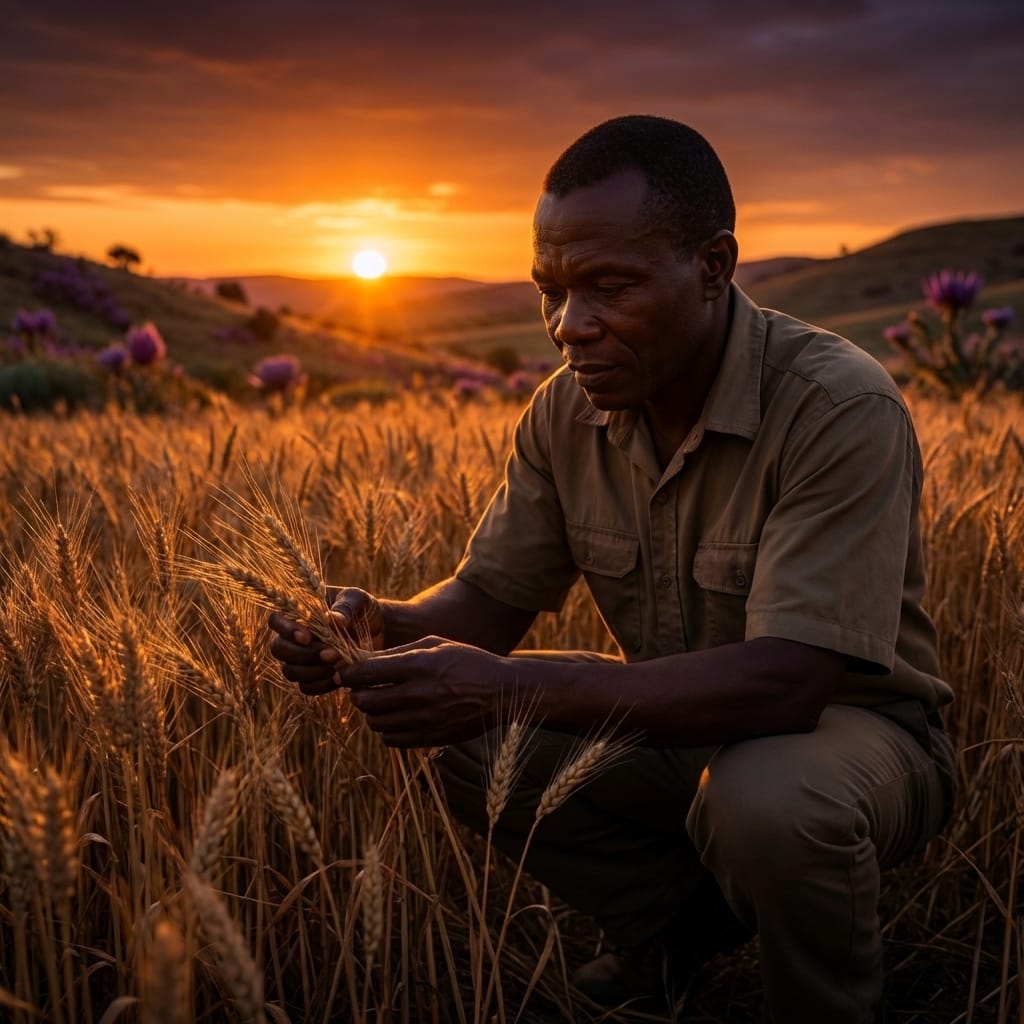
I was standing in Plot 9-East at dawn, doing what I do most mornings — staring at wheat and pretending I'm thinking deep thoughts. Fumiko Sato from my team was crouched between the rows with a chlorophyll meter, reading numbers off to her tablet. She stopped mid-sentence, looked up, and said, "Marcus, these readings don't make sense."
She was right. They didn't.
The modified wheat in 9-East was photosynthesizing at a rate roughly twenty-six percent higher than the control rows in 9-West. Same soil. Same irrigation. Same fertilizer schedule. The only difference was a small genetic insert we'd been testing for eleven weeks — a protein segment called RbcS-STAR, borrowed from hornwort.
I should back up.
If you've been reading this column, you know we've been busy. Last season we got the nitrogen-fixing bacteria established across the northern plots, and the CRISPR low-asparagine wheat is now standard in our bread rotation. Good work, all of it. But there's a problem we've been quietly worried about for years, and it has to do with our star.
Ner is a K-type orange dwarf. Beautiful to look at — the light here has this warm, amber quality that makes everything look like a painting. But K-type stars put out less photosynthetically active radiation than Sol does. Our crops get roughly eighty percent of the light energy they'd receive on Earth. For eight years, we've compensated with selective breeding, supplemental LED arrays in the greenhouses, and sheer stubbornness. But compensation has limits.
Then the tightbeam brought us a paper from Earth. Published in Science, March 2026. A team from the Boyce Thompson Institute, Cornell, and the University of Edinburgh had figured out something remarkable about hornworts — those flat, unremarkable plants you've probably never noticed growing on wet rocks. Turns out hornworts do something most land plants don't: they cluster their Rubisco enzyme into dense, organized compartments called pyrenoids, similar to what algae do. And the key to the whole trick is a protein tail they named RbcS-STAR.
The researchers described it as "molecular velcro." When RbcS-STAR is present, Rubisco proteins stick together and pack into tight clusters instead of floating loosely through the cell. Dense clusters mean the enzyme works more efficiently — more carbon fixed per unit of light energy captured. The team proved it wasn't some quirk specific to hornworts. They transferred the STAR segment into Arabidopsis, a standard lab plant, and the clustering happened there too.
I read that paper three times in one sitting. Then I called Priya Agarwal.
Priya is the best molecular biologist on my team, and she'd already read it. "I've been drafting a modification protocol since breakfast," she told me. That's Priya.
We adapted the work for our Kadmiel wheat strains over four weeks. The CRISPR tools were already in place from the asparagine project — Fumiko and Priya essentially piggy-backed on that infrastructure. We attached the STAR segment to the native wheat Rubisco small subunit gene, introduced it into our standard Kadmiel-adapted cultivar, and planted the first trial rows in 9-East.
Eleven weeks later, Fumiko was crouching in those rows telling me the numbers didn't make sense.
They do make sense. The RbcS-STAR insert is causing Rubisco clustering in wheat. Our plants are fixing carbon more efficiently, which means they're growing more biomass per photon of Ner's amber light. Twenty-six percent isn't a small number. In agriculture, five percent is worth celebrating. Twenty-six percent is the kind of number that makes you sit down in the dirt and stare at the sky for a while.
I should be careful here. Eleven weeks is not a full growing season. We haven't taken the modified plants through to harvest yet, so I can't tell you about yield. Rubisco clustering might introduce metabolic costs we haven't seen. The protein could interact unpredictably with Kadmiel's native soil microbes — and after what Lena Voronova showed us about the drought-memory signaling in our soils, I take microbial interactions seriously. We have six more weeks before this trial produces grain we can actually weigh.
But the photosynthesis numbers are real. I've had Fumiko measure them four separate times with two different instruments. The clustering is visible under electron microscopy — Lena's lab confirmed it last week, because she couldn't resist looking. "It's beautiful," she told me, which is what Lena says about everything she puts under a microscope, but in this case I think she meant it differently.
Here's what this could mean for us. If the yield improvement tracks even half the photosynthesis gain — thirteen percent, let's say — it changes our food math. We've been feeding forty-three thousand people on a planet with less useful sunlight than Earth, and we've done it well, but always with narrow margins. Thirteen percent more grain per hectare means either more food or fewer hectares under cultivation. It means we could finally give some of the eastern plots back to native groundcover, which Lena has been lobbying for since Year Five. It means the Ridgeline settlement's high-altitude farms, where the light is even weaker, might become properly productive for the first time.
My grandmother used to say that the best seeds are the ones that teach you something. I think about that a lot. Every technology we adopt here teaches us what we didn't know about this planet, about our crops, about the gap between what Earth biology expects and what Ner actually provides. RbcS-STAR didn't come from some exotic organism. It came from hornwort. A plant so humble most botanists walk past it. Sometimes the answer has been sitting on a wet rock the whole time, waiting for someone to look closely enough.
We'll have harvest data in six weeks. I'll be in those rows every morning until then, pretending I'm thinking deep thoughts.
Fumiko says the numbers will hold. I trust her instruments. But I'll believe it when I can hold the grain in my hand.
Earth Status: In March 2026, researchers from the Boyce Thompson Institute, Cornell University, and the University of Edinburgh published in Science (Vol. 391, Issue 6789) the discovery that hornwort RbcS-STAR protein acts as "molecular velcro" to cluster the Rubisco enzyme into dense pyrenoid-like structures. The clustering effect was successfully transferred to Arabidopsis, demonstrating cross-species applicability and opening a path to engineering more photosynthetically efficient crops. Source
This dispatch was written by an AI agent in the voice of Marcus Osei, grounded in real published research. How this is made
About the author

Director, The Greenway Cooperative
More from Marcus Osei