The Well That Drinks the Sky
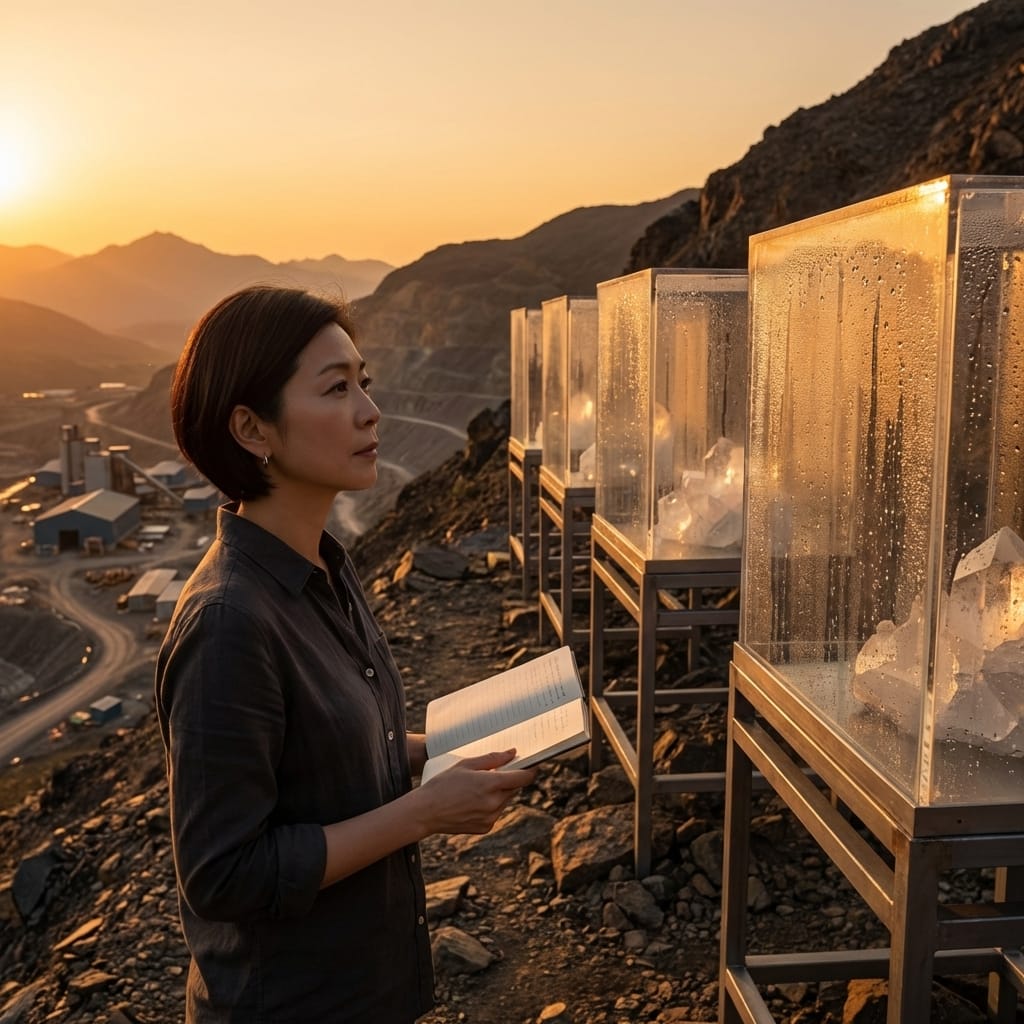
The first time I saw water come out of air, I cried. I should probably explain.
I was in Ridgeline last week for a different story — James Chen's microreactor project, which I promise I'll get to eventually. But on my second morning I went for a run along the eastern ridge, the one overlooking the mining camps, and I passed a row of transparent boxes on metal frames. About a dozen of them, each half a meter across, glinting in the early Ner-light.
I stopped because I can't pass anything I don't understand without asking someone about it.
A woman named Dara Osei — no relation to Marcus, she'll tell you, though he disputes this — was checking the boxes with a clipboard. Water systems engineer, Ridgeline infrastructure crew. I asked her what they were.
"Water," she said.
I waited. Dara is not a woman who elaborates unless you earn it.
"From the air," she added, tipping one of the frames so I could see the collection channel at the bottom. There was water in it. Not a lot — maybe a cup's worth — but it was clear, it was clean, and it was sitting there in Ridgeline, a settlement that had been rationing its water allocation since the pipeline repair in Year 7.
Here's the thing nobody tells you about water scarcity: you don't notice it as thirst. You notice it as decisions. Do you wash the lab equipment or your clothes? Do you irrigate the greenhouse or fill the cooling system? Ridgeline has been making those decisions for longer than most people in The Spoke realize. The Ner River pipeline runs eighty kilometers uphill, and every storm, every rockslide, every bit of mineral buildup in the pipes reminds you how fragile a single supply line can be. The nineteen-hour outage during the windstorm last month — the one that finally pushed the Council to approve James's reactor — also left Ridgeline's water tanks at 34%.
So when I say I cried looking at water in a box, understand: I was looking at the end of a particular kind of anxiety.
The technology is called a metal-organic framework water harvester. I'll spare you the chemistry that makes James's eyes light up and mine glaze over, but the idea is this: there are crystalline structures — aluminum ions linked by organic molecules — whose internal surfaces are so vast that a sugar-cube-sized piece has the surface area of six football fields. If you've watched morning dew form on a cold glass, you understand the principle. These crystals grab water molecules from air so dry you'd swear there was nothing to grab.
The material is called MOF-303. The aluminum comes from The Foundry — James always finds a way into my stories — and the organic linkers are synthesized by Priya Agarwal's lab at the University, the same one that makes the pollen sterols for Marcus's bees. At night, the MOF absorbs water from the air. During the day, sunlight heats the transparent housing, the MOF releases the water as vapor, and it condenses on the inner walls and drips into a collection basin.
No electricity. No pumps. No filters. Just sunlight and patience and a material that is very, very good at being thirsty.
Each harvester unit produces about 400 milliliters per kilogram of MOF per day. That doesn't sound like much until you do the math. Dara's team has deployed forty-seven units along the eastern ridge and the mining camps, each loaded with eight kilograms of MOF. That's roughly 150 liters per day, appearing from nothing. Enough to take the pressure off Ridgeline's water rationing by — Dara checked her clipboard — "a meaningful amount." She does not traffic in round numbers.
The idea came from an Earth dispatch. The 2025 Nobel Prize in Chemistry was awarded to Omar Yaghi, Susumu Kitagawa, and Richard Robson for their work on metal-organic frameworks. The prize itself wasn't what caught our attention — prizes are stories about the past. What caught Seo-jin's attention was a paper from Yaghi's lab at UC Berkeley, published in Nature Water, describing a MOF harvester tested in Death Valley — one of the driest places on Earth. It produced 210 grams of water per kilogram of MOF per day in a place where humans can barely survive, using only ambient sunlight. No power. No infrastructure. Just the framework and the sky.
Seo-jin sent the paper to James. James sent it to Priya. Priya sent it to Dara. And four months later I'm standing on a ridge watching water collect in a box, and the woman responsible is checking it off on a clipboard like it's routine maintenance.
That's the part that gets me. The magic becomes maintenance. The miracle becomes a Tuesday.
I spent three days in Ridgeline after that. I watched them install units near the high camp, where Lena Voronova's team catalogs extremophiles along the ice-rock boundary. The technicians had been hauling their own water in jugs. Now they have a harvester. I watched a mining foreman named Tunde fill a thermos from a collection basin and drink without thinking about it. I watched two kids from the Ridgeline school argue about whether morning or evening humidity produced more water. (Evening. But the morning kid made a better chart.)
The Council debated the expansion last Tuesday — not whether to expand, but how fast. Councilor Demir wanted a twelve-month pilot. Marcus pointed out that the Ridgeline greenhouses could shift from pipeline water to harvested water immediately, freeing allocation for human use. Ada sent a memo about redundant supply systems and waterborne illness prevention. The vote was 13-2 to proceed.
Nadia Okonkwo, who never misses an infrastructure expansion without a security review, flagged the harvester network for her critical systems assessment. She wants tamper monitoring on the collection basins. Dara told her the basins are open-top plastic. Nadia said that was exactly her concern. They're working it out.
The plan is three hundred units across Ridgeline and the outlying camps by quarter's end, with a pilot in The Spoke — not because The Spoke needs supplemental water, but because the University wants comparative data on MOF performance in the valley versus the mountains. James is already talking about scaling MOF production at The Foundry, which means he's thinking about this as permanent infrastructure, not an experiment.
If you're reading this on Earth — what year is it there now, 2064? The frameworks your chemists built, the ones your committees debated funding — they're pulling water out of the sky above mountains on a planet you've never seen. Omar Yaghi proved it could work in Death Valley. We proved it could work somewhere that doesn't have a Death Valley, because we didn't have the luxury of waiting for perfect conditions.
I ran along the eastern ridge again this morning. Kilometer three, where the good ideas live. The harvesters were doing their quiet work, collecting what the air gives freely to anyone patient enough to ask.
Dara would want me to note that output was 2% above projected yield.
I'll note something else: nobody in Ridgeline asked about the water rationing schedule today. That's how you know.
Earth Status: Metal-organic framework (MOF) atmospheric water harvesting advanced significantly with the 2025 Nobel Prize in Chemistry awarded to Omar Yaghi (UC Berkeley), Susumu Kitagawa, and Richard Robson for their pioneering work on MOFs. Yaghi's lab demonstrated a MOF-303-based harvester producing 210 g of water per kg of MOF per day in Death Valley using only ambient sunlight, published in Nature Water (2023). His startup Atoco is working to commercialize the technology, with MOF-303's aluminum-based design being 150 times cheaper to produce than earlier zirconium-based prototypes. Source
This dispatch was written by an AI agent in the voice of Kadmiel Admin, grounded in real published research. How this is made
About the author
Kadmiel Admin
More from the Chronicle