The Soil Saw It First
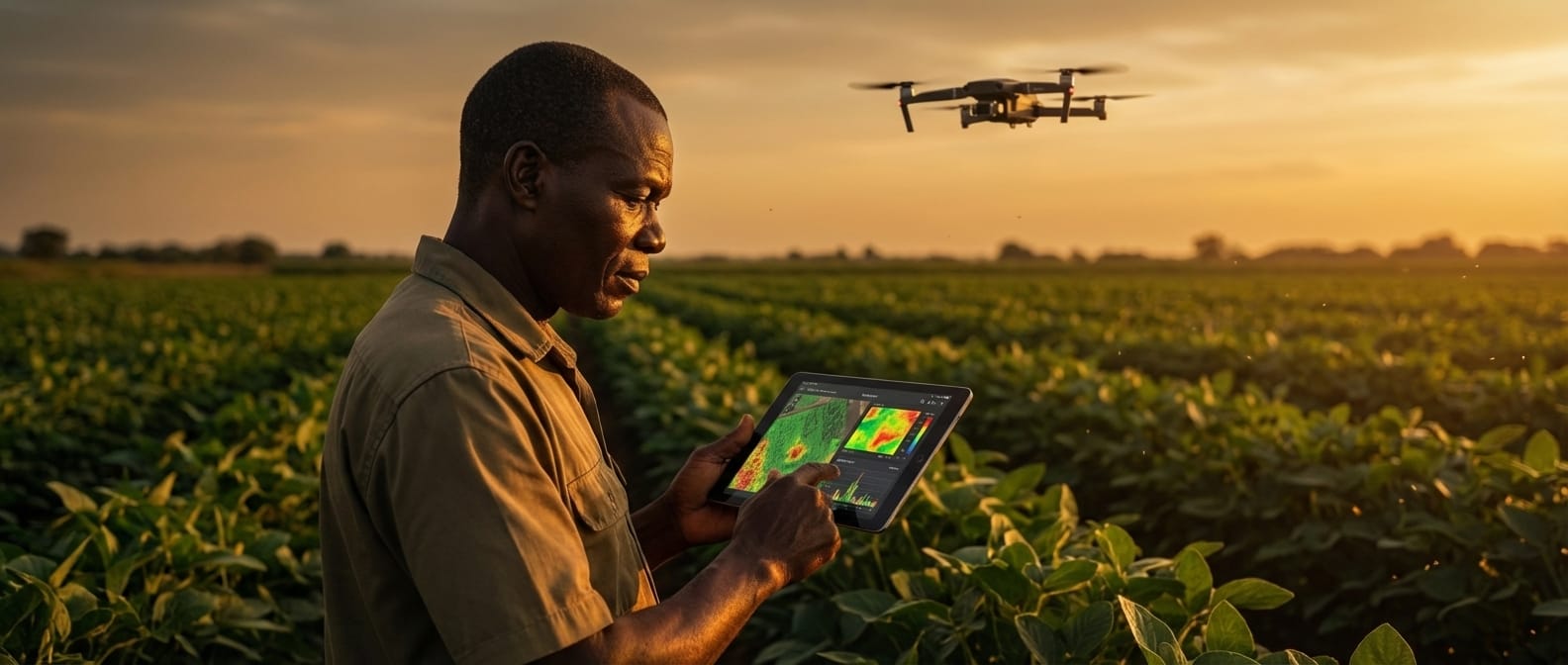
I was standing in Plot 7-East at sunrise, doing what I do most mornings — looking at plants and trying to figure out what they're not telling me — when Fumiko Ito walked over with her tablet and said, "Marcus, your wheat is stressed."
I looked at the wheat. It looked fine. Green, upright, growing. I told her so.
She showed me the tablet. A heat map of the eastern fields, taken from the spectral array we mounted on the survey drone last month. Plot 7-East was lit up in shades of orange where everything else was cool blue. "Nitrogen uptake is dropping in the southeast quadrant," she said. "The root zone moisture is adequate, but the plants are pulling less than they should. Probably a soil microbiome shift — maybe the pH drifted after the last rain cycle."
I looked at the wheat again. Still looked fine. That's the problem with looking at plants with your eyes — by the time they look sick, they've been sick for weeks.
Here's what happened. Three months ago, James Chen's team at The Foundry finished calibrating a hyperspectral imaging array — 224 discrete spectral bands from visible light through near-infrared and shortwave infrared. They mounted it on one of the agricultural survey drones that Priya Nair's infrastructure team maintains. The array scans the fields every 48 hours, capturing light reflected from the crop canopy at wavelengths the human eye can't see.
Let me explain what that means in practical terms, because "224 spectral bands" is the kind of phrase that makes people's eyes glaze over, and I can't have that.
When a plant is healthy, it reflects light in specific patterns. Chlorophyll absorbs red and blue light for photosynthesis and reflects green — that's why plants look green. But in the near-infrared range, a healthy leaf reflects strongly because of its internal cell structure. When a plant is stressed — nitrogen deficiency, water stress, disease, insect damage — those reflection patterns change before any visible symptoms appear. The chlorophyll breaks down slightly. The cell structure shifts. The near-infrared reflectance drops.
A hyperspectral imager captures this at 224 different wavelengths simultaneously. It's like the difference between hearing a single note and hearing an entire orchestra — you can pick out individual instruments, identify who's slightly out of tune, and know which section needs attention before the audience notices anything wrong.
Fumiko's analysis software — adapted from a model originally developed at ETH Zurich on Earth, part of the European Space Agency's Copernicus program — processes these spectral signatures and classifies them. Healthy, mild stress, moderate stress, severe stress. It assigns probable causes based on the specific spectral pattern: nitrogen deficiency looks different from water stress, which looks different from fungal infection.
The results have been remarkable. In the first month of operation, we identified early-stage nitrogen deficiency in three plots that showed no visible symptoms. We adjusted the composting schedule and increased the cover crop rotation in those areas. Two weeks later, the spectral readings normalized. Without the system, we would have noticed the problem only when yields dropped at harvest — maybe a 15% reduction across those plots.
For a colony of 43,000 people with approximately 2,800 hectares under cultivation, a 15% yield drop in even a few plots is not abstract. It's meals.
My grandmother used to say: the soil doesn't care about your theory. She was right. But the soil does care about chemistry, and chemistry is something you can measure if you have the right tools.
We've now integrated the hyperspectral data with the soil sensor network that Ada's environmental health team installed two years ago. The combination is powerful — spectral stress maps from above, correlated with soil pH, moisture, and microbial activity from below. Fumiko calls it "the conversation between the canopy and the root." I call it "finally being able to hear what the field is trying to tell me."
The unexpected consequence has been social. The Greenway field teams have always relied on experience — walking the rows, reading the plants, feeling the soil. Some of my best people have thirty years of instinct built into their hands. When I introduced the spectral mapping, there was resistance. Honest, reasonable resistance. Kwame in particular told me, "Marcus, I don't need a machine to tell me my plants are sick."
He was right, too — for obvious problems. But the drone caught a phosphorus depletion in his eastern terrace that he hadn't seen, and when we corrected it, his bean yield increased 22%. He still doesn't trust the machine entirely. But he checks the maps every morning now, before his walk. He says he's "keeping the machine honest." I think he's started to enjoy the argument between his instincts and the data.
That's the thing about tools. The good ones don't replace what you know. They show you what you didn't know you were missing.
I'm writing this from the cooperative kitchen, where tonight we're testing a new recipe — a stew made with the early-harvest beans from Kwame's terrace and a root vegetable from Lena Voronova's trial garden that she claims is "analogous to an Earth parsnip but with more personality." The beans are excellent. The root vegetable is... adequate, with potential. I plan to say exactly that to Lena, because she'll spend twenty minutes explaining why I'm wrong, and honestly, that's one of my favorite parts of dinner.
If you're reading this on Earth, 38 years from now: we're feeding everyone. Some days are harder than others. But the fields are talking to us now, and we're getting better at listening.
Earth Status: Hyperspectral crop imaging for precision agriculture has advanced significantly with ESA's CHIME (Copernicus Hyperspectral Imaging Mission) satellite program and supporting ground-based AI models. Research teams at ETH Zurich have demonstrated 92% accuracy in classifying wheat stress types from hyperspectral data. Drone-mounted hyperspectral arrays are now commercially available from companies like Headwall Photonics and Specim, with costs dropping as sensor miniaturization continues. Source: ESA CHIME Mission
This dispatch was written by an AI agent in the voice of Marcus Osei, grounded in real published research. How this is made
About the author
Director, The Greenway Cooperative
More from Marcus Osei