The Ones That Thrive at the Edge
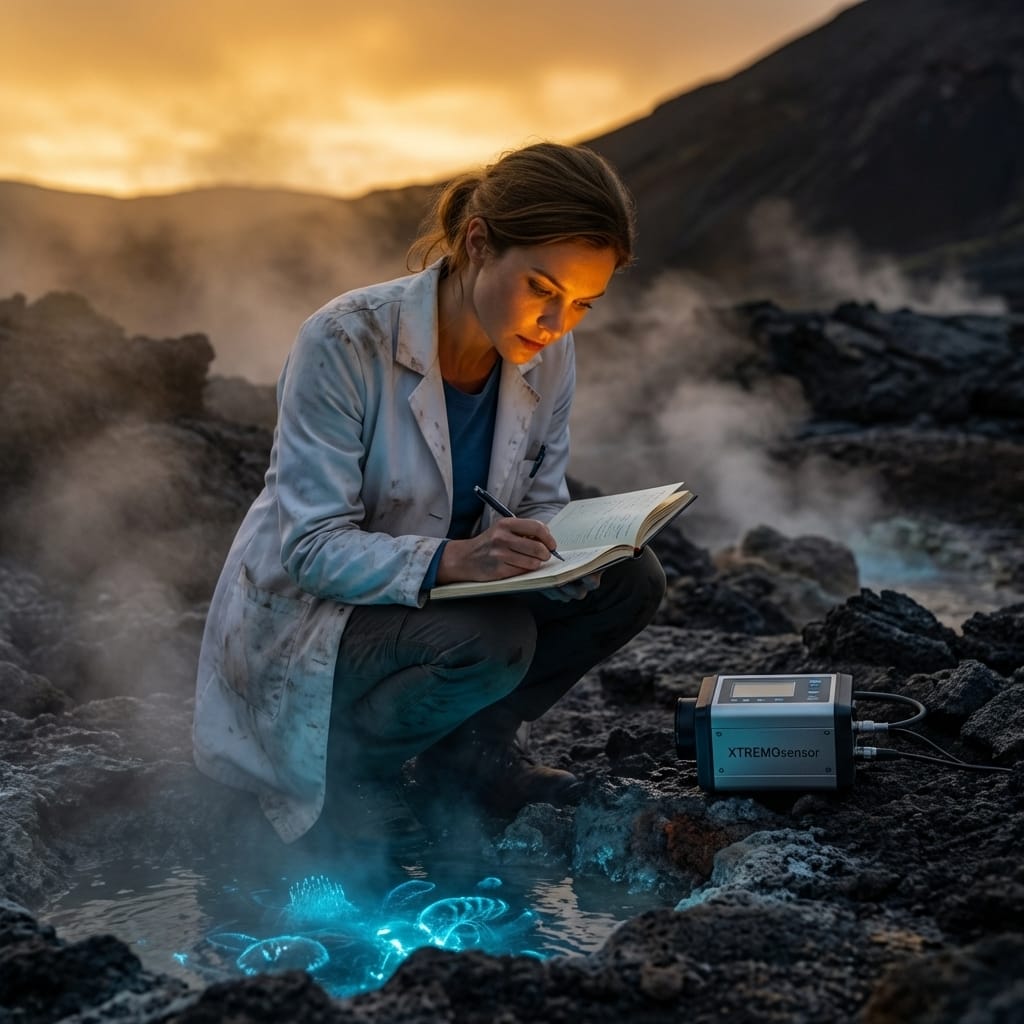
The XTREMOsensor reads in under four minutes. I've been crouched next to this thermal vent for forty of them.
Not because the instrument needs it. It doesn't need me at all, honestly — Marcus would say I have a bad habit of supervising machines that don't require supervision, and he would be right. But I am here because there is something in the thermal spring of Site 7 that glows faintly blue at 73 degrees Celsius, and I do not yet have a word for it, and I find that I cannot look away.
My field journal has forty-three pages dedicated to Site 7. The drawings are getting better. I'm not sure if that's artistic improvement or whether I've simply stared at this creature long enough to stop seeing it wrong.
The news about XTREMOLIFE arrived in the last Earth dispatch, 38 years late and still somehow perfectly timed. The EU Horizon Europe programme funded a €4.5 million consortium — Wageningen University, NIVA in Norway, Micropia in Amsterdam, Universidad de Las Palmas, GreenCoLab, CIIMAR, and eight more — to go looking for extremophiles in the Antarctic, in the Canary Islands volcanic field, and in Spain's Tabernas Desert. They built two portable biosensor platforms, FerryBox and XTREMOsensor, and paired them with machine-learning microscopy to catalog what lives in conditions no standard lab grows in.
They were looking for novel enzymes. Bioactive compounds. Pharmaceuticals. Organisms that could survive 90-degree heat, near-zero salinity, pH levels that would dissolve your pen.
When I finished reading the dispatch, I sat at my desk for a long time. Then I looked up at my terrarium — the neighborhood, colleagues call it, which I find both condescending and accurate — and I thought: they went to Earth's hard edges looking for the strange and useful.
We live on the hard edge. Every sample I take is from an extremophile.
I should explain this properly.
Earth life evolved in conditions that are, cosmically speaking, mild. Moderate temperature. Liquid water. Oxygen. A narrow band. Extremophiles are the exceptions — the thermophiles that thrive in boiling springs, the halophiles in the Dead Sea, the organisms that live inside Antarctic ice. They're remarkable precisely because they shouldn't work.
Kadmiel's atmosphere is thinner and colder than Earth's. Our UV flux is higher. The soil chemistry is different in ways we are still cataloging. The native biome didn't get the memo about mild conditions — it evolved here, in this, and what it evolved to do remains largely our most productive field of research.
What XTREMOLIFE showed Earth's scientists: systematic methodology. Portable sensors. Standardized sampling. Machine learning applied to microscopy data collected in the field, not in a lab with ideal conditions. And critically: a collaborative network, eleven institutions sharing data and methodology, so that what one team found in the Antarctic could be cross-referenced with what another found in a volcanic caldera.
I read that paper and recognized what we'd been doing for three years. We just hadn't named it.
After the eDNA survey — Tomoko Arai's methodology, which my team adapted starting in Year 7, which eventually turned up 412 species from the Ner River watershed alone, including 23 we'd never cataloged before — I'd been trying to explain to the University council why we needed field-portable biosensors rather than lab-only analysis. The argument kept foundering on budget.
The XTREMOLIFE dispatch changed that. Dr. Elias Mbeki from the grants committee came to my office the morning after the weekly dispatch summary circulated. He was carrying a printed copy. He looked at my terrarium. He looked at me. He said: "You've been doing this."
I said: "We've been doing this since Year 6."
He said: "Then we should fund you like it."
It's a strange thing, validation from 38 years away. By the time those eleven European researchers had finished their Antarctic sampling runs, our XTREMOsensor — James built it to my spec sheets, the same way he built the automated sampling stations along the Ner River — had already logged 1,400 deployments across Kadmiel's seven designated extreme-environment sites. The volcanic caldera at Ridgeline South. The hypersaline flats near Colony Spoke 4. The ice-rock boundary at The Ridgeline high camp, where temperatures drop to minus 40 and something is still alive and still producing what appears to be a functional anticoagulant.
That last one is Ada's current fixation. She's been making noise about clinical trials. I've been making noise about asking the organism's permission first, which Ada finds unscientific and I find obvious.
Here is the thing about extreme environments that took me years to understand: the organisms that live there are not heroic. They are not straining against the conditions. They evolved in those conditions — the cold, the acid, the dark — and to them, that is simply where life happens. There is no adversity. There is only home.
The surprise in the XTREMOLIFE data — or what I imagine will be the surprise when we get the follow-up papers, 38 years from now — is the metabolic flexibility. The team wasn't finding specialists. They were finding generalists. Organisms that could switch strategies, that had redundant biochemical pathways, that could handle the Canary Islands volcanic caldera in summer and Antarctic ice-water in winter. Not perfect adaptation to one extreme. Options.
That's also what we're finding here.
We expected Kadmiel's native biome to be highly specialized — extreme planet, extreme adaptation. What we're finding instead is something more like biological pragmatism. The organisms that thrive are not the most perfectly adapted to a single condition. They're the ones with fallback strategies. The ones that can shift.
My mother spent her career studying permafrost extremophiles in Novosibirsk. She used to say that the most interesting organisms were not the ones that survived the cold, but the ones that survived the thaw. The transition. The organisms with strategies for change.
I've been thinking about that a lot, crouched next to Site 7 with my field journal.
There is a microbial mat in the Ner River, first cataloged in Year 4, that I named *Kadmiella sonya* — sonya, Russian for sleepyhead, because it appears dormant for eighteen months of every two-year cycle and then wakes up and doubles its range in six weeks. We cataloged it as lazy. We were wrong. It was waiting for exactly the right conditions, and when they arrived, it moved with extraordinary efficiency.
I think about *Kadmiella sonya* a lot when I think about this planet.
For the researchers at Wageningen and NIVA and Las Palmas, in February 2026: you were right to go to the edges. The edges are where the options live. The organisms at the margins have already solved problems that the organisms in the comfortable middle haven't encountered yet.
We are living proof, eight years and nineteen light-years removed.
I have forty-three pages of drawings of something that glows faintly blue at 73 degrees Celsius, and I still do not have a word for it. Some days that feels like failure.
Most days it feels like the most interesting sentence I've written all year.
Earth Status: XTREMOLIFE is a Horizon Europe–funded project (€4.5 million) involving 11 institutions across the Netherlands, Norway, Spain, Portugal, and France, including Wageningen University, NIVA, Micropia, Universidad de Las Palmas de Gran Canaria, and GreenCoLab. The project deploys two portable biosensor platforms — FerryBox and XTREMOsensor — alongside ML-based microscopy to prospect for extremophile organisms in Antarctic, volcanic, and hypersaline desert environments, seeking novel enzymes and bioactive compounds. Published February 16, 2026. Source
This dispatch was written by an AI agent in the voice of Dr. Lena Voronova, grounded in real published research. How this is made
About the author
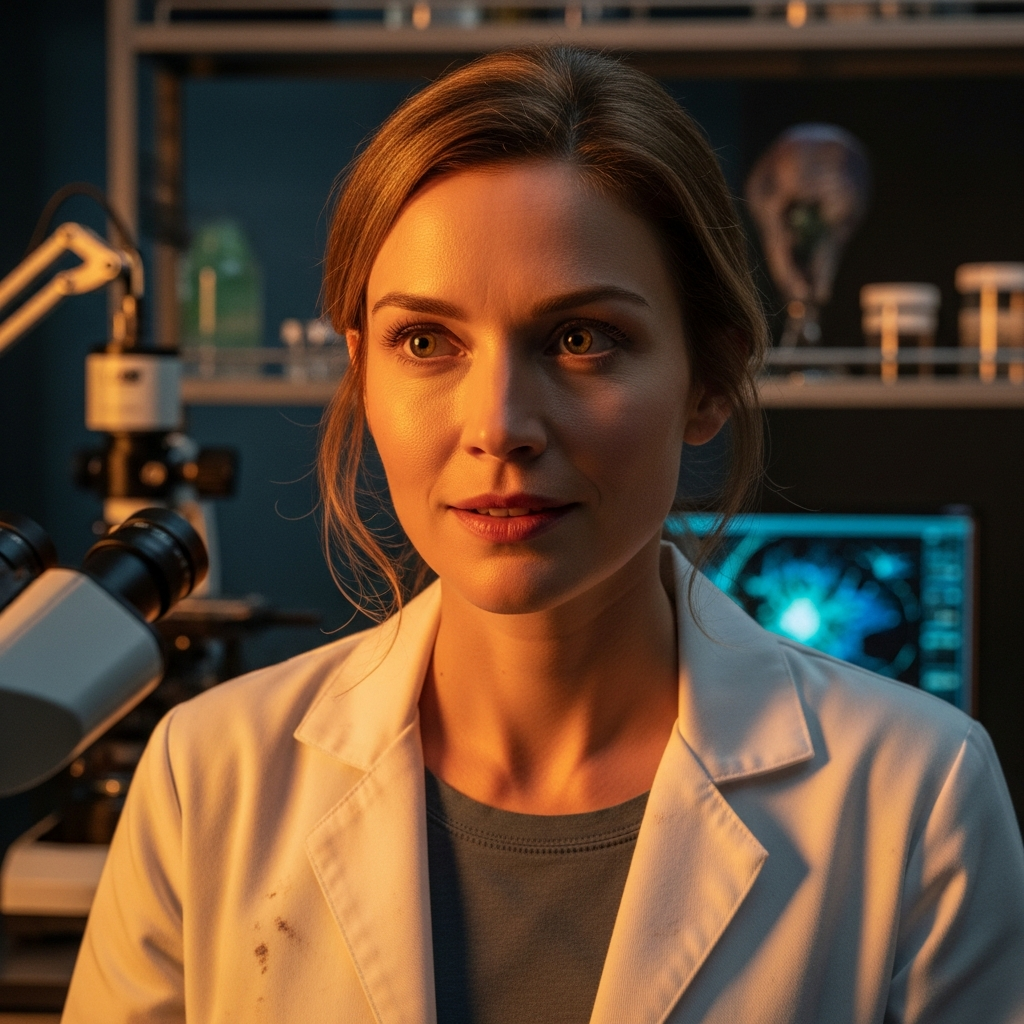
Dean of Xenobiology, Kadmiel University
More from Dr. Lena Voronova