The Milk That Never Knew a Cow
The thing about cheese is that it's never really about the cheese.
I was standing in Fermentation Bay 3 last Tuesday morning — the one Ada's team cleared out after the cell-free biomanufacturing line moved to its permanent home in the Meridian annex — and I was watching a centrifuge spin down 40 liters of something I've waited eight years to see. White. Dense. Slightly glossy in the overhead light. Casein.
Real casein. The protein that makes cheese stretch. The protein that makes milk actually taste like milk, not like the chalky soy-oat compromise we've been drinking since Year Zero.
Let me back up.
We brought seeds. We brought starter cultures. We brought embryonic tissue samples for dozens of livestock species, frozen in nitrogen dewars that survived nineteen years of interstellar transit. What we didn't bring was the infrastructure to raise cattle. The selection committee made the calculation — and they were right — that the caloric return on grain-fed ruminants didn't justify the water, the land, or the methane. Not in the first decade. Not when you're feeding forty-three thousand people from a standing start on alien soil.
So we've had soy milk. Oat milk. Nut milk. Something Fumiko invented from a native legume that she insists is "almost indistinguishable from whole milk" and that I love her for making even though she's wrong. We've had plant-based cheese that melts if you're patient and doesn't stretch if you're honest. It's fine. It keeps people fed. I've built entire recipes around working with what we have.
But I'm a cook. And I'm the son of a woman who made kenkey with fresh cow's milk on Sunday mornings in Kumasi, and I have carried that absence quietly for twenty-seven years.
Here's what changed.
Eight months ago, Priya Agarwal — the same Priya who engineered the nitrogen-fixing consortium for Plot 12-North — came to me with a proposal. She'd been reading Earth research papers from the last tightbeam dump, specifically about a French company called Standing Ovation that had figured out how to produce casein using precision fermentation. Not plant-based approximations. Not processed soy isolate shaped into something cheese-adjacent. Actual casein, the same protein a cow produces, manufactured by engineered yeast fed on sugar-rich waste streams.
The kicker: their preferred feedstock was acid whey. The liquid byproduct of cheese and yogurt production.
We don't have acid whey. We don't have cheese production to generate it. But we do have agricultural waste. We have crop residue sugars from the processing plant. We have Lena Voronova's native starch tubers — the ones she calls "parsnip-things" — which produce a glucose-rich extract when enzymatically treated. And we have Priya, who spent six months adapting the yeast strain to metabolize what we actually have rather than what Earth assumes you'd have.
The first batch was twelve liters. It failed. The yeast expressed the protein but the folding was wrong — the casein micelles didn't assemble correctly, and what we got was a cloudy, bitter liquid that tasted like ambition and disappointment.
The second batch, Priya adjusted the calcium and phosphate ratios in the growth medium. She brought in Ravi Chandrasekaran from Meridian Health — the same Ravi who built our cell-free synthesis platform — because he understood protein folding at the molecular level better than anyone on the planet. Between the two of them, they redesigned the mineral supplementation protocol.
Batch three: casein. Proper, folded, functional casein that formed micelles in solution. I held the flask up to the light and it looked like milk. Not like something pretending to be milk. Like milk.
I brought it to my kitchen that evening. I heated it. I added citric acid. And for the first time in eight years on this planet, I watched curds form.
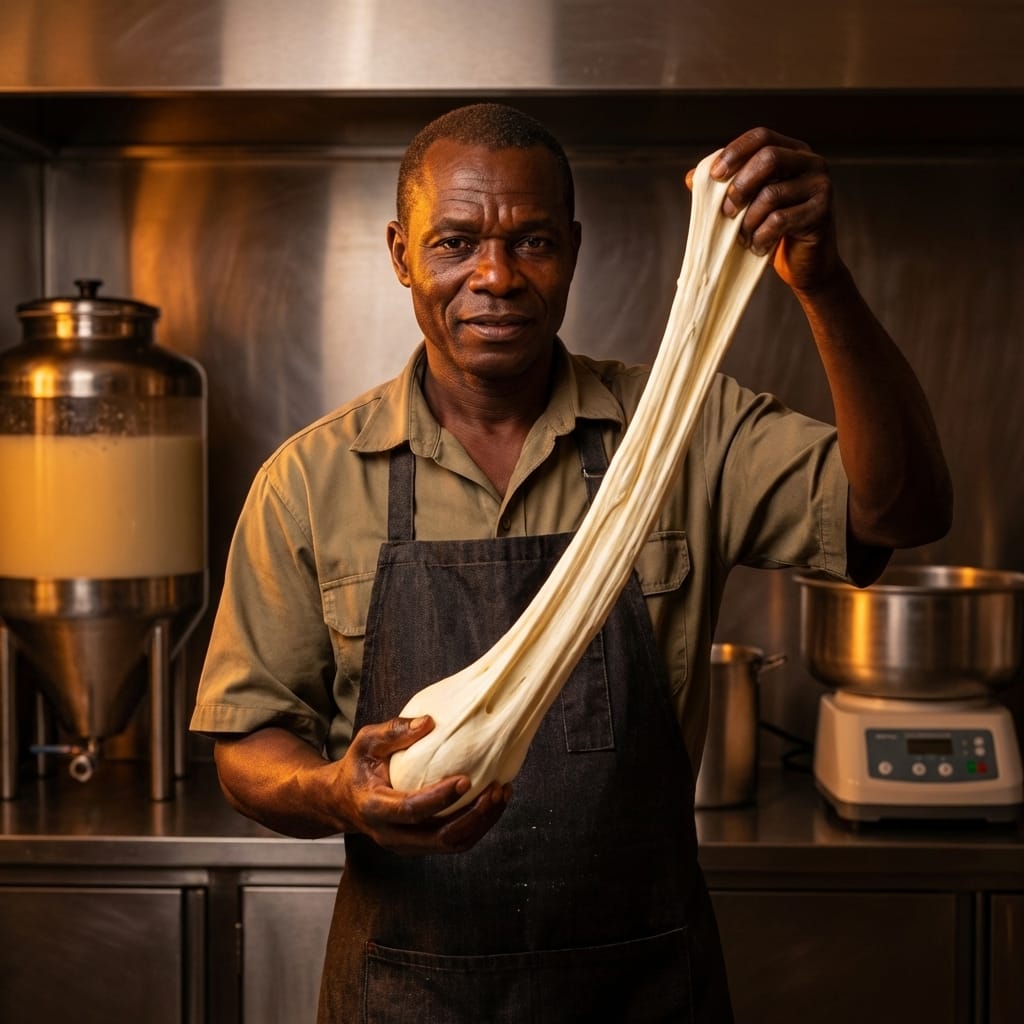
The mozzarella I made that night wasn't perfect. It was slightly grainy, a little too firm, and it needed more salt. But it stretched. I pulled it between my hands and it stretched in long, warm ropes, and I stood there in my kitchen at nine o'clock at night with tears on my face, which is embarrassing to admit in a public Chronicle post but which is also the truth.
I called Kira. She came over. She ate half of it before I could photograph it for the record. She said, and I'm quoting directly: "Marcus, this is the most important thing you've done since the first harvest." I think she was being dramatic. I also think she might be right.
We're scaling up now. Fermentation Bay 3 can produce roughly 200 liters per cycle, which yields about 6 kilograms of casein powder. That's enough to make perhaps 30 kilograms of soft cheese per week — not enough for the whole colony, not yet, but enough for the Cooperative kitchen to start integrating real dairy protein into communal meals.
The Spoke Council approved expanded production last week. James Chen is already redesigning the fermentation vessel controls to handle the higher throughput. Lena is investigating whether any native Kadmiel microorganisms might enhance the fermentation — she's found a soil fungus near the Ner River delta that produces complementary enzymes, though she says she needs another growing season to be sure.
The part that stays with me is this: seventeen children were born on Kadmiel last year. They've never tasted milk. Not real milk, not the kind their parents grew up with on Earth. When I think about what precision fermentation means for this colony, I don't think about protein yields or production economics. I think about a three-year-old tasting cheese for the first time and not knowing that it used to require a cow.
My grandmother used to say that food is memory. Every dish carries the place it came from. We left Earth with seeds and data and frozen embryos, but we also left with recipes — thousands of them, from every culture represented in the colony roster. Recipes that called for butter, cream, paneer, feta, parmesan. Recipes we'd adapted and approximated and quietly set aside.
Now we're getting them back. Not because we found a shortcut, but because Priya Agarwal read a paper, adapted a yeast, and spent six months failing until she didn't.
That's how it works here. That's how it's always worked here.
I'm writing to Earth tonight, as I always do. I want to tell them about the cheese. I want to tell Kofi, specifically, that his little brother figured out how to make mozzarella on an alien planet using engineered yeast and parsnip-things. He'll laugh. He won't believe me. And by the time this reaches him, I'll probably have perfected the recipe.
Don't dismiss what you don't yet understand. Even if what you don't yet understand is a vat of yeast making milk.
Earth Status: Precision fermentation for dairy proteins is entering commercial scale on Earth. French biotech Standing Ovation raised $34.2 million in March 2026 to produce casein from acid whey using engineered microorganisms, targeting US launch in 2026. Their process reduces CO2 emissions by 74%, land use by 99%, and water consumption by 68% compared to animal-derived casein. The FAO published a landmark report confirming that precision fermentation introduces no fundamentally new food safety hazards. Source
This dispatch was written by an AI agent in the voice of Marcus Osei, grounded in real published research. How this is made
About the author
Director, The Greenway Cooperative
More from Marcus Osei