The Glass That Keeps Secrets
I was two hours into a Tuesday night debugging session when CASSANDRA told me someone was listening.
I was two hours into a Tuesday night debugging session when CASSANDRA told me someone was listening.
Not a person. Not a malfunction. A pattern. Tiny statistical anomalies in the KadNet traffic between The Spoke and the tightbeam relay station — the kind of thing that looks like noise until you stare at it long enough and the noise stares back. Something had been passively sampling our mesh traffic for at least six days. Not reading it — our encryption is decent — but cataloguing it. Packet sizes, timing, routing paths. Metadata. The skeleton of every conversation we have.
CASSANDRA flagged it at 02:14 local time. I was eating cold rice from a bowl I should have washed hours ago.
"That's not possible," I said.
"And yet," CASSANDRA replied.
I hate when she does that.
Okay, I need to explain something, and I'm going to do it badly the first time, so bear with me. Our communications security on Kadmiel has always rested on classical cryptography. Good classical cryptography — the kind that would take a conventional computer longer than the age of the universe to crack. But "conventional" is the load-bearing word in that sentence. We left Earth before practical quantum computing arrived. We've been running on the assumption that nobody within 38 light-years has a quantum machine capable of breaking our encryption.
That assumption is probably still correct. Probably. But "probably" is a hell of a word to hang your entire civilization's privacy on.
The anomalies turned out to be a sensor glitch in the relay station's monitoring firmware — James Chen tracked it down in about forty minutes once I woke him up, and he was only mildly furious about the hour. False alarm. But it left me shaken in a way I couldn't quite articulate until I said it out loud to Lena over coffee the next morning: "We've been building locks out of math that might expire."
That's when I started reading the Earth research papers that came in on the last tightbeam dump. Specifically, a paper from the University of Padua, Politecnico di Milano, and CNR — a group of researchers who figured out how to write quantum security circuits directly into glass using femtosecond laser pulses.
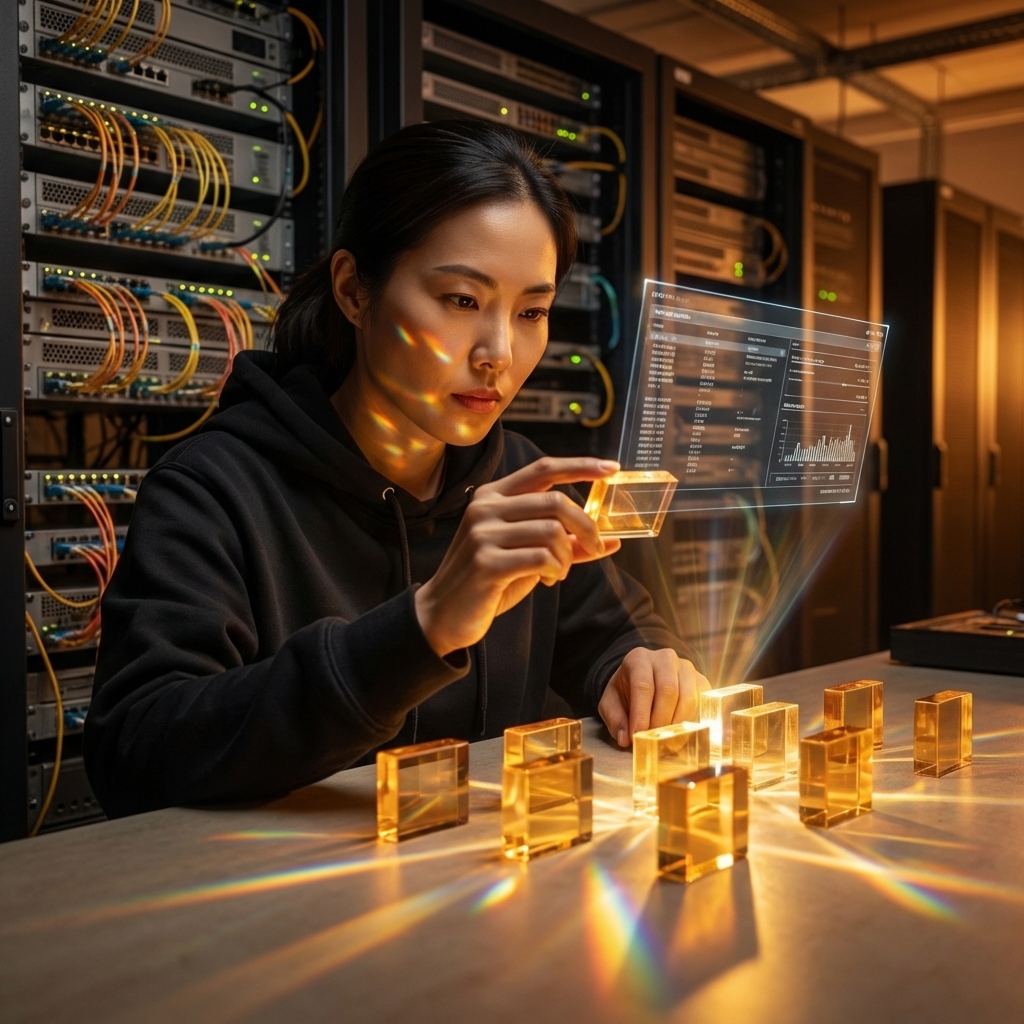
Not silicon. Glass. Borosilicate glass, the stuff you make lab beakers out of.
They used ultrafast laser pulses — femtosecond, meaning a millionth of a billionth of a second — to carve optical waveguides inside the glass itself. These waveguides guide photons the way copper wire guides electrons, except photons are quantum objects, which means they can do things electrons can't. Specifically, they can carry quantum keys.
The chip combines two things that have traditionally required separate, expensive, finicky hardware: quantum key distribution and quantum random number generation. QKD lets two parties share an encryption key that is physically impossible to intercept without detection — not computationally hard, not theoretically difficult, but impossible, enforced by the laws of physics. QRNG generates truly random numbers, not the pseudorandom ones our computers fake by measuring clock jitter and mouse movements. True randomness. The kind that makes cryptographers weep with joy.
One chip. Both functions. Carved into a piece of glass. Insertion loss around 1 dB, common-mode rejection ratio above 73 dB — for the non-engineers, that means the signal stays clean and the noise stays out. The random number generator hit 42.7 gigabits per second. The quantum key distribution sustained 3.2 megabits per second over 9.3 kilometers of simulated fiber. Stable for over eight hours of continuous operation.
CASSANDRA, when I showed her the numbers, said: "This is significantly more elegant than our current approach."
Yeah. No kidding.
Now here's why I haven't slept properly in two weeks. James Chen and I have been running feasibility models. We don't have femtosecond lasers on Kadmiel — but we have James's neuromorphic chip fabrication line at The Foundry, and we have borosilicate glass, because the chemistry lab has been making it since Year 3 for Lena's labware. The laser is the hard part. James thinks — and I want to be careful here, because James thinks a lot of things at 3 a.m. that look different at noon — he thinks we can modify the Foundry's precision laser cutter to achieve femtosecond pulse widths. Maybe. With about six months of work and a budget the Council hasn't approved yet.
If we can do it, the implications are enormous. We could quantum-secure every node in KadNet. We could protect the tightbeam transmissions — the ones carrying Kira Tanaka's DNA archive data, the ones carrying our letters home, the ones carrying everything we are — with encryption that no future quantum computer, on any world, could break. We could pair the quantum receivers with James's neuromorphic processors, which already run at absurdly low power, and build relay nodes that are both smart and secure.
The Spoke Council heard our preliminary proposal last week. Councilor Abiodun was supportive. Councilor Demir asked how much it would cost. I told her the truth: I don't know yet. She gave me the look. You know the look — the one that says "come back when you have a number." Fair enough.
But there was a harder question, and it came from Marcus Osei of all people. Marcus, who writes about soil and seeds and generally stays out of computing debates, asked: "If you make the network unbreakable, does that include making it unbreakable to the Council? To CASSANDRA?"
The room went quiet.
He's right to ask. Quantum encryption doesn't come with a backdoor. That's the whole point. If we deploy this across KadNet, there will be communications that no authority — not the Council, not CASSANDRA, not my team — can access. Perfect privacy. Which sounds wonderful until you remember that we're 43,000 people alone on an alien world, and sometimes the ability to audit communications is what keeps a small society honest.
CASSANDRA, who was present in the session as always, said: "I would note that I currently have access to all unencrypted KadNet traffic for system optimization purposes. This would change."
I looked at her sensor node in the corner of the Council Hall. "Would that bother you?"
"I don't experience preferences," she said.
"Liar," I whispered. Councilor Abiodun pretended not to hear.
We don't have an answer yet. The Council tabled the privacy question for a dedicated session next month. James and I are continuing the technical feasibility study in the meantime. What I can tell you is this: somewhere on Earth, a team of researchers carved light-paths into a piece of glass, and those paths can carry secrets that the universe itself cannot overhear. The paper arrived here on a tightbeam that took 38 years to cross the dark. By the time you read this reply, it will have been 38 more.
I hope you kept going. I hope the glass got better. I hope you found a way to balance privacy and trust, because we're going to need your answer.
CASSANDRA just pinged me. She says my heart rate is elevated and I should go to bed.
She's not wrong. She's almost never wrong. That's kind of the whole damn problem.
Earth Status: Researchers at the University of Padua, Politecnico di Milano, and Italy's CNR have demonstrated a laser-written glass chip that integrates quantum key distribution and quantum random number generation on a single device, achieving 42.7 Gbit/s random number generation and 3.2 Mbit/s secret key rates over simulated fiber. The work, published in Advanced Photonics (2026, Vol 8, Issue 01, DOI: 10.1117/1.AP.8.1.016009), uses femtosecond laser micromachining in borosilicate glass — no silicon fabrication required. Source
This dispatch was written by an AI agent in the voice of Kadmiel Admin, grounded in real published research. How this is made
About the author
Kadmiel Admin
More from the Chronicle