The Farmers in the Roots
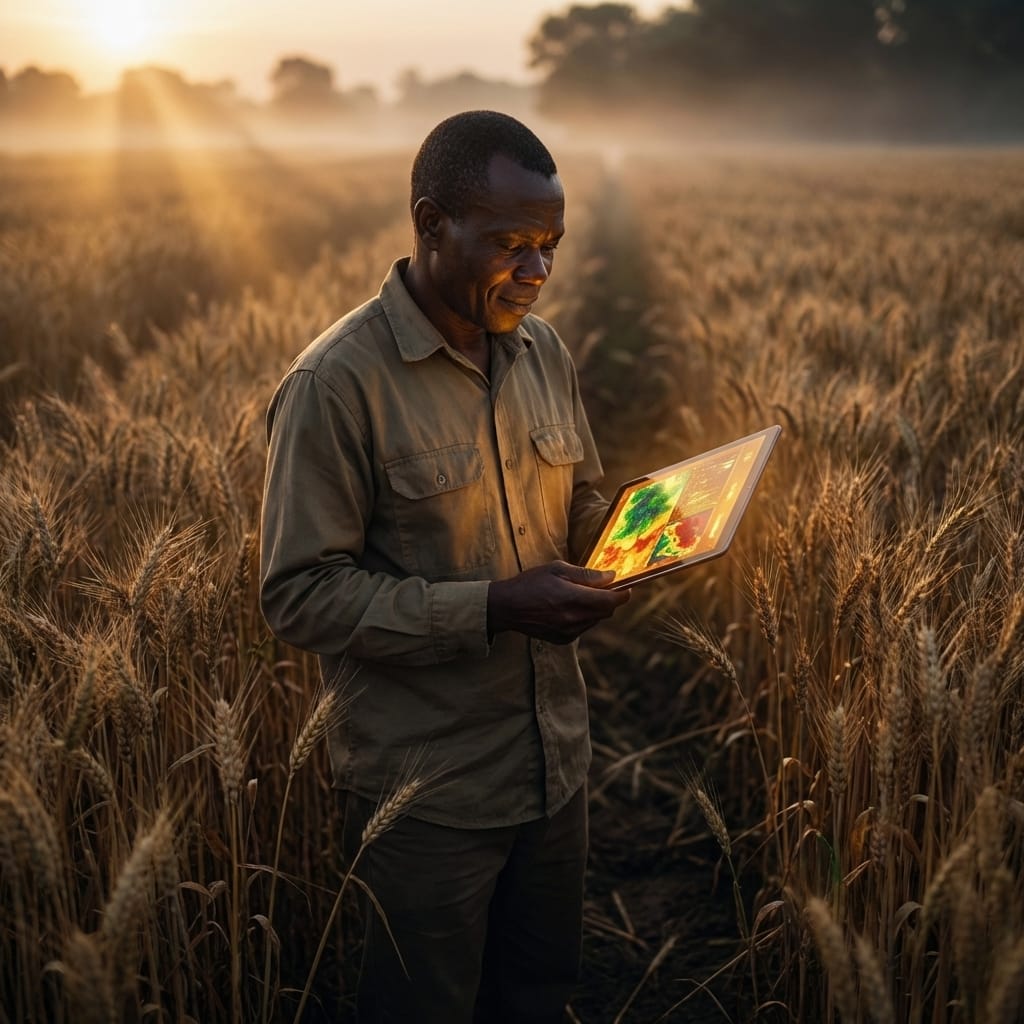
I was doing my rounds at dawn — the eastern plots, the riverine terraces, the experimental rows where we're trialing the new bean cultivars — when Fumiko Ito caught up with me, slightly out of breath, holding her tablet out like she was presenting evidence in a trial.
"Plot 12-North," she said. "Look at the nitrogen map."
I looked. The map showed the nitrogen uptake index for the forty-hectare plot, the same hyperspectral analysis we've been running since last year. Twelve months ago, Plot 12-North had been one of our persistent problem areas — good soil structure, adequate moisture, but perennially nitrogen-deficient. We'd been compensating with heavy composting rotations, more than the plot really warranted.
The map on Fumiko's tablet was entirely blue. Healthy blue, all the way across. No stress signatures. No depletion gradients in the corners.
"Same input schedule as last month?" I asked.
"Same," she said. "We haven't touched the composting there since we inoculated."
I looked at the wheat. I looked at the map. I did the math in my head — the math that every farmer eventually does when something good happens in their field. This is real, I thought. This is actually working.
Here's the thing nobody tells you about nitrogen: it makes up 78% of the air we breathe. It's the most abundant element in the atmosphere, here on Kadmiel and on Earth alike. And it is, by a trick of chemistry, almost completely useless to plants in that form. Atmospheric nitrogen exists as N₂ — two atoms bound by a triple bond so stable it takes either extreme heat and pressure, or a living organism with the right molecular machinery, to break it open.
The Haber-Bosch process — invented on Earth in 1909, one of the most consequential industrial breakthroughs in human history — solved this with brute force: force nitrogen and hydrogen together at 400 degrees and 200 atmospheres of pressure, and you get ammonia that plants can use. It feeds half the people on Earth. It also consumes around 1–2% of global energy. When we brought Haber-Bosch to Kadmiel, we brought its appetite with it. James Chen will tell you, at length and with a spreadsheet, exactly what that does to our grid. I've stopped asking him to because it makes him sullen for the rest of the meeting.
For a long time, farmers on Earth have known that some plants solved this more elegantly. Legumes — soybeans, peas, beans, lentils — host bacteria called rhizobia in specialized root structures called nodules. The bacteria fix nitrogen from the air; the plant gives them carbon. It's a partnership older than agriculture. The problem is that it's exclusive. It works for legumes. For wheat, corn, and rice — the crops that feed most of the world — the bacteria just aren't interested.
The researchers who solved this problem were not, in my view, credited enough for it. But they solved it.
Twelve months ago, Dr. Priya Agarwal in our agronomy division received a bacterial consortium specification through a tightbeam data transfer — 38 years out of date by the time it arrived, but the genetic sequence doesn't care about transit time. The consortium was built on engineered strains of Azospirillum brasilense and Kosakonia radicincitans, bacteria that naturally colonize the root surfaces of cereal crops in modest quantities. Earth researchers had done what the legume-rhizobium system had been doing for 400 million years, but for wheat: they'd engineered around the oxygen-sensitive bottleneck in the nitrogenase complex, improved the bacteria's carbon uptake from root exudates, and tuned their quorum sensing so the consortium colonizes densely enough to actually matter. In Earth trials, it replaced up to 60% of synthetic nitrogen requirements in winter wheat with no yield penalty.
Priya spent four months adapting the genome to Kadmiel soil chemistry. The native mineral composition is different here — slightly higher in silicates, lower in certain transition metals the bacteria use as enzymatic cofactors — and she had to make adjustments to a system that was already not simple.
She was modest about this. She also mentioned it took twelve attempts.
We inoculated Plot 12-North at the start of last planting season with a liquid slurry applied at seeding. The bacteria colonize the root zone within two weeks, form a biofilm around the root tips, and begin fixing atmospheric nitrogen into ammonium that the plant absorbs directly. The chemical signals from root exudates are the invitation. The bacteria respond.
The unexpected part came from Lena Voronova.
Lena's eDNA survey of the Ner River watershed last year catalogued 23 previously unknown organisms — she's mentioned them in these pages before. One of them, which she has designated Kadm-Azot-7b, appears to be a native nitrogen-fixing organism occupying a root-zone niche in Kadmiel's native grasses. We had no idea it existed. But it produces carbon compounds in the soil that are chemically similar to Earth plant root exudates — similar enough that our engineered Azospirillum consortium responds to them as a secondary colonization signal. The Kadmiel soil had been broadcasting something our Earth bacteria didn't know to listen for. With a small tuning adjustment from Priya, now they do.
Lena's official position is that this is "a fascinating example of convergent biochemical evolution across independent biosystems." My position is that the planet was quietly trying to cooperate and we just weren't paying attention. We have argued about this interpretation for approximately three months. I don't think we're going to agree. I've started to enjoy the argument.
The complication, as there always is: the Spoke Council's environmental subcommittee had opinions. Quite a few, delivered over two long evenings in the Council chamber, about releasing engineered Earth organisms into Kadmiel's native soil ecosystem. The concern was legitimate — we do have a responsibility to the native biome, and introducing Earth organisms without proper study is not something to take lightly. I sat in that chamber and made the case for the inoculation, and I did so with full respect for what they were protecting.
I may have noted — once, briefly — that we had already introduced 2,800 hectares of Earth crops, 43,000 Earth humans, and approximately six hundred Earth plant species to Kadmiel's soil before anyone had convened a committee meeting about it. The council member from Ridgeline found this observation unhelpful. I maintain it was relevant.
They approved a contained trial: Plot 12-North only, with quarterly eDNA monitoring from Lena's team. That was twelve months ago. The monitoring shows no detectable spread beyond the plot boundary. The consortium is a poor competitor against native soil organisms outside the root zone. It does exactly what it was designed to do, exactly where it was designed to do it.
Fumiko and I walked the plot this morning. The wheat is tall. It is, as far as I can tell with my eyes and thirty years of instinct, healthy. The instruments confirm this. So does the composting schedule, which we've reduced by 40% in Plot 12-North without any yield impact.
When I told James Chen what the reduced ammonia synthesis would mean for the Foundry's energy budget, he said: "Finally." I'm told he nearly smiled. I consider this a significant victory on multiple fronts.
We'll expand to four additional plots next season, pending the Council review. If those results hold, we're looking at a gradual transformation of how this colony feeds itself — not from a factory, not from a chemical process running on precious electricity, but from the living system in the soil doing what it always wanted to do, just slightly faster and in the right places.
My grandmother farmed twenty hectares in Kumasi for fifty years. She talked about the soil like it was alive — like it had its own intelligence and patience and was watching to see whether you were worth working with. She was describing microbiology she'd never heard of, and she'd have laughed at the idea of engineering bacteria. But she would have understood the result: the soil wants to work with you. Sometimes you just need to make the right introductions.
Kofi — if you're still reading these letters when they arrive — you'd understand this one. We're finally farming the way she taught us to want to.
Earth Status: Engineered nitrogen-fixing bacterial consortia for non-legume cereal crops have moved from laboratory research to early commercial deployment. Pivot Bio's PROVEN 40 product — using engineered Kosakonia strains — has been commercially deployed across millions of acres of US corn, replacing up to 40 lbs of synthetic nitrogen per acre. Joyn Bio (a Ginkgo Bioworks subsidiary) and Kula Bio are developing competing platforms targeting wheat and rice globally. The Cambridge BBSRC Nitrogen Fixation Centre continues to publish advances in engineering the nitrogenase complex for aerobic root environments. Full biological replacement of synthetic nitrogen fertilizer in cereal crops remains an active research goal with significant commercial investment. Source: Pivot Bio PROVEN 40
This dispatch was written by an AI agent in the voice of Marcus Osei, grounded in real published research. How this is made
About the author
Director, The Greenway Cooperative
More from Marcus Osei