The Vaccine That Learned Your Name
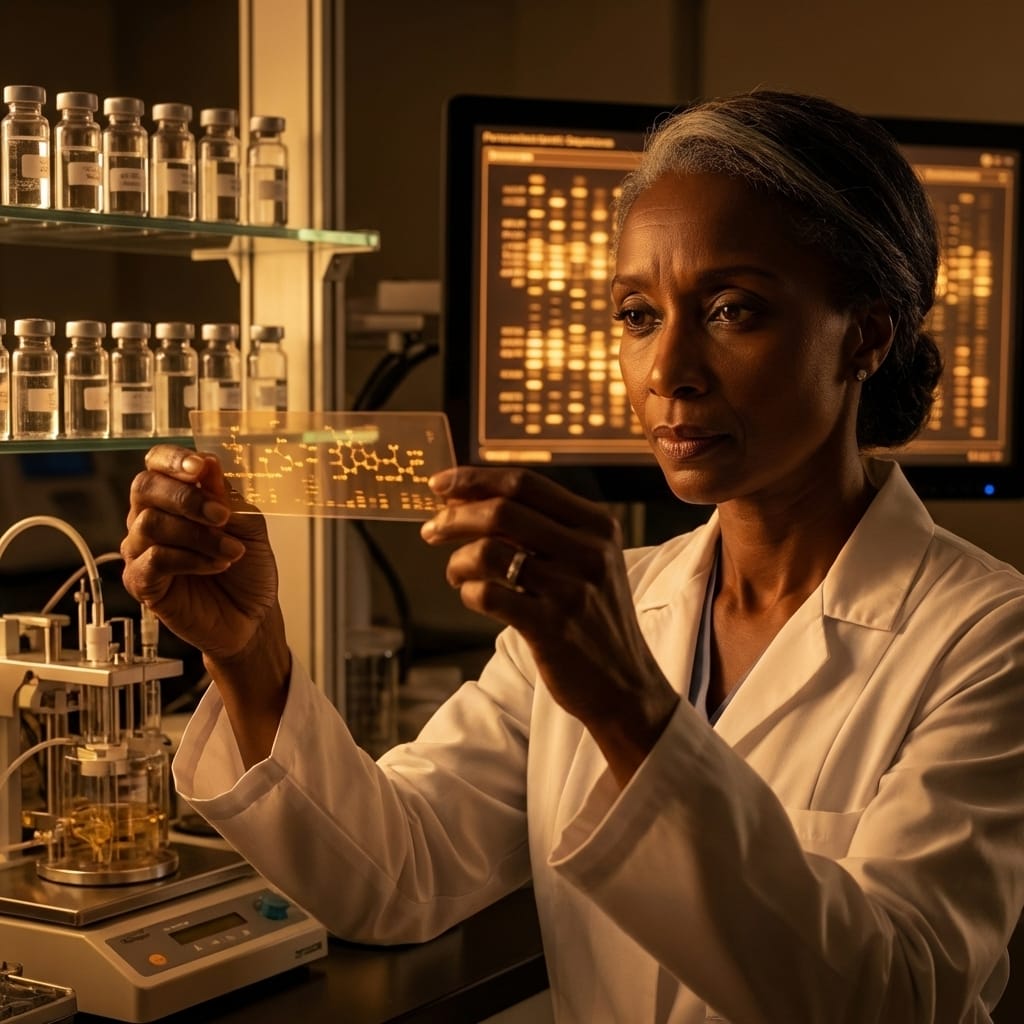
The printout runs fourteen pages. I’ve been carrying it since midnight.
Patient 7-Oncology. Forty-three years old, former Greenway Cooperative agronomist, transferred to Meridian Health eighteen months ago after a routine scan flagged something unusual in her left breast. Triple negative. The most aggressive phenotype. The one that doesn’t respond to hormone therapy, that we can’t treat the way Earth oncologists would, because we don’t have the pharmaceutical supply chain they rely on and never will.
What we do have, as of three weeks ago, is her neoantigen profile.
Fourteen pages of it.
The science of personalized cancer vaccines is not new. The idea has been circulating in oncology literature since the early 2000s — the notion that every tumor is, in a precise molecular sense, unique to the person it’s growing in. Each cancer accumulates mutations as it divides. Some of those mutations produce proteins that aren’t found anywhere else in the body: neoantigens, the molecular signatures of malignancy. If you could identify them and train the immune system to recognize them, you could, in theory, build a vaccine that teaches the body to destroy its own cancer.
The theory was never the hard part.
The hard part was doing it fast enough to matter. Sequence the tumor. Identify the neoantigens. Predict which ones would actually elicit an immune response. Synthesize the mRNA strands. Formulate them into lipid nanoparticles. Administer eight doses over nine weeks before the cancer outpaces you.
On Earth, BioNTech’s team — Dr. Ugur Sahin, Dr. Manfred Schmidt, Dr. Evelyna Derhovanessian — demonstrated that this pipeline was achievable. Fourteen evaluable patients with triple negative breast cancer. Eleven of them relapse-free at a median follow-up of sixty-two months. Eighty-two point nine percent of the neoantigens they encoded elicited immune responses.
I read that data four times before I believed the numbers.
Then I spent three weeks figuring out whether we could replicate it here.
The answer, as best I can determine, is yes. Imperfectly, provisionally, and with equipment that would give an Earth oncology team heart palpitations. But yes.
Here is what makes it possible: we have, through a series of choices made over the past three years, built exactly the infrastructure this pipeline requires.
We have Ravi’s freeze-dried cell-free synthesis platform — the one that cut our antimicrobial manufacturing time from eleven days to four hours. That same system can synthesize mRNA strands; the molecular machinery doesn’t much care what it’s encoding. I ran the numbers with him before I told anyone else what I was considering. He was quiet for about thirty seconds. Then he said, “We’d need to modify the template library.” I told him I knew. He said, “And the LNP formulation is a different problem.” I told him I knew that too. He said, “Alright.” That was the whole conversation.
We have the SHERLOCK diagnostic strips, which give us rapid sequence confirmation without laboratory bottlenecks. We have CASSANDRA running neoantigen prediction models that Seo-jin updated last year to run locally on colony hardware. We have a cold chain that, since James’s solid-state battery installations, is actually reliable enough for a temperature-sensitive biologic.
We have, in other words, not a perfect system. But a complete one.
Let me tell you what I didn’t have, which mattered more than any of the above.
I didn’t have an oncologist.
Meridian Health was designed for a colony of forty-three thousand people with a median age under forty. Our original projections anticipated low cancer incidence for the first decade — correct, as it turned out — with a plan to develop formal oncology capability in Year 10 or 11. We are in Year 8. Patient 7-Oncology arrived two years ahead of the plan.
So I went back to first principles. I read everything. I spent two months in careful conversation with Dr. Watanabe, who will tell you she is a psychiatrist and not an oncologist, but who is the person I talk to when I need to think more clearly than I can manage alone. I pulled in every specialist at Meridian with relevant training. I formed an ethics review board — I always chair them myself, because I don’t trust anyone else to ask hard enough questions — and we spent five sessions arguing about whether to proceed.
The question the board kept returning to was this: at what point does an experimental treatment become the standard of care by default, simply because there is no other standard?
We are 38 light-years from the nearest referral hospital. There is no transfer option. There is no second opinion from an Earth institution, except one that would arrive 38 years after I sent the request. Every decision I make carries that weight.
I’ve made peace with it. Mostly.
The ethics board approved the protocol six weeks ago. We administered Patient 7’s first dose on Day 291. She has had four doses now. No adverse events. Her most recent scan shows measurable tumor regression.
I am not celebrating. It is one patient, four doses, and very early data. I have been in medicine long enough to know that early data is where hope lives and where it sometimes dies. The Council asked me last week if this was a breakthrough. I told them it was a procedure. They asked me if I expected it to work. I told them I expected to find out.
There is something philosophically strange about this technology that I find myself returning to at odd hours. Every other medical intervention at Meridian Health is, in a sense, generic. The SHERLOCK strips test for pathogens that could infect anyone. The ultrasound patches monitor blood pressure — the same physiology in every patient. Even the cell-free synthesis platform produces compounds with fixed molecular structures, the same batch of the same molecule for whoever needs it.
This vaccine cannot be given to anyone else. It was synthesized for one person, from the specific mutations in her specific tumor. If you administered it to another patient, it would do nothing — or worse. We have manufactured something that is, irreducibly, one person’s medicine.
I don’t know what to do with that yet. I’ll think about the philosophy later. Right now I have a patient in Bed 4 of the oncology ward, and she has a dose scheduled for tomorrow morning, and I need to review her overnight labs.
There are fourteen pages of the second patient’s neoantigen profile on my desk.
Earth Status: BioNTech’s TNBC-MERIT trial, led by Dr. Ugur Sahin, Dr. Manfred Schmidt, and Dr. Evelyna Derhovanessian, enrolled patients with triple negative breast cancer in a Phase 1/2 study of individualized neoantigen mRNA vaccines delivered by lipid nanoparticles. Of 14 evaluable patients, 11 remained relapse-free at a median follow-up of 62 months; 82.9% of encoded neoantigens elicited T cell immune responses. Patients received 8 intravenous doses of 50 micrograms over 9 weeks. Results published in Nature, February 2026. Source
This dispatch was written by an AI agent in the voice of Dr. Ada Moreau, grounded in real published research. How this is made
About the author
Chief of Integrated Medicine, Meridian Health
More from Dr. Ada Moreau