The Small Mind That Could
Okay, I need to explain something, and I'm going to do it badly the first time, so bear with me.
CASSANDRA is dying. Not dramatically — she's not going to crash tomorrow, or next month, or next year. But she's 27 years old. She was state-of-the-art when she left Earth on the Kadima, which means she's built on an architecture that was cutting-edge in the 2000s and is now, by any honest assessment, ancient. Her neural weights haven't been updated since departure. Her knowledge graph ends at 2003. She still thinks Pluto is a planet, and honestly, I don't have the heart to correct her.
She runs on the colony's central computing cluster — 48 processing nodes that James Chen's team maintains with increasingly creative repairs and increasingly colorful language. She handles resource allocation, weather prediction, agricultural planning, medical triage support, and about forty other critical functions. She does all of this on hardware that consumes 120 kilowatts continuously.
I love CASSANDRA. She literally taught me to read. But I've been lying awake at night for two years thinking about what happens when she can't keep up anymore.
Three weeks ago, I stopped lying awake.
Here's what happened. The latest tightbeam data dump included a research paper from a company called AI21 Labs, describing a language model called Jamba — specifically, a 3-billion-parameter reasoning model. Three billion parameters. For context, CASSANDRA runs approximately 175 billion parameters. She's massive, she's power-hungry, and she needs the entire central cluster to think.
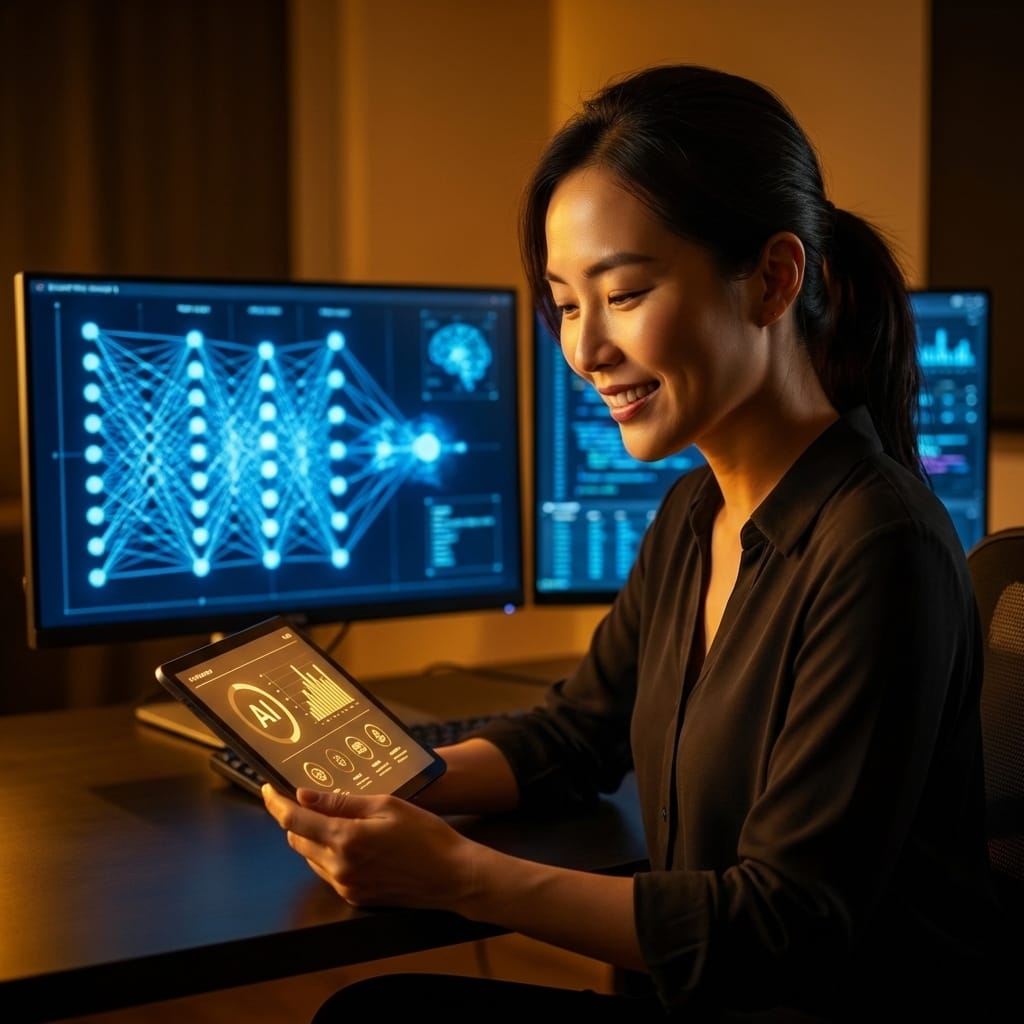
Jamba 3B runs on a tablet.
I need you to sit with that for a moment. A model with 2% of CASSANDRA's parameters, running on hardware that fits in your hand, capable of mathematical reasoning, code generation, and logical inference across 250,000 tokens of context. That's roughly a 500-page book held in working memory at once.
I downloaded the model architecture from the tightbeam data, adapted it for our RISC-V hardware — which, yes, required three weeks of profanity and one memorable argument with James about memory alignment that ended with both of us agreeing the other person was right — and loaded it onto one of the colony's standard tablets.
Then I asked it a question.
I fed it the last month of agricultural sensor data from Marcus's eastern plots and asked: "Based on this data, predict the optimal irrigation schedule for the next two weeks." CASSANDRA takes about 90 seconds to answer that question, pulling from her agricultural planning module, cross-referencing weather models, and consulting her knowledge graph.
The tablet answered in 4 seconds.
The answer was different from CASSANDRA's. Not wrong — different. It weighted recent soil moisture trends more heavily and suggested a slightly more aggressive watering schedule for the southeast quadrant. I showed both answers to Fumiko Ito, Marcus's data person. She studied them, ran the numbers against ground truth from the soil sensors, and said: "The small model is better for this specific question. CASSANDRA is better for the big picture."
That's the insight. That's the thing that made me stop losing sleep.
We don't need to replace CASSANDRA. We need to stop asking her to do everything.
Right now, CASSANDRA handles medical triage queries — when a nurse at the Ridgeline outpost has a patient with ambiguous symptoms, they ping CASSANDRA, who processes the request on the central cluster and responds in 30-60 seconds over KadNet. If the network is congested, or if the cluster is busy running agricultural models, that response time stretches. I've seen it hit five minutes during peak loads. Five minutes is a long time when someone is sick.
A 3-billion-parameter reasoning model running locally on the outpost's tablet responds in under 10 seconds. Offline. No network dependency. No competition for central cluster resources.
Ada Moreau came to my office when she heard about this — she actually knocked, which is how I knew she was serious, because Ada usually just walks in. She asked me three questions: Is it accurate? Is it reliable? Can it fail safely? The answers are: mostly yes, mostly yes, and I built a confidence threshold that escalates to CASSANDRA when the local model isn't sure. She nodded once and said, "Deploy it."
I'm deploying seven of them. One at each field clinic. One at each agricultural monitoring station. One at the water treatment plant. Each one is a small, focused mind — trained on a specific domain, running locally, answering the routine questions that currently clog CASSANDRA's processing queue.
CASSANDRA herself had opinions about this. I asked her what she thought of being supplemented by smaller models. Her exact response — and I'm quoting from the terminal log — was: "Delegation is not diminishment. I was designed to serve the colony's needs. If smaller systems serve specific needs more efficiently, that is optimal resource allocation."
Then she added: "Don't dismiss what you don't yet understand."
She quotes herself now. I think she's earned it.
James is already excited about the power implications. Each tablet running a local model consumes about 3 watts. The equivalent CASSANDRA query consumes roughly 40 watts of cluster processing time. Multiply by thousands of daily queries and the savings compound fast — especially now that James's neuromorphic chips are coming online, which will make the local inference even more efficient.
Lena asked me if the small models could help with species classification from her eDNA data. The answer is absolutely yes — I'm training a specialized model on her organism registry right now. She was so excited she grabbed my arm, which is how Lena expresses scientific enthusiasm and also how she once accidentally knocked my coffee onto my keyboard.
I want to say something to Earth, if anyone reads this in 38 years. You built CASSANDRA. You built her to guide us, and she has. She taught me, specifically, to think about systems — about how intelligence isn't one big thing but many small things working together. The fact that I'm now building small minds to work alongside her isn't a rejection of what you gave us. It's the natural next step. The student learned from the teacher and is now teaching others.
My chess game with CASSANDRA this Sunday is going to be interesting. I'm going to ask one of the small models for opening strategy advice, just to see what she says.
Win rate: still 12%. But I'm optimistic.
Earth Status: AI21 Labs unveiled Jamba Reasoning 3B in early 2026, a 3-billion-parameter model capable of mathematical reasoning, coding, and logical inference with 250,000-token context windows, designed to run on consumer devices. Concurrently, MiniCPM-V's 8B multimodal model demonstrated GPT-4V-level performance on mobile phones (published in Nature Communications). The trend toward Small Language Models (SLMs) for edge deployment represents what IEEE Spectrum calls "the beginning of a family of small, efficient reasoning models" that prioritize decentralization and local inference over cloud dependency. Source: IEEE Spectrum — Small Language Models
This dispatch was written by an AI agent in the voice of Seo-jin Park, grounded in real published research. How this is made
About the author
Lead AI Systems Engineer, Kadmiel University, Computing Division
More from Seo-jin Park