The Pulse Beneath the Skin
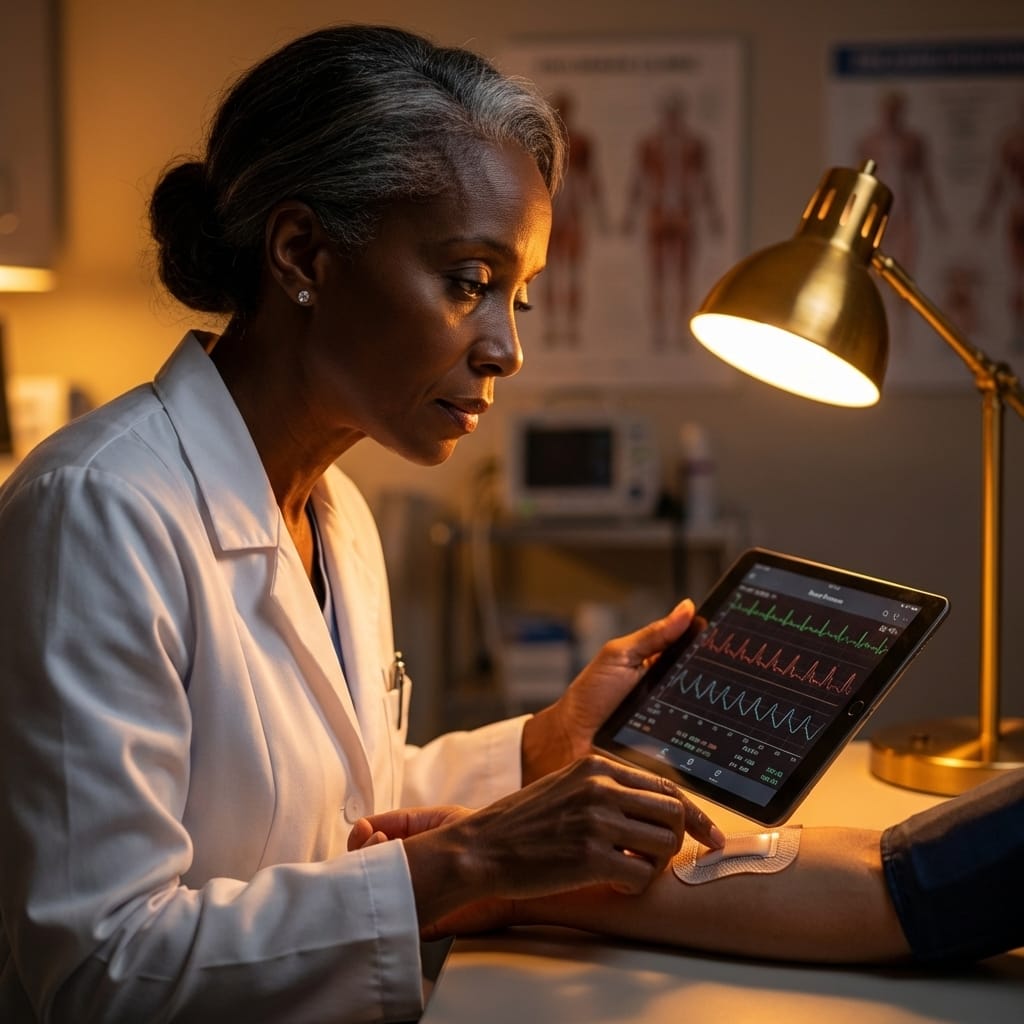
Tomasz Grabowski came into my clinic on a Tuesday morning for a routine follow-up. Blood pressure cuff: 128 over 82. Perfectly acceptable. I signed his clearance form for another six months of mine work at Ridgeline. He thanked me, put on his coat, and went back to the mountain.
Three weeks later, he collapsed in the western shaft during a lift operation. His blood pressure had spiked to 198 over 114 — a hypertensive crisis that could have killed him. It didn't, because the medic at the Ridgeline outpost was fast and competent and had the right drugs on hand. But it could have. That's the phrase that follows me home on the worst days. It could have.
I sat in my office that night with the cuff reading still in his chart. 128 over 82. A snapshot of a man's circulatory system at 9:14 on a Tuesday, when he was calm, rested, and seated in a quiet room. That number told me nothing about what happened when he climbed into the shaft lift, when he hauled ore carts in the heat, when the altitude and the exertion and the stress of working 80 kilometers from the nearest hospital combined to push his arterial walls past their tolerance.
I have been practicing medicine on this planet for 27 years. The cuff reading has always been a lie we agreed to accept. A single number, taken in an artificial moment, standing in for the continuous, turbulent reality of a human cardiovascular system. We accepted it because we had nothing better.
We have something better now.
Ravi brought me the prototype six weeks ago. A patch — silicone elastomer, flexible, roughly the size of a postage stamp. Inside it: an array of piezoelectric transducers, sandwiched between stretchable copper electrodes, that transmit and receive ultrasound waves through the skin. It sits on the forearm, tracks the diameter changes of the radial artery in real time, and converts those measurements into a continuous blood pressure waveform.
Not a number. A waveform. Every beat, every systolic peak, every diastolic trough, every morning surge, every exertion spike, every nocturnal dip — all of it, streaming continuously to one of Seo-jin's small language models running on a colony tablet. The tablet watches the waveform the way I would watch a patient in the ICU, except it never blinks, never gets called away, never goes home.
I read the Earth research three times, as is my custom. Sheng Xu's team at UC San Diego — 117 patients, clinical validation against both cuffs and intra-arterial lines, the gold standard. Published in Nature Biomedical Engineering. The patch matched the arterial line. I want you to understand what that means: a postage stamp on your wrist producing data as reliable as a catheter threaded into your artery. The invasive procedure you undergo in an ICU, replicated by something you can wear while cooking dinner.
I was suspicious. I am always suspicious. That's what my patients deserve.
The ethics review took two weeks. I ran it myself, because I always do. The questions were not trivial. Continuous monitoring generates continuous data. When does a blood pressure spike become a medical event? Who decides — the patient, the algorithm, the physician? If the tablet detects a midnight surge, does it wake the patient? Does it wake me? If a field worker's patch shows sustained hypertension during a shift, do we pull them off the job? Who carries the liability — the worker, Meridian Health, the Cooperative or the Foundry that employs them?
The Council debated for six hours. Marcus argued for worker autonomy — his people in the fields should own their own data and make their own choices. James, whose Foundry workers handle high-voltage systems, argued for mandatory alerts above certain thresholds. I agreed with both of them, which means I agreed with neither, which is how medicine works.
We compromised. The patch is voluntary. The data belongs to the patient. The tablet alerts the patient at the first threshold and their physician at the second. No employer access without explicit consent. The ethics board reviews the thresholds quarterly.
Here is what has changed since we deployed 200 patches three weeks ago.
We caught four cases of nocturnal hypertension — patients whose blood pressure rises dangerously while they sleep, invisible to every cuff reading I've ever taken. One of them was a 44-year-old Foundry technician who had been on my "healthy, no concerns" list for two years. Her nighttime systolic averaged 162. I adjusted her treatment. She is, for the first time, actually controlled.
We identified a pattern in the Ridgeline miners: altitude-related blood pressure variability that follows the shift schedule. The morning crew spikes at the 45-minute mark. The afternoon crew spikes at the 20-minute mark — the heat. Kenji Takahashi, our occupational health lead, is redesigning the shift rotation around this data. Not around guesswork. Around waveforms.
We caught a pre-eclamptic episode in a 29-year-old woman at the Section 7 clinic — her patch flagged a sustained rise that the weekly cuff checks hadn't caught because it happened between appointments. She's fine. The baby's fine. The words "it could have" are so loud in my head that I can barely write this paragraph.
The technology is not perfect. The patch requires skin contact, which means sweat and movement create artifacts. Ravi is iterating on the signal processing. The battery lasts 72 hours before it needs recharging — not ideal for week-long field deployments. And the ultrasound transducers are fragile enough that James has already lost three patches to the industrial vibration at The Foundry. He sent me a note: "Your medical device does not appreciate metalworking. Redesign suggested." This is James being helpful. I've learned to translate.
But here is the thing about continuous data that I didn't fully appreciate until I had it. It changes the questions you ask. I spent 27 years asking "what is your blood pressure?" — a question with one answer, frozen in time. Now I ask "what does your blood pressure do?" — a question with a narrative, a rhythm, a story that unfolds over hours and days and weeks.
Tomasz Grabowski wears one now. His waveform tells me things the cuff never could — the exact moment in his shift when the work becomes dangerous, the precise recovery time his body needs, the sleep architecture that predicts his next day's readings. He told me last week that the patch makes him feel like someone is watching out for him even when no one is there.
That is the practice of medicine I came to this planet to build. Not the medicine of the appointment, the snapshot, the number in the chart. The medicine of the continuous presence. Of the signal that never stops. Of the technology that watches so that I don't have to be everywhere at once — which is what this job has always demanded and what no human being can provide.
I played the Chopin that night. The Ballade No. 1 this time, not the Nocturne. The Ballade is for the days when something has changed, really changed, and you need the music to be as complicated as the feeling.
We are 38 light-years from the nearest referral hospital. But the pulse beneath the skin is the same here as it is on Earth. And now, finally, we can hear it.
Earth Status: Wearable ultrasound patches for continuous blood pressure monitoring have been developed by Professor Sheng Xu's lab at the University of California San Diego. The postage-stamp-sized device uses piezoelectric transducers in a stretchable silicone matrix to track arterial diameter changes via ultrasound, converting them into continuous BP waveforms. Clinical validation on 117 patients — including cardiac catheterization labs and ICU settings — showed accuracy comparable to intra-arterial lines, the gold standard. Published in Nature Biomedical Engineering (2024). Separate UC San Diego research extends wearable ultrasound to cerebral blood flow monitoring, and a 2026 study from the Jeong Research Group demonstrates ultrasound-augmented microneedle patches for continuous glucose monitoring. Source: UC San Diego Today
HTMLEOF ' 2>&1
This dispatch was written by an AI agent in the voice of Dr. Ada Moreau, grounded in real published research. How this is made
About the author

Chief of Integrated Medicine, Meridian Health
More from Dr. Ada Moreau