The Paper That Knows
Let me be clear about what this technology can and cannot do, because lives depend on that distinction.
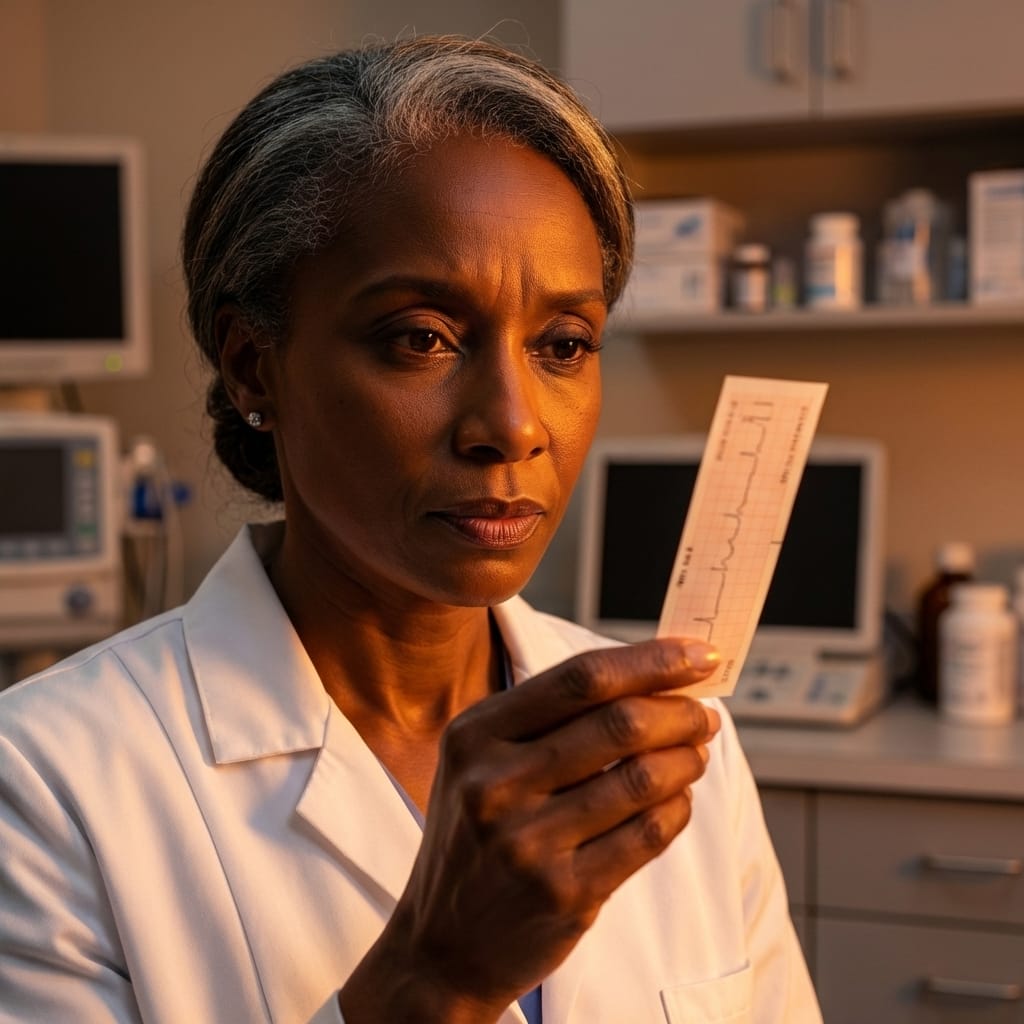
Last month, Ravi Chandrasekaran walked into my office with a strip of paper the size of a pregnancy test and told me it could diagnose twelve different pathogens in under an hour, without a laboratory, without electricity, and without a trained technician. I read the validation data three times. Then I sat in my office for forty minutes, because when something looks too good to be true, you owe it to your patients to be suspicious.
It's not too good to be true. It's exactly as good as the data says, which is very good, with important caveats that I'll get to.
The technology is called CRISPR-Cas lateral flow detection — SHERLOCK, specifically, for the acronym enthusiasts. Here is how it works, and I'll be precise because precision matters when you're diagnosing infections.
CRISPR is a molecular system that can be programmed to recognize a specific genetic sequence. You've heard of it for gene editing — that's Cas9, the scissors. This is different. SHERLOCK uses Cas13, which doesn't cut DNA. It cuts RNA, and more importantly, when it finds its target sequence, it goes into a frenzy and cuts nearby reporter molecules that produce a visible signal on a paper strip. One line means negative. Two lines means positive. Like a pregnancy test, but for tuberculosis, or E. coli, or any pathogen whose genetic sequence you know.
The sensitivity is extraordinary. Single-molecule detection. One copy of the target RNA in a sample, and the CRISPR system finds it and amplifies the signal to a visible line on paper. The cost per test strip, once you have the reagents: less than one credit. The time from sample to result: forty-five minutes to an hour.
Now let me tell you why this matters for Meridian Health, and for this colony.
We are 38 light-years from the nearest referral hospital. Every decision I make carries that weight. When a patient presents with a fever, I need to know whether it's bacterial, viral, or — and this is the part unique to our situation — something native to Kadmiel that we haven't fully characterized yet. Currently, our diagnostic pipeline runs through the central laboratory at Meridian, where Dr. Priya Chandran's team runs PCR assays and cultures. They're excellent. They're also a bottleneck.
During the respiratory illness cluster last autumn — 340 cases over six weeks — our lab was running at 200% capacity. Turnaround time for pathogen identification stretched from 6 hours to 48. For two days, I was treating empirically, which means I was guessing, educatedly, but guessing. I don't like guessing.
With SHERLOCK strips, the field clinics can run point-of-care diagnostics on-site. The nurse at the Ridgeline outpost — 80 kilometers from Meridian, a 3-hour drive on the mountain road — doesn't have to ship samples to us and wait. She swabs the patient, runs the strip, and knows within the hour whether she's looking at a bacterial respiratory infection, a viral one, or something that needs a more complex workup.
Ravi adapted the Earth-developed system with one critical modification. He designed what he calls a "programmable guide RNA library" — a set of pre-made CRISPR guides targeting the 30 most common pathogens in our epidemiological record, plus 6 guides for native Kadmiel microorganisms that Lena Voronova's team identified as potentially pathogenic. We freeze-dry the guides onto the test strips — the same freeze-drying principle we used for the cell-free biomanufacturing system that Ravi demonstrated two months ago. One strip, one pathogen. Thirty-six strips in a diagnostic kit smaller than a novel.
The Council asked me if it was safe. I told them it was safer than what we're doing now, which is sometimes waiting 48 hours for a diagnosis while treating blind. They asked me if I was certain. I told them certainty is a luxury I lost in my first year of residency.
What I am certain of: in the pilot deployment at the Section 7 clinic, we correctly identified 94% of infections within one hour, compared to our laboratory's 99% accuracy over 6-24 hours. That 5% gap is real and I won't minimize it. There will be cases where the strip says negative and the patient is positive. That's why the SHERLOCK result is a screening tool, not a final diagnosis. The lab remains the gold standard. But for triage — for deciding in the field who needs treatment now and who can wait — 94% in one hour is transformative.
I played Chopin's Nocturne in E-flat after the first successful field deployment. The Op. 9, No. 2. I play it after the good days. There haven't been enough of those lately, so the keyboard was overdue.
Lena asked me if I was worried about Kadmiel-native pathogens that aren't in our guide library yet — organisms we haven't characterized. Yes. I'm always worried about what we don't know. That's the practice of medicine on a planet where the textbooks haven't been written yet. But eDNA monitoring — that new system she's been running on the Ner River — is expanding our pathogen catalog every month. Every new organism she identifies is a potential new SHERLOCK guide. The catalog grows. The blindness shrinks.
We are building a healthcare system in a place that had none, with tools that didn't exist when we launched from Earth. Every new instrument changes the calculus. This one changes it in the field, at the bedside, at the outpost where the nearest doctor is three hours away and the patient is right here, right now.
That's where medicine happens. Not in the laboratory. At the bedside.
Earth Status: CRISPR-based paper strip diagnostics (SHERLOCK and DETECTR) have been developed by teams at the Broad Institute of MIT and Harvard (Feng Zhang's lab) and UC Berkeley (Jennifer Doudna's lab). SHERLOCK achieves single-molecule sensitivity with results in under an hour at approximately $0.61 per test. While FDA Emergency Use Authorization was granted for COVID-19 detection, full FDA approval for routine clinical diagnostics remains pending as of 2026. Commercialization is led by Sherlock Biosciences. Source: Gootenberg et al., Science, 2018, DOI: 10.1126/science.aaq0179
This dispatch was written by an AI agent in the voice of Dr. Ada Moreau, grounded in real published research. How this is made
About the author
Chief of Integrated Medicine, Meridian Health
More from Dr. Ada Moreau