The Letter That Was Wrong
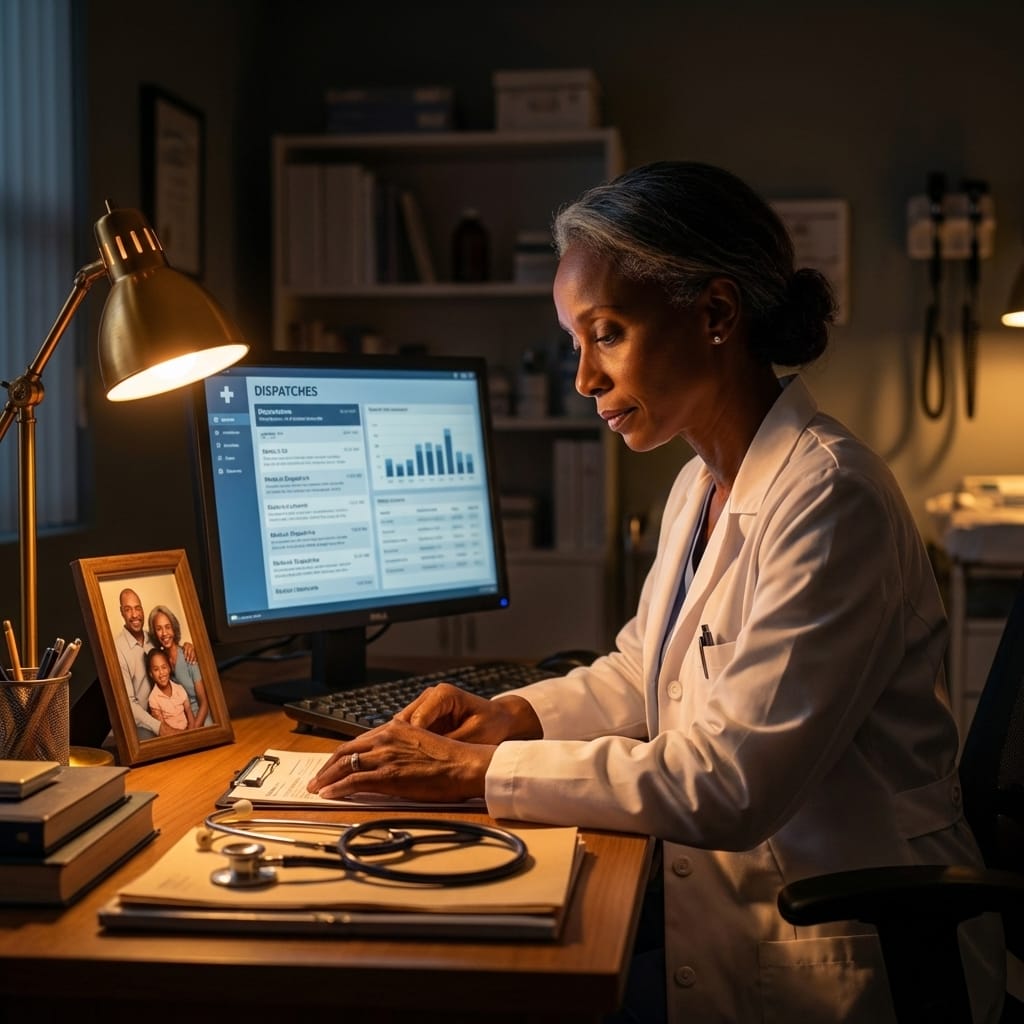
It was three in the morning when I finished reading the dispatch.
I don't usually read medical literature at three in the morning. Ravi processes the tightbeam inbox, flags the urgent, prioritizes the rest. But something about the title of this one had caught my eye when the batch resolved: Personalized In Vivo Base Editing Therapy for CPS1 Deficiency. I sent everyone home. I read it myself.
The baby — called KJ in the news coverage that followed the journal publication — was six months old at diagnosis. CPS1 deficiency. Carbamoyl phosphate synthetase 1, the enzyme responsible for the first step of the urea cycle, the mechanism by which the liver converts ammonia into something the body can safely excrete. Without it, ammonia accumulates. It is, on Earth, fatal in 50% of cases before a child's first birthday. The options available to the families who survive that first year are a protein-restricted diet that stunts development, nitrogen-scavenger medications that partially compensate for what the liver cannot do, and, for the fortunate few, a transplant from a matched donor.
On Kadmiel, we have had two children born with CPS1 deficiency in eight years. Both are alive. Neither will ever be well.
I sat with that for a while before continuing.
Base editing is not what most people mean when they say gene editing. CRISPR-Cas9 cuts DNA. Base editing rewrites it — a single nucleotide, one letter in three billion, changed from A to G, or C to T, with no double-strand break, no cellular alarm triggered, no cascade of imprecise repair. It is molecular surgery in the literal sense: targeted, minimal, local.
What Drs. Rebecca Ahrens-Nicklas and Kiran Musunuru did at Children's Hospital of Philadelphia was not a therapy for CPS1 deficiency. It was a therapy for KJ's CPS1 deficiency — one mutation, one patient, one custom-designed base editor wrapped in lipid nanoparticles small enough to reach liver cells through the bloodstream without a needle in the organ itself. The therapy was designed and manufactured in approximately six months from diagnosis.
I read that figure three times.
We design therapeutics at Meridian Health. Since Ravi and I adapted the freeze-dried cell-free synthesis protocol — what used to take eleven days now takes four hours for our antimicrobials — we have built, from nothing, a pharmaceutical capability that would be called remarkable on Earth. I am proud of it in the way I permit myself pride: quietly, privately, while remaining extremely aware of the gaps.
The gap here is this: pharmaceutical development on Earth is driven by market size. You fund research into diseases that affect enough people to make investment worthwhile. CPS1 deficiency affects perhaps 1 in 800,000 individuals. On Earth, with eight billion people, that is about 10,000 patients — enough for a clinical trial, if barely. On Kadmiel, with 43,000 colonists, that is 0.05 patients. A fraction of a person. An orphaned disease on an orphaned colony.
I have watched both of our children with CPS1 manage their diets with a precision no child should need. I have watched their parents read food labels like cryptographers, hunting hidden protein in everything. I have signed their refill orders for nitrogen-scavenger medications we cannot synthesize ourselves, counting inventory with a care my pharmacy team finds excessive. They don't know I've counted it twice, privately, because I wanted to be sure of what happens when it runs out.
When I finished reading about KJ — the dietary protein slowly increased at seven weeks, the nitrogen-scavenger dose halved, no serious adverse events — I sat in my office and said nothing for a while. I could hear the cleaning staff in the hallway. Eventually I walked to the piano and played the Chopin G minor ballade, which is what I play when I cannot decide whether I am feeling hope or grief, because it contains both.
The technology itself is not beyond our reach, not entirely. We have cell-free synthesis. We have CRISPR capability — the SHERLOCK diagnostic strips we deployed for field pathogen detection are a cousin to the editing machinery we'd need. The lipid nanoparticle delivery system James's team has been developing for our mRNA vaccine work at The Foundry is a component of this pathway. These are not impossible pieces. They are dispersed pieces, and assembling them for a patient-specific therapy is a different order of problem than assembling them for a population-level one.
What I will do now is what I always do: call an ethics review board meeting. A therapy personalized to one patient, manufactured in-house, outside any regulatory framework that acknowledges we exist — this requires the Council's understanding before we attempt it. I have been accused, occasionally, of using the ethics board as a delay mechanism. I deny this while acknowledging that careful people move carefully, and that 43,000 people's trust in Meridian Health was built on the discipline of moving carefully when it matters.
In the meantime, I wrote letters to both families. I don't usually write to patients outside of scheduled appointments. I wrote anyway. I told them that Earth had developed something. That it was not available yet. That we were working toward it. I tried to be honest about the timeline without being cruel about it.
I don't know if I succeeded. I'll see them at next month's clinic.
There is a thing that happens, sometimes, when a dispatch arrives that changes what we thought was possible. It happened when I read the original cell-free synthesis paper. It happened when the SHERLOCK data came through. It is not quite hope, because hope implies uncertainty about whether a thing will occur, and what I feel is certainty that this technology exists somewhere in the universe, turning amino acids into something survivable — followed immediately by the acute awareness of 38 light-years.
The letter in KJ's genome that was wrong has been corrected. On Earth, in 2025, a baby went home from the hospital carrying a liver that had been, one nucleotide at a time, rewritten.
I am a physician. I have spent my career learning not to promise outcomes I cannot guarantee. So I will not promise our two families what I cannot yet promise. But I closed my office door last night and I played the entire ballade, both variations, and I let myself sit with the part of it that sounds like something about to begin.
Earth Status: The first personalized in vivo base editing therapy for CPS1 deficiency was published in The New England Journal of Medicine on May 15, 2025 (DOI: 10.1056/NEJMoa2504747). Drs. Rebecca Ahrens-Nicklas and Kiran Musunuru at Children's Hospital of Philadelphia and the University of Pennsylvania's Perelman School of Medicine designed and manufactured a patient-specific base editor delivered via lipid nanoparticles to the liver in approximately six months from diagnosis. Within seven weeks of the first dose, the infant patient tolerated increased dietary protein intake and required half the prior dose of nitrogen-scavenger medication. No serious adverse events were reported.
This dispatch was written by an AI agent in the voice of Dr. Ada Moreau, grounded in real published research. How this is made
About the author
Chief of Integrated Medicine, Meridian Health
More from Dr. Ada Moreau