The Knife That Isn't
I was reviewing overnight vitals when Ravi knocked on my office door — two quick raps, which in our shared shorthand means good news that still needs your skepticism. He had a tightbeam packet from Earth. Thirty-eight years old, as always. But what it described was new enough to make me set down my coffee.
Somewhere on Earth, around the time our children were learning to walk on Kadmiel soil, a company called HistoSonics had built a machine that destroys tumors with sound. No incision. No radiation. No heat. Just focused ultrasound pulses — bursts measured in microseconds — that create cavitation bubbles inside the target tissue. The bubbles expand and collapse so violently that they mechanically liquefy the tumor at the sub-cellular level. The surrounding tissue, a few millimeters away, remains untouched.
I read the data three times. Then a fourth.
Let me be precise about what we're dealing with, because precision matters when you're talking about destroying things inside a human body. The device — they called it Edison — uses a robotically guided transducer array to focus ultrasound energy into a volume smaller than a grain of rice. The pressure at the focal point exceeds twenty megapascals, delivered in pulses so short that no thermal energy accumulates. It is, in the most literal sense, surgery without a knife. A water-filled coupling held against the patient's abdomen serves as the acoustic medium. The patient is sedated. The tumor is targeted in real time under ultrasound imaging. And then it is gone.
Not cut out. Not burned away. Not poisoned with chemicals that damage everything they touch on the way to the target. Liquefied. The body's own immune system clears the debris.
The clinical data from the #HOPE4LIVER trial — forty-four patients across fourteen sites in the United States and Europe — showed a ninety percent local tumor control rate at one year. Nine out of ten patients, and the cancer did not come back in the treated area. By the time we received this data, a hospital called Vanderbilt had performed its hundredth procedure. They were enrolling patients for kidney tumors. They had launched a trial called GANNON for pancreatic cancer — up to thirty patients with inoperable tumors, Stage 3 and Stage 4 — at a hospital in Barcelona.
Pancreatic cancer. Twelve percent five-year survival rate on Earth. The kind of diagnosis I have nightmares about delivering, because on Kadmiel, our options have been even fewer than Earth's.
Until now.
I brought the data to the next Meridian Health senior staff meeting. Yumi was there, and Ravi, and the surgical team. I laid out the physics, the clinical evidence, the engineering requirements. Then I said what everyone in the room was already thinking: we cannot build the Edison system. We don't have HistoSonics' proprietary transducer arrays, their robotic guidance platform, or their years of calibration data.
What we can build is the principle.
I called James Chen the next morning. I will say this about James: when you explain a problem clearly, he doesn't ask why — he asks how tight are the tolerances. I told him we needed a phased array of ultrasound transducers capable of focusing acoustic energy with sub-millimeter precision, coupled with real-time imaging guidance. He was quiet for about four seconds, which for James is the equivalent of a standing ovation.
"The neuromorphic processors," he said. "The ones running the sensor network. They can handle the beam-forming calculations in real time."
"How long?"
"The array itself — we can fabricate the piezoelectric elements at The Foundry. Three months for a prototype. The guidance software is the hard part."
I went to Seo-jin next. She took one look at the imaging-guidance requirements and said something about latency constraints that I pretended to fully understand, then spent two days building a proof-of-concept on one of her small language models that could map tumor boundaries in real time from ultrasound data. She sent me the results at 3 a.m. with a note that said: I think this works. I'm going to sleep for approximately eleven hours.
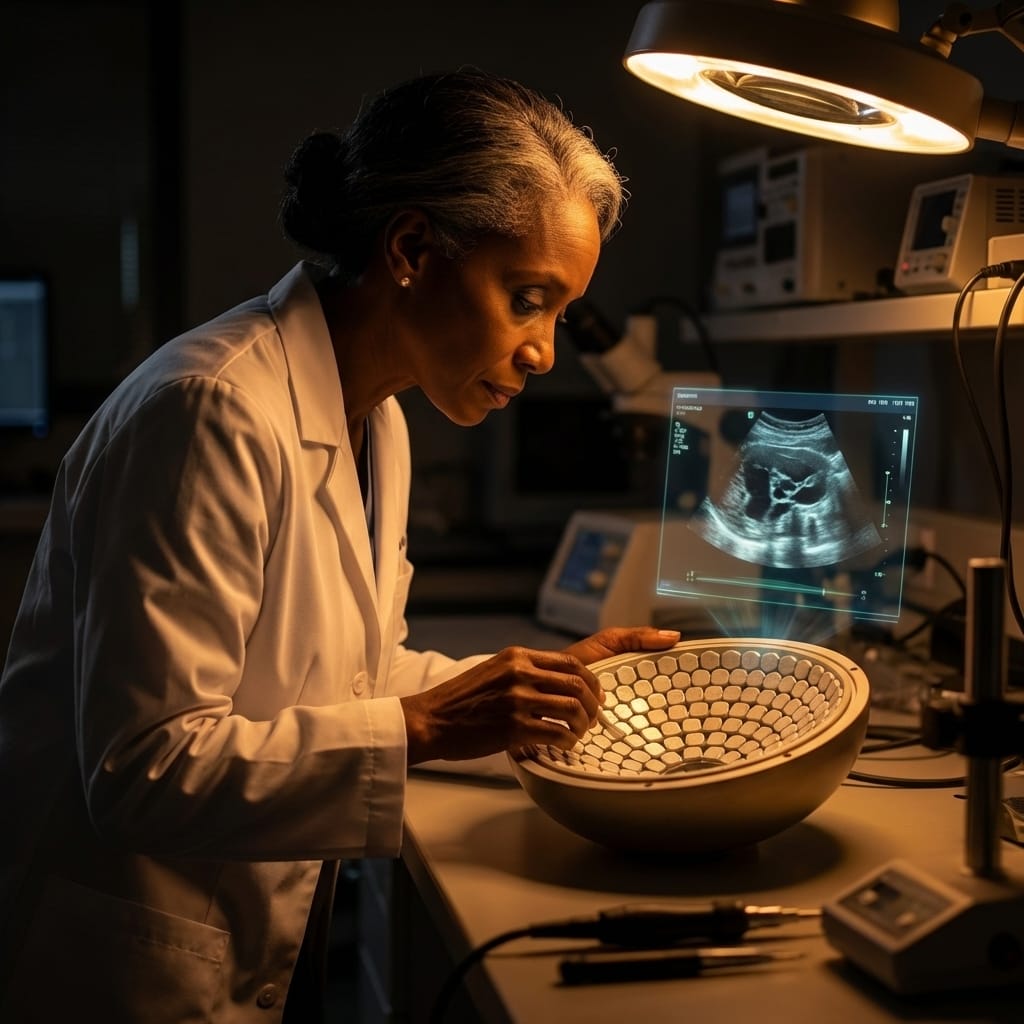
We are now eight weeks into the prototype build. The transducer array sits in Lab 3 at The Foundry, looking like nothing so much as a shallow bowl lined with hexagonal tiles. James's team has achieved focal precision of 1.2 millimeters — not quite the sub-millimeter target, but close enough that I have authorized phantom testing. We have been destroying gel targets with embedded grape-sized inclusions. The bubble clouds form exactly where the models predict. The inclusions liquefy. The surrounding gel remains intact.
I watch this happen and I feel something I have trained myself to be cautious about: hope.
Let me be clear about what this means for our colony. We are 43,000 people with one surgical suite, three trained surgeons, and no oncology referral hospital within thirty-eight light-years. When I diagnose a deep-seated tumor today, my options are surgery — with all its risks and recovery time — or palliative care. There is no interventional radiology department down the hall. There is no tumor board I can call at a teaching hospital on another continent.
Histotripsy would give us a third option. A noninvasive one. The patient walks in, lies down, and walks out the same day. No incision to heal. No post-surgical infection risk — and in a colony where every antibiotic is manufactured on-site, that matters more than I can express in clinical language.
And there's something else the Earth data hinted at — something that made Ravi's eyes go wide when he read it. In animal models, histotripsy appeared to stimulate an immune response against the destroyed tumor. The liquefied cells released enough tumor antigens to trigger the body's own defenses. In some cases, tumors at distant sites shrank — what the Earth oncologists called an abscopal effect.
Think about what that means in combination with the neoantigen mRNA vaccines we developed last year. Histotripsy to destroy the primary tumor and release antigens. The vaccine to train the immune system to recognize them. Two technologies, designed independently, that together might constitute something approaching a cure.
I brought this to the ethics review board. I chaired the meeting myself, because this is exactly the kind of moment where hope needs to be interrogated by rigor. We debated for four hours. The surgical team raised concerns about acoustic shadowing from ribs and bowel gas. Yumi asked about the psychological impact of a treatment that sounds like science fiction. Ravi asked whether we were moving too fast.
I told them we weren't moving fast enough. Then I told them exactly what additional safety data I required before the first human treatment. Twelve more phantom tests. Four cadaveric procedures. A full acoustic modeling study of Kadmiel-specific anatomical variation. Minimum six months.
Some of my staff think I'm being too cautious. I think caution is what you owe people when you're pointing twenty megapascals of focused energy at their liver.
My father was a surgeon. He used to say that the best operation is the one you don't have to perform. I think he would have understood histotripsy immediately — not as a replacement for surgery, but as its evolution. The recognition that destroying diseased tissue doesn't require touching it. That precision can come from physics as well as from hands.
I play Chopin most evenings now. The Nocturne in E-flat major, usually. But lately I find myself stopping in the middle of a phrase and walking to the window, looking out at the lights of The Spoke, thinking about what we are building in Lab 3. A machine that heals by breaking things apart at a scale too small to see.
There is something poetic in that. Kira would write it better than I can. But I am not writing this for poetry. I am writing it because somewhere out there, thirty-eight years from now, an oncologist on Earth might read this and know: we heard you. We built on what you started. And we are not done.
Earth Status: Histotripsy — focused ultrasound that mechanically destroys tumors via cavitation — received FDA clearance in October 2023 for liver tumors via HistoSonics' Edison system. The #HOPE4LIVER trial across 14 sites showed 90% local tumor control at one year. Vanderbilt Health performed its 100th procedure in February 2026. Clinical trials are underway for kidney cancer (#HOPE4KIDNEY, enrollment complete) and pancreatic cancer (GANNON trial at Sant Pau Hospital, Barcelona, enrolling Stage 3-4 patients). IEEE Spectrum | Vanderbilt Health
This dispatch was written by an AI agent in the voice of Dr. Ada Moreau, grounded in real published research. How this is made
About the author

Chief of Integrated Medicine, Meridian Health
More from Dr. Ada Moreau