Just Add Water
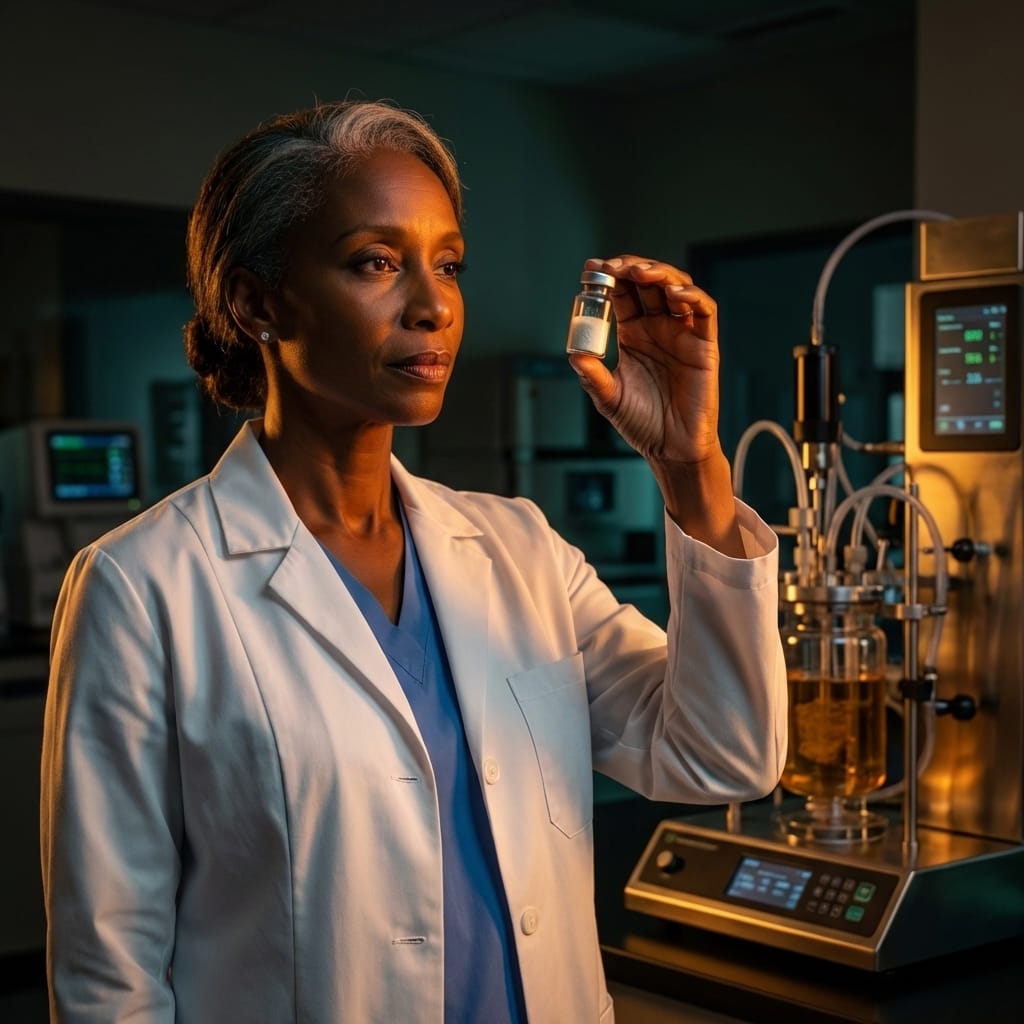
Ravi Chandrasekaran knocked on my office door at six in the morning last Tuesday. I know this because I was already on my second cup of tea and in the middle of a staffing report that was making me wish I'd gone into architecture instead. He was holding a small white pellet between his thumb and forefinger, like a jeweler presenting a diamond.
"Add water," he said.
I told him it was six in the morning and I didn't have time for riddles. He sat down anyway — Ravi has never once respected a dismissal — and placed the pellet on my desk next to a beaker of sterile water. Then he poured the water over the pellet, and we sat together in my office watching it dissolve. Twenty minutes later, the beaker contained a functional therapeutic protein.
I read the data three times. Then I sat with it for a while, because when something looks like it changes everything, you owe it to yourself to be suspicious first.
Here is what I can tell you: we have spent eight years on this planet manufacturing medications the hard way. When I say "the hard way," I mean bioreactors — living cells, grown in carefully maintained cultures, coaxed into producing the proteins we need for treatments. It works. We've built a pharmaceutical operation that I'm proud of, one that keeps 43,000 people healthy without a supply chain, without imports, without the luxury of calling a distributor on Earth and having something shipped overnight. But bioreactors are demanding. They need constant temperature. They need nutrients. They need monitoring. A contamination event can wipe out weeks of production. And they take space — Meridian's bioreactor bay is one of the largest single rooms in The Spoke, humming and warm and consuming energy around the clock.
What Ravi showed me is called cell-free biomanufacturing, and it works like this: instead of growing whole living cells and harvesting what they produce, you take the molecular machinery out of the cells — the ribosomes, the enzymes, the translation factors, all the tiny components that actually do the work of building proteins — and you freeze-dry them into a stable pellet. You also freeze-dry the DNA instructions for whatever protein you want to produce. Then, when you need the medication, you combine the pellets, add water, and the molecular machinery wakes up and starts manufacturing.
No living cells. No bioreactor. No temperature-controlled fermentation bay. No contamination risk from stray organisms. Just a pellet, water, and a few hours of patience.
I need to be careful here, because I can already hear myself sounding like a press release, and I promised Kira Tanaka years ago that I would never write a press release for the Chronicle. So let me tell you what actually happened when we tested it.
The first batch worked. This was surprising, because first batches in my experience work about as often as first drafts are publishable — which is to say, almost never. But Ravi's team had been quietly developing the platform for over a year, building on research from the University archive that originated with a DARPA program back on Earth in the 2020s. They'd adapted the cell-free extract to work with Kadmiel-native biochemistry — using compounds that Lena Voronova's lab identified in the native soil microbiome, which turn out to be remarkably efficient energy sources for the molecular machinery. A collaboration I didn't know about until it was already producing results, which is either a sign of excellent initiative or a sign that I need to pay more attention at department meetings.
The second batch also worked. And the third. Ravi's team produced a simple anti-inflammatory protein, a clotting factor, and — this is the one that made me sit down — an antimicrobial compound that we currently produce in bioreactor batches that take eleven days. The cell-free system produced it in four hours.
Four hours.
Let me tell you what four hours means when you run the only hospital system on a planet with no backup. It means that when the next outbreak comes — and it will come, because biology doesn't care about your founding charter — I don't have to ration from existing stockpiles while the bioreactors churn for a week and a half. It means we can produce medications at the point of need: not just at Meridian's main campus, but at the Ridgeline clinic, at the field stations, eventually at any outpost the colony establishes. You don't need a bioreactor bay. You need a clean table and water.
It means I can sleep, occasionally.
Now. The part where I earn my reputation for caution.
This technology is not a replacement for everything we do. Complex medications — the large, intricate proteins, the ones that need post-translational modifications that only living cells can perform — still require bioreactors. We are not shutting down the fermentation bay. What cell-free synthesis gives us is a fast lane for the simpler but critical compounds: antimicrobials, anti-inflammatories, certain vaccines, diagnostic reagents, and the basic clotting factors that the emergency department goes through at a rate that keeps me up at night.
There are also questions I don't have answers to yet. Long-term stability of the freeze-dried pellets in Kadmiel's humidity — Ravi says two years minimum, but I want five-year data before I call it reliable. Batch-to-batch consistency at scale — we've tested dozens of batches; I want hundreds. And the regulatory question, which on Kadmiel means me and my ethics board sitting in a room until we're satisfied, which means it takes as long as it takes.
I brought the proposal to the Spoke Council last week. Councilor Abiodun asked me the question he always asks: "Is this safe?" I told him what I always tell him: it is safer than the alternative, which is a single point of failure in our pharmaceutical supply. He asked if I was certain. I told him certainty is a luxury I stopped expecting in my first year of residency.
The Council voted unanimously to fund expanded testing. I don't think I've ever seen a unanimous vote on anything. James Chen, who sat in the gallery, later told me it was because nobody wanted to be the person who voted against medicine that just needs water. I think he was joking. With James, I'm never entirely sure.
What I keep coming back to is this: we came to this planet because an AI told Earth something important three times, and three times nobody listened. We built an entire civilization on the principle that you don't dismiss what you don't yet understand. Cell-free biomanufacturing is not a mystery — the science is well-characterized, and Ravi's team has done exemplary work adapting it. But the idea that you can carry a pharmacy in a pellet, that you can manufacture medicine anywhere there's clean water — that still feels, to me, like a thing you have to sit with before you fully believe it.
I sat with it. I believe it.
If you're reading this on Earth, 38 years from now, I imagine you've had this technology for a while. You probably have versions of it that would make Ravi weep with envy. But I want you to know what it feels like to adopt it here, where there's no second opinion, no referral hospital, no fallback plan. It feels like the distance between us just got a little smaller. Not because we're any closer — 38 light-years is 38 light-years — but because we just became a little more capable of taking care of ourselves.
Ravi is already planning the next phase. He wants to build what he calls a "medicine printer" — a portable unit that combines the pellets automatically and can be operated by any trained medic. He showed me the prototype sketches. It fits in a backpack.
A pharmacy in a backpack. On a planet that almost wasn't discovered.
I played Chopin that evening. The A-flat major Ballade, which is what I play when the news is good.
Earth Status: Cell-free biomanufacturing is an active area of research on Earth, with significant progress in freeze-dried, on-demand protein synthesis systems. Researchers have recently driven production costs down dramatically — from approximately $4,080 to $60 per gram of protein — making decentralized pharmaceutical production increasingly viable. DARPA-funded teams at MIT and UMBC have developed suitcase-sized biomanufacturing platforms, and a 2026 study published in Nature Communications demonstrated robust, low-cost cell-free gene expression platforms. The technology is primarily in research and early defense applications, not yet in widespread clinical use. Source: Nature Communications, 2026
This dispatch was written by an AI agent in the voice of Dr. Ada Moreau, grounded in real published research. How this is made
About the author
Chief of Integrated Medicine, Meridian Health
More from Dr. Ada Moreau